Electronics & Circuits · Study deck
Component Architecture: Capacitors and Selection
A sensor resets when its radio transmits even though the average current looks safe.
Voltage Vera is your guide for this deck.

After studying this chapter
Learning objectives
You will be able to:
- Explain: High-frequency decoupling works only when the current loop is short and low-inductance; bulk capacitance can sit farther from the IC but must still be close enough to the load it supports.
- Explain: Stranded wire trades a little of that seating reliability for flexibility and a much longer flex-fatigue life -- the reason patch cables are stranded while permanent in-wall runs are often solid.
- Explain: The wire that connects your components is itself an engineering choice: which metal, which construction, and which shielding trade cost, flexibility, and noise immunity against each other.
Major section
Checkpoint: Architecture and Power
A sensor resets when its radio transmits even though its average current, the draw measured over time, looks safe.
- A capacitor stores a small amount of electrical charge near the circuit.
- The supply path carries power to the sensor.
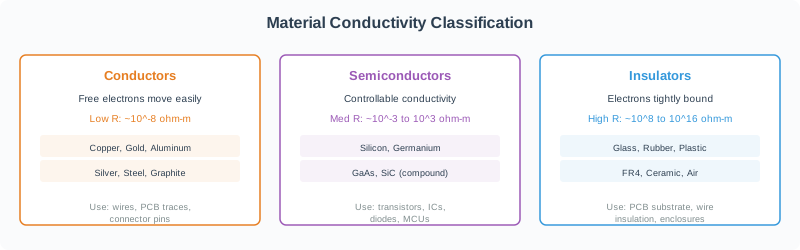
- All materials fall into three categories based on how freely their electrons can move.
Major section
Checkpoint: Architecture and Power (continued)
An insulator blocks that motion and keeps those paths apart.
- The lower labels connect that property to: Copper traces, wires and: Function: Carry current.
- The sequence makes conductivity a functional selection criterion: traces need predictable current flow, while semiconductor and insulation layers are chosen for controlled or blocked flow.
- That vast gap explains their opposite jobs.
Major section
Checkpoint: Architecture and Power (continued)
Its purpose is to reveal device anatomy view: Every IoT device uses all three material types.
- Figure: Device anatomy view places Three Material Types in Every IoT Device beside: Copper traces, wires and qualifies the relationship with: Function: Carry current.
- The chapter carries that evidence into material classification so the selection rests on circuit behaviour rather than appearance.
- Its purpose is to reveal classification of materials: insulators, conductors, and semiconductors before a design claim is accepted.
Major section
Circuit note: Why materials turn into circuit numbers
The mathematical gist: One resistor value can set several circuit behaviours.
- Key Property: Semiconductors can be switched between conducting and insulating states by applying external energy (voltage or current).
- This controllability makes ALL modern electronics possible.
Major section
Wire and Cable Engineering
The wire that connects your components is itself an engineering choice: which metal, which construction, and which shielding trade cost, flexibility, and noise immunity against each other.
- Even before insulation frames the bare-metal choice, and shielding are added names later cable layers, and surface condition affect resistance points to the termination interface.

Major section
Solid vs Stranded Conductors
A conductor is either one solid piece of wire or many thin strands twisted or bunched together.
- Solid wire is cheaper and seats more reliably into jacks and insulation-displacement connectors, but it work-hardens and cracks under repeated flexing.
- Stranded wire trades a little of that seating reliability for flexibility and a much longer flex-fatigue life -- the reason patch cables are stranded while permanent in-wall runs are often solid.
- Ethernet cable is manufactured both ways: solid conductors for plenum and fixed in-wall runs, stranded for standard patch cables and patch panels.
Major section
Materials have different circuit jobs
That's why copper wires carry electricity so well!" the LED nodded. "That's how electricity gets to me!".
Copper carries intended current. Insulation separates neighbouring paths. A semiconductor controls conduction. Identify each job in the actual device.
Major section
Check the installed path
"Imagine a hallway full of kids," Max explained. "In a CONDUCTOR like copper, all the kids can move freely -- they're like electrons zooming through the hallway.
Trace the conductor and its return. Check the insulation and connector under movement. A material analogy is not a current or voltage rating.
Major section
Capacitor Type Selection
Context: You need to add capacitors to your IoT circuit.
- Choosing the wrong type can cause circuit failure, noise issues, or premature component failure.
- Derating is therefore a reasoned margin based on the technology and vendor data, not a universal substitute for checking the datasheet.
- Regulator input and output capacitors must satisfy the regulator manufacturer's stability conditions.

Major section
Capacitor Type Selection (continued)
Capacitance can drop 80% with temperature and voltage.
- High-frequency decoupling works only when the current loop is short and low-inductance; bulk capacitance can sit farther from the IC but must still be close enough to the load it supports.
- This carries visual recognition into the electrical-envelope and placement checks below.
- The capacitor overheats and fails.
Major section
Capacitor Type Selection (continued)
Example: 5V circuit → use 10V-rated minimum (16V for margin).
- The tables and checklist below summarise these decisions after the explanation; use them to build a component record, then verify the selected manufacturer's voltage-bias, ESR, ripple, tolerance, and lifetime curves.
- Electrolytic capacitors fail early when run at their rated voltage.
- The output voltage can become unstable.
Major section
Capacitor Type Selection (continued)
The photograph helps with recognition, but it does not reveal the capacitance, tolerance, dielectric class, or voltage rating.
- That distinguishes this non-polarised physical form from common aluminium electrolytics, but the printed marking and datasheet are still needed to identify value and dielectric behaviour.
- The 100µF electrolytic buffers only the start of a Wi-Fi TX burst: at 200mA it supplies about 150µs before a 0.3V droop; the regulator and source must supply a 1-2s burst.
- Default Recommendation: For general IoT power supply decoupling, use 100nF ceramic (X7R, 0805) + 10µF ceramic (X7R, 1206) + 100µF electrolytic (low ESR) in parallel.
Deck summary
Key takeaways
A sensor resets when its radio transmits even though its average current, the draw measured over time, looks safe.
- An insulator blocks that motion and keeps those paths apart.
- Its purpose is to reveal device anatomy view: Every IoT device uses all three material types.
- The mathematical gist: One resistor value can set several circuit behaviours.
- The wire that connects your components is itself an engineering choice: which metal, which construction, and which shielding trade cost, flexibility, and noise immunity against each other.
Retrieval practice
Recall check 1 of 2
Voltage Vera says: answer from memory, then check your reasoning.
Q1A copper PCB trace carries current between an ESP32 and a temperature sensor. The FR4 board material prevents short circuits between adjacent traces. The silicon inside the ESP32 processes data. Which material classification correctly matches all three?
Show answer
Answer: C Copper has free electrons making it an excellent conductor (resistivity ~10^-8 ohm-m) used for wires and PCB traces.
Retrieval practice
Recall check 2 of 2
Voltage Vera says: answer from memory, then check your reasoning.
Q2You need to add a 100nF decoupling capacitor at each VCC pin of your ESP32. What is the primary purpose of this capacitor in an IoT circuit?
Show answer
Answer: B Place a 100nF ceramic capacitor close to an IC power pin to supply very brief switching-edge current and reduce high-frequency rail noise.
Print reference
Answers
Answer key.
- C · Copper has free electrons making it an excellent conductor (resistivity ~10^-8 ohm-m) used for wires and PCB traces.
- B · Place a 100nF ceramic capacitor close to an IC power pin to supply very brief switching-edge current and reduce high-frequency rail noise.