Electronics & Circuits · Study deck
Op-Amp Sensor Front-End Contracts
Picture a greenhouse probe whose voltage changes only a little as the soil dries.
Voltage Vera is your guide for this deck.

After studying this chapter
Learning objectives
You will be able to:
- Use the negative-feedback op-amp golden rules without applying them outside their valid range.
- Choose a buffer, non-inverting amplifier, inverting amplifier, or comparator for a sensor front-end job.
- Explain how a unity-gain follower prevents voltage-divider loading errors.
- Check output swing, input common-mode range, and supply rails before trusting an amplified signal.
Major section
Start Simple
An amplified number should not become an unchecked act on a heater or pump.
- The reading unit cannot use the full change well, so the designer adds an amplifier.
- Too much gain can clip the wet end, and the wrong input load can change the probe itself.
- This opening does not choose a part or prove the whole instrument.
Major section
Phoebe's Field Notes: Why Gain and Bandwidth Trade, Not Just Correlate
The mathematical gist.: Negative feedback sets non-inverting gain $A_v=1+R_f/R_g=1/\beta$, while a single-pole op-amp supplies about $GBW/f$ open-loop gain.
- The loop reaches its bandwidth boundary when $\beta GBW/f=1$, so $f_{-3dB}=GBW/A_v$.
Major section
Two Rules for Op-Amps
An operational amplifier (op-amp) is a high-gain differential amplifier — it amplifies the difference between its + and − inputs.
- An amplifier is the active opposite of an attenuator: it takes energy from a supply and uses it to produce a larger output signal while preserving the input shape as much as the circuit allows.

Major section
Two Rules for Op-Amps (continued)
Those labels show a UA741 packages the op-amp's differential inputs, high-gain stages, compensation, and output driver into one eight-pin IC; the feedback components outside the package decide how that gain is used.
- This connects the visual to two rules for op-amps by making the relevant component behaviour part of the design check.
- A package diagram is part of that contract.
- The same triangle symbol can hide very different assumptions.
Major section
Two Rules for Op-Amps (continued)
Specification matching starts with the two voltages you actually have: the board-side signal level and the project-side requirement.
- If a 1.8 V GPIO path must drive a higher analog threshold or ADC span, the amplifier is sized around that ratio instead of around a convenient part.
- Output slams to a rail depending on which input is higher — an analog threshold detector.
- If a feedback path returns the output to the inverting input, the virtual-short rule can be used only while the output has enough rail headroom and the inputs are inside common-mode range.
Major section
Sensor Op-Amp Five Checks
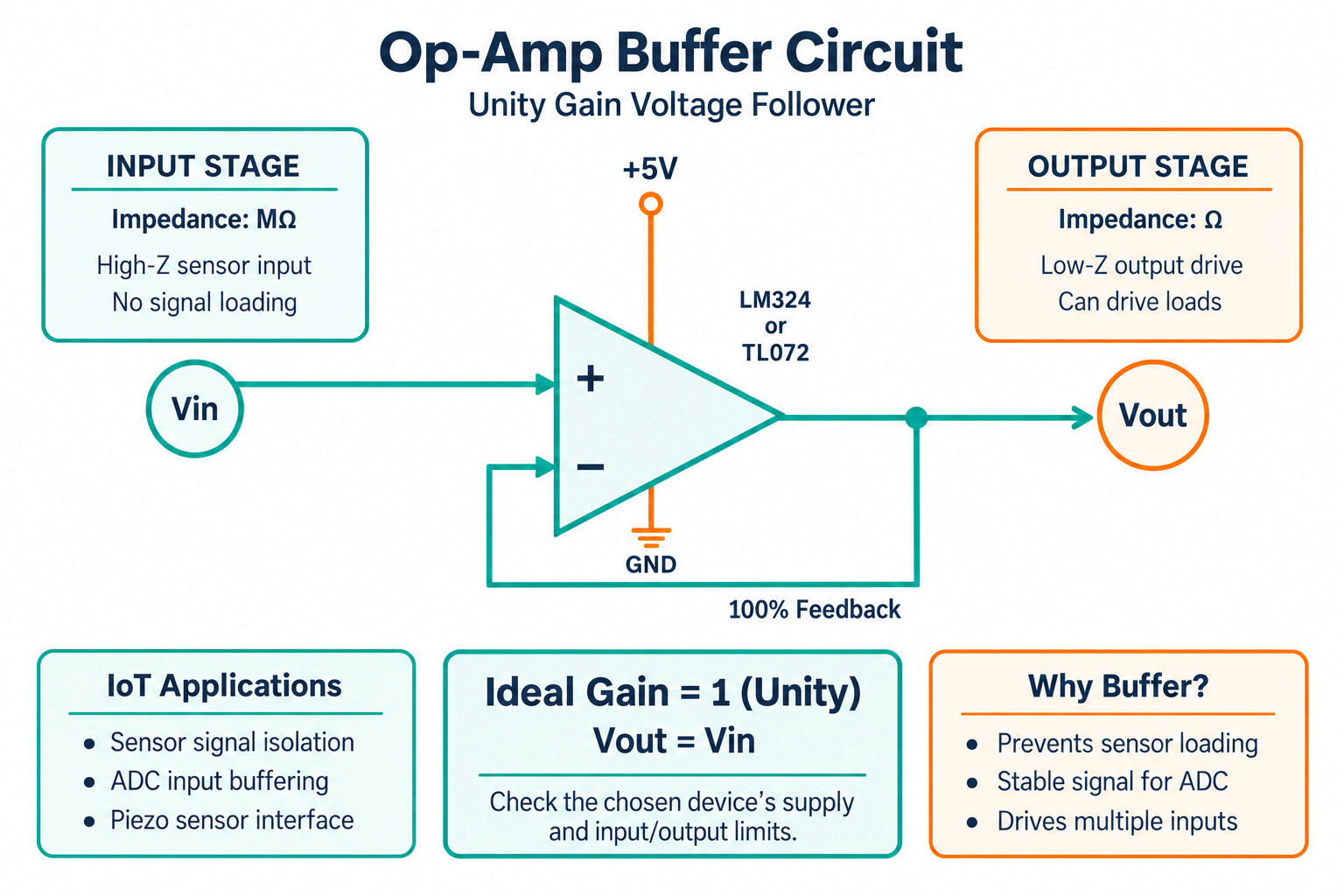
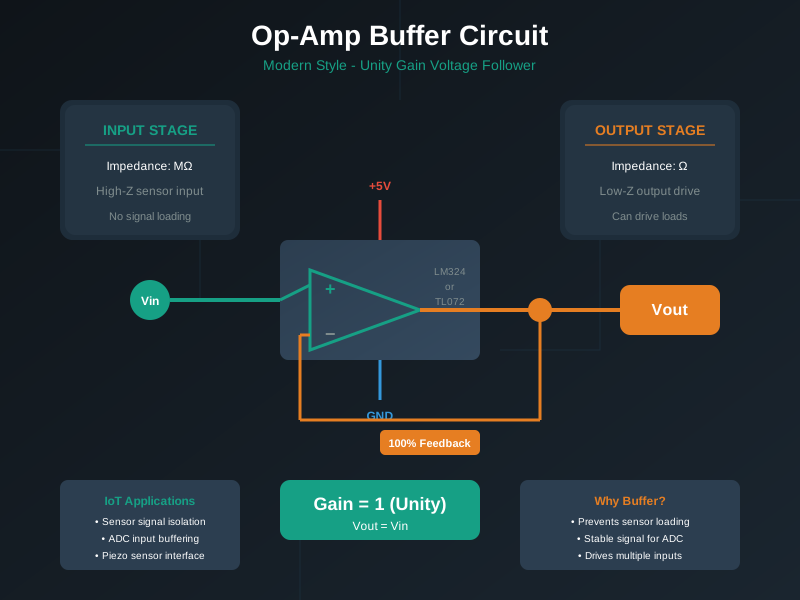
Buffer a voltage divider so it stops sagging.: Earlier in this chapter a resistor divider's output dropped when a real load drew current.
- A unity-gain buffer fixes exactly that: it presents near-infinite impedance to the divider (so it draws no divider current) and near-zero impedance to the load (so it can supply current).
- If the source impedance is high, the capacitor steals charge and the conversion reads low or depends on the previous channel.
- A buffer, smaller divider resistors, a longer acquisition time, or a local charge reservoir fixes that contract; the right choice depends on current budget and sample rate.
Major section
Virtual Short Feedback Limits
Dynamic limits are separate from small-signal bandwidth.
- The virtual short is not magic — it is a consequence of enormous open-loop gain plus feedback.
- Two real limits bound these circuits.
- The math is still Ohm's Law and feedback, but the reference node defines what "zero" means to the circuit.
Major section
Release Checklist
Input common-mode range includes the expected sensor voltage across temperature and tolerance.
- Output swing leaves enough headroom below the rails for the chosen op-amp and load.
- Closed-loop bandwidth from GBW / gain exceeds the signal bandwidth with margin.
- The op-amp can drive the ADC sampling input, load capacitance, cable, or next-stage impedance without instability.
Deck summary
Key takeaways
An amplified number should not become an unchecked act on a heater or pump.
- The mathematical gist.: Negative feedback sets non-inverting gain $A_v=1+R_f/R_g=1/\beta$, while a single-pole op-amp supplies about $GBW/f$ open-loop gain.
- An operational amplifier (op-amp) is a high-gain differential amplifier — it amplifies the difference between its + and − inputs.
- Those labels show a UA741 packages the op-amp's differential inputs, high-gain stages, compensation, and output driver into one eight-pin IC; the feedback components outside the package decide how that gain is used.
- Dynamic limits are separate from small-signal bandwidth.
Retrieval practice
Recall check 1 of 3

Voltage Vera says: answer from memory, then check your reasoning.
Q1With negative feedback and an unsaturated output, what do the two op-amp golden rules say?
Show answer
Answer: A Near-infinite input impedance means no input current, and negative feedback forces V+ = V-.
Retrieval practice
Recall check 2 of 3

Voltage Vera says: answer from memory, then check your reasoning.
Q2A resistor divider gives the right voltage in theory, but the reading sags whenever it is connected to the load. Which op-amp circuit fixes this without changing the voltage?
Show answer
Answer: A The follower isolates the divider from the load, so the divider no longer sags.
Retrieval practice
Recall check 3 of 3

Voltage Vera says: answer from memory, then check your reasoning.
Q3You build a non-inverting amplifier with a gain of 100 using an op-amp whose gain-bandwidth product is 1 MHz. Approximately what -3 dB bandwidth do you get?
Show answer
Answer: A Gain and bandwidth trade through the gain-bandwidth product: at a gain of 100, a 1 MHz-GBW part gives roughly 10 kHz of bandwidth.
Print reference
Answers
Answer key.
- A · Near-infinite input impedance means no input current, and negative feedback forces V+ = V-.
- A · The follower isolates the divider from the load, so the divider no longer sags.
- A · Gain and bandwidth trade through the gain-bandwidth product: at a gain of 100, a 1 MHz-GBW part gives roughly 10 kHz of bandwidth.