Electronics & Circuits · Study deck
Ohm's Law and Power
Picture an indicator light that works at first and then damages its controller pin.
Voltage Vera is your guide for this deck.

After studying this chapter
Learning objectives
You will be able to:
- Explain: With 100 ppm/°C it reaches 261.56 ohms at 85°C, only +0.600%, while a copper conductor with 3,930 ppm/°C would move +23.6%.
- Explain: The same temperature-aware resistance then sets LED current and resistor heat through I=(3.3-2.0)/R and P=I^2R.
- Explain: The visual is a route through the checks, not a substitute for naming the two voltage points and the current path.
- Explain: For a 5 mA target, Ohm’s Law gives \(R=V/I=1.3/0.005=260\ \Omega\).
Major section
Start Simple
The circuit needed a current limit and a power check before it was connected.
- A microcontroller means the small computer that reads inputs and controls a device.
- GPIO means general purpose input/output.
- A GPIO pin is one of the controller's small digital connections.
- This runway does not prove that Ohm's Law describes every component by itself.
Major section
Phoebe's Field Notes: Why "Constant Resistance" Is Only Approximately True
With 100 ppm/°C it reaches 261.56 ohms at 85°C, only +0.600%, while a copper conductor with 3,930 ppm/°C would move +23.6%.
- The same temperature-aware resistance then sets LED current and resistor heat through I=(3.3-2.0)/R and P=I^2R.
Major section
Overview: Ohm's Law Is A Safety Check
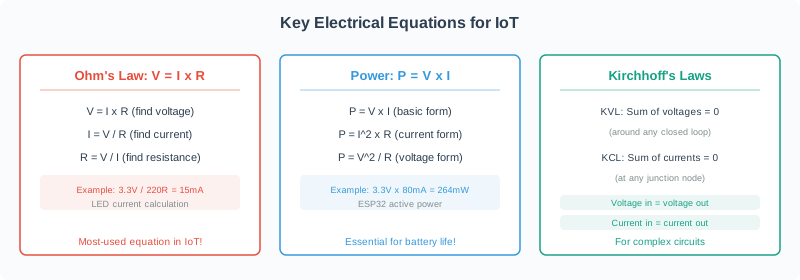
The visual is a route through the checks, not a substitute for naming the two voltage points and the current path.
- The calculated resistance still has to become a physical part.
Major section
Size an LED Resistor and Its Heat
A 3.3 V output drives a red LED whose forward drop is 2.0 V.
- The resistor must take the remaining 3.3-2.0=1.3 V.
- For a 5 mA target, Ohm’s Law gives \(R=V/I=1.3/0.005=260\ \Omega\).
Deck summary
Key takeaways
The circuit needed a current limit and a power check before it was connected.
- With 100 ppm/°C it reaches 261.56 ohms at 85°C, only +0.600%, while a copper conductor with 3,930 ppm/°C would move +23.6%.
- The visual is a route through the checks, not a substitute for naming the two voltage points and the current path.
- A 3.3 V output drives a red LED whose forward drop is 2.0 V.
Retrieval practice
Recall check 1 of 3

Voltage Vera says: answer from memory, then check your reasoning.
Q1A 3.3 V GPIO drives a red LED through a resistor. The LED forward voltage is about 2.0 V. What voltage should be used across the resistor when estimating LED current?
Show answer
Answer: A The resistor voltage is approximately 3.3 V - 2.0 V, so Ohm's Law should use about 1.3 V for the resistor path.
Retrieval practice
Recall check 2 of 3

Voltage Vera says: answer from memory, then check your reasoning.
Q2A prototype uses a resistor divider to scale a 5 V sensor output for a 3.3 V ADC. The calculated output is safe, but the measured ADC value is noisy and shifts when the sensor cable is connected. What should the review check next?
Show answer
Answer: A The voltage-divider equation is only the first check; practical loading, impedance, noise, and grounding decide whether the divider works in the real circuit.
Retrieval practice
Recall check 3 of 3

Voltage Vera says: answer from memory, then check your reasoning.
Q3A small DC motor normally runs at a modest measured current, but the microcontroller resets whenever the motor starts. What is the best next review step?
Show answer
Answer: A The reset is likely tied to transient load behavior or supply disturbance that a steady running-current calculation does not capture.
Print reference
Answers
Answer key.
- A · The resistor voltage is approximately 3.3 V - 2.0 V, so Ohm's Law should use about 1.3 V for the resistor path.
- A · The voltage-divider equation is only the first check; practical loading, impedance, noise, and grounding decide whether the divider works in the real circuit.
- A · The reset is likely tied to transient load behavior or supply disturbance that a steady running-current calculation does not capture.