Electronics & Circuits · Study deck
Voltage, Current, and Resistance
Imagine a small sensor node powered by a coin cell.
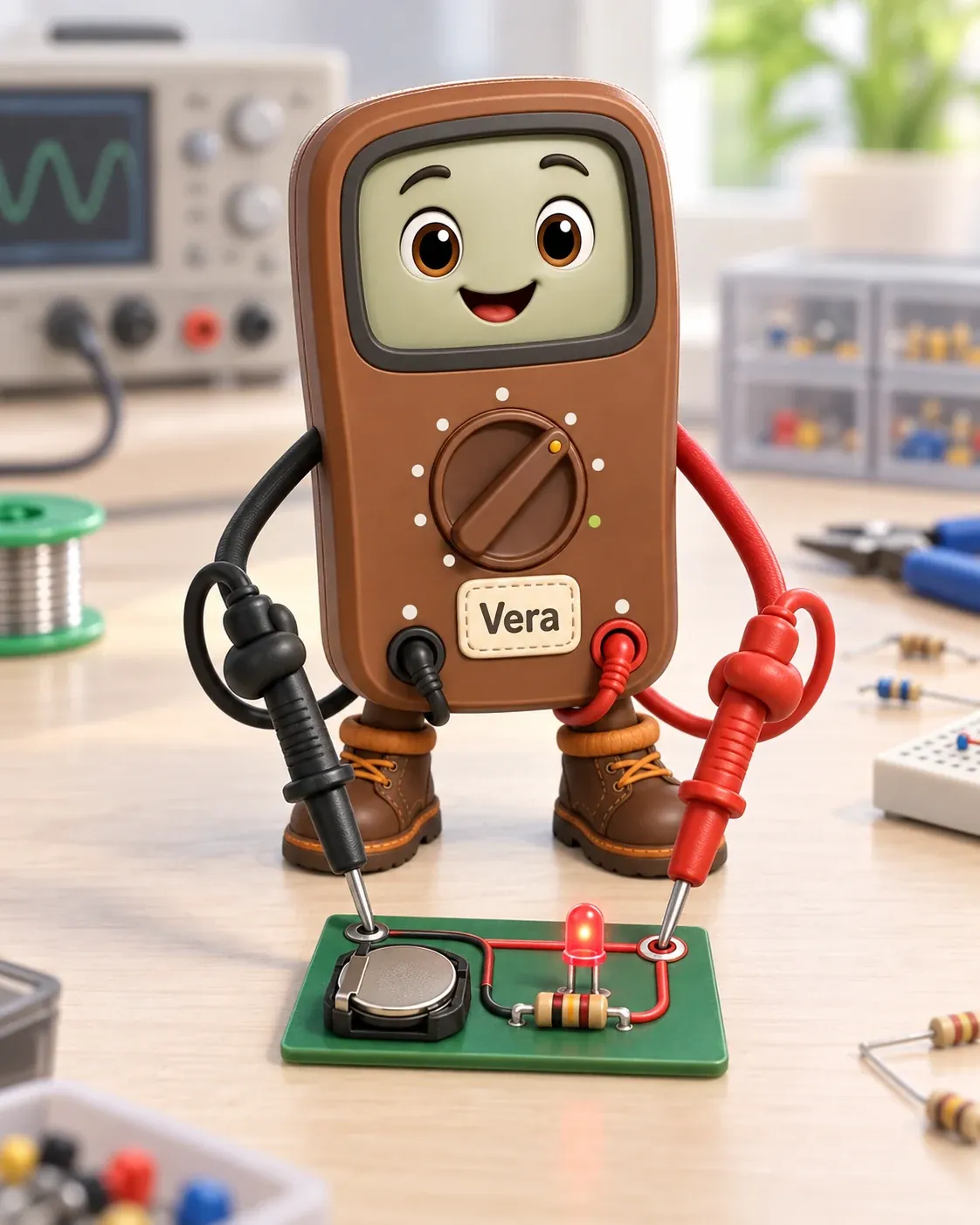
Voltage Vera is your guide for this deck.
After studying this chapter
Learning objectives
You will be able to:
- Explain: A voltmeter is placed across two nodes and usually draws very little current, so it can show a plausible voltage on a weak or floating node.
- Explain: If the measured state differs, return to the first boundary where the expected and observed evidence separate instead of changing several parts at once.
- Explain: Useful electricity notes therefore name the two voltage nodes, the current path, the current limit, and the state where the measurement was taken.
- Explain: If those balances do not match the sketch, the sketch is missing a path, a reference, or a load state.
Major section
Overview: Electricity Needs a Complete Loop
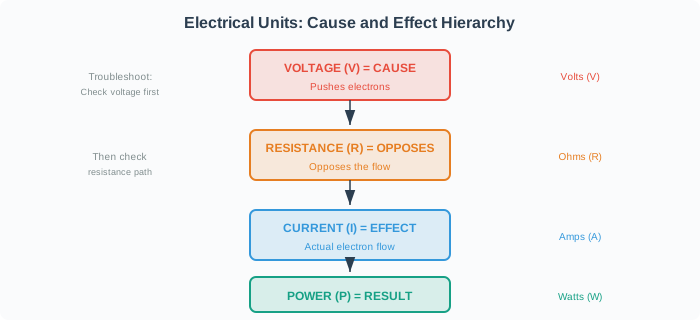
Electricity is the movement of charge through a circuit.
- Voltage is the potential difference between two points.
- A useful beginner model starts with a source, a load, conductors, and a return path.
Major section
Overview: Electricity Needs a Complete Loop (continued)
A low-resistance path can pull too much current even when the voltage looks normal.
- A small current can still matter if the device sleeps for months on a battery.
- Useful electricity notes therefore name the two voltage nodes, the current path, the current limit, and the state where the measurement was taken.
- It must be limited so wires, pins, regulators, and parts stay within their ratings.
Major section
Practitioner: Review the Circuit as Evidence
The electrical record should name the states that were checked.
- If the measured state differs, return to the first boundary where the expected and observed evidence separate instead of changing several parts at once.
- Under the hood, electricity in IoT circuits is about boundaries.
- Voltage only has meaning between two nodes.
Major section
Under the Hood: References and Ratings Define Trust
If those balances do not match the sketch, the sketch is missing a path, a reference, or a load state.
- Measurements also change the evidence depending on where the instrument is placed.
- A voltmeter is placed across two nodes and usually draws very little current, so it can show a plausible voltage on a weak or floating node.
- An ammeter is placed in series with the path and changes the circuit if it is put across a source by mistake.
Deck summary
Key takeaways
Electricity is the movement of charge through a circuit.
- A low-resistance path can pull too much current even when the voltage looks normal.
- The electrical record should name the states that were checked.
- If those balances do not match the sketch, the sketch is missing a path, a reference, or a load state.
Retrieval practice
Recall check 1 of 3
Voltage Vera says: answer from memory, then check your reasoning.
Q1A sensor board powers on, but the microcontroller reads random values from its signal pin. Which electricity checks should come first?
Show answer
Answer: A A powered board can still have an invalid reference, missing return path, or floating signal.
Retrieval practice
Recall check 2 of 3
Voltage Vera says: answer from memory, then check your reasoning.
Q2A GPIO pin must switch an external load. What is the safest first review step?
Show answer
Answer: B GPIO pins have limits; external loads often need a driver, protection, and measured evidence.
Retrieval practice
Recall check 3 of 3
Voltage Vera says: answer from memory, then check your reasoning.
Q3Why is a voltage reading incomplete unless the two measurement points are named?
Show answer
Answer: C Voltage is not meaningful as an isolated point; the reference or component endpoints must be identified.
Print reference
Answers
Answer key.
- A · A powered board can still have an invalid reference, missing return path, or floating signal.
- B · GPIO pins have limits; external loads often need a driver, protection, and measured evidence.
- C · Voltage is not meaningful as an isolated point; the reference or component endpoints must be identified.