Analytics & ML · Study deck
Applied: Edge Workload Placement
Imagine a freezer that must warn a shop worker before food warms.
Data Dora is your guide for this deck.

After studying this chapter
Learning objectives
You will be able to:
- Place processing stages on device, edge, fog, storage, cloud, or application tiers based on latency, bandwidth, privacy, and compute constraints.
- Distinguish connectivity movement from Level 3 semantic transformation in the IoT reference model.
- Specify evidence records for local alarms, cloud model updates, and tier-crossing data reductions.
- Review what information is lost when raw data becomes features, summaries, events, or work orders.
Major section
Start With the Story
A small computer in the shop can act in one second.
- A distant service can study months of readings, but the internet may fail at the worst time.
- The system designer should split the work by job.
- For every hand-off, name what goes in, what comes out, how old it may be, and who owns a failure.
Major section
Start With the Story (continued)
The warning must still be safe, and the later record must show what happened.
- This simple placement rule does not say that nearby work is always best.
- Some jobs need more power or a wider history.
- Practitioner compares those costs.
- Under the Hood follows the exact data changes and proof across each boundary.
Major section
Choose the Right Tier
Four forces drive that placement: latency (how fast must it respond?), bandwidth (how much data would travel?), privacy (must the raw data stay local?), and compute/energy (how heavy is the work?).
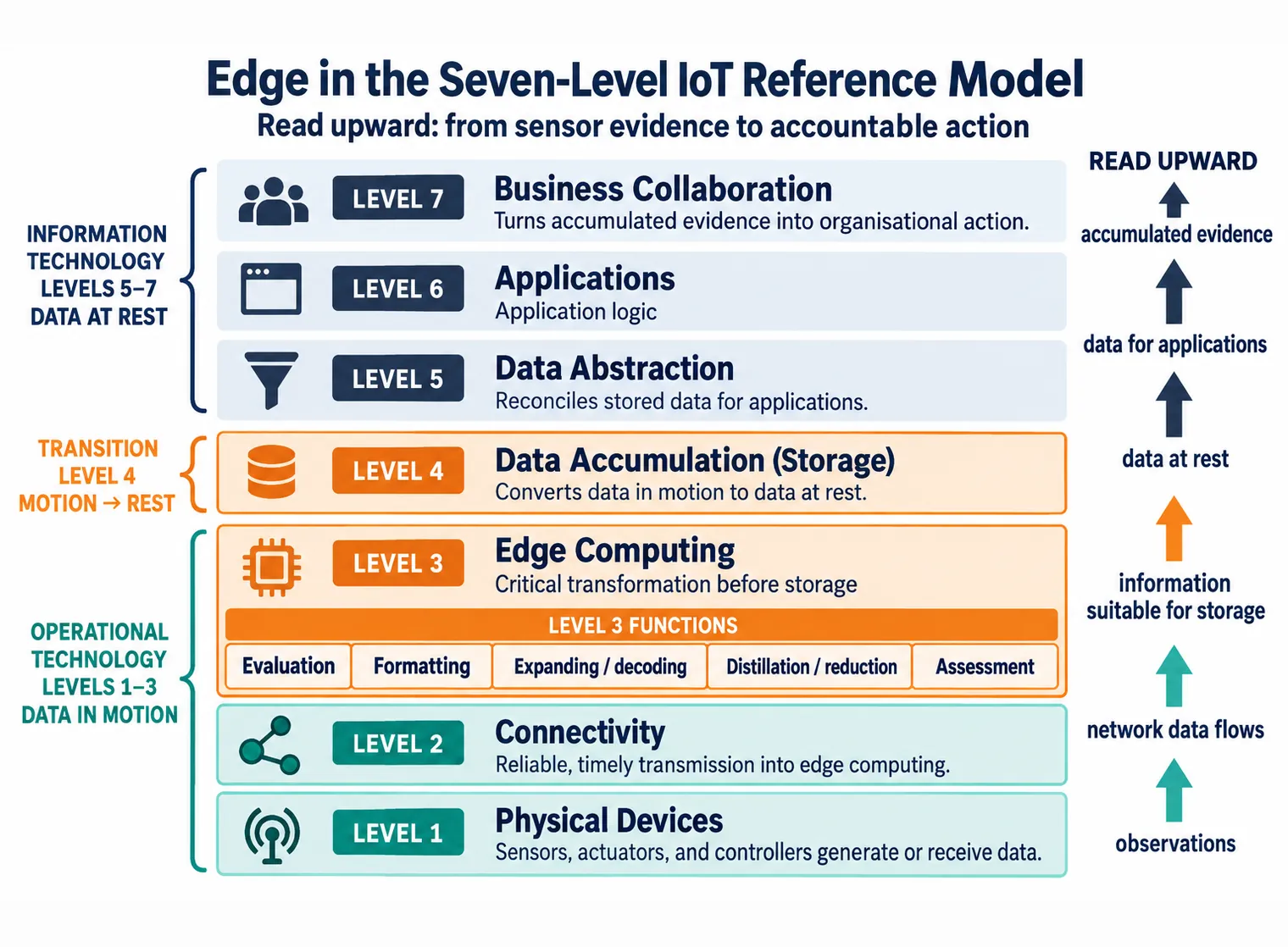
- A useful way to apply the model is to follow one measurement upward.
- Level 2 carries it across a local link.
Major section
Choose the Right Tier (continued)
Level 3 decides whether the stream needs immediate action, format repair, feature extraction, or aggregation before it becomes a stored record at Level 4.
- Levels 5 to 7 then use the accumulated data for analytics, applications, and business coordination.
- If the gateway interprets payloads, removes noise, computes a feature, or triggers a local response, it is doing Level 3 edge work.
- The stack does not require every observation to visit every level before action.
Major section
Choose the Right Tier (continued)
Level 3 is where immediate evaluation or reduction can occur near moving data; higher levels add durable history and broader organisational context.
- It connects to the chapter's running placement rule: choose the lowest tier that can satisfy the decision safely, then send the evidence needed by higher-level learning and governance.
- For example, a cold-chain truck may sample temperature at Level 1 and forward readings over BLE or a vehicle bus at Level 2.
- The gateway at Level 3 rejects impossible values, converts units, checks the 8 C compliance threshold, and sends one-minute summaries unless an excursion occurs.
Major section
Practitioner: Placing Each Stage
A design review should also record the evidence contract for each tier.
- In practice, tier placement starts as a row-by-row review of the data path.
- Operations that compare many sites, train models, or join historical records move upward.
- A gateway that stops a motor must retain the local readings and threshold that justified the stop.
Major section
Practitioner: Placing Each Stage (continued)
Worked example: a vibration monitor for a machine: This split -- inference at the edge, training in the cloud, models pushed back down -- is the backbone pattern of production IoT analytics.
- The edge alarm should include the sensor ID, feature window, threshold version, local clock, and gateway software version so the cloud can audit why a shutdown happened.
- The cloud model update should include the training data period, model hash, rollout target, and rollback condition before it is pushed back to gateways.
- A cloud service that changes a maintenance interval must retain the fleet-level trend and model version that justified the change.
Major section
Edge Continuum, Not Switch
Under the hood, the placement decision is about what state changes at each boundary.
- Level 2 moves packets and frames, so its evidence is delivery status, link quality, retries, and addresses.
- Level 4 changes persistence state by assigning retention, indexes, lineage, and replay rules.
- That separation is useful during outages.
- The other hidden issue is information loss.
Major section
Edge Continuum, Not Switch (continued)
Edge reduction is valuable only when the discarded data is not needed for the decision being defended.
- Levels 5 to 7 change organizational state by turning stored records into trends, dashboards, maintenance tickets, automation rules, or business decisions.
- The reference model is therefore both an architecture diagram and an accountability map.
- Privacy is a placement force.
Major section
Edge Continuum, Not Switch (continued)
Keeping only event clips may protect privacy, but incident review still needs timing, thresholds, confidence, and local clock evidence.
- If the cloud is unavailable, a well-designed Level 3 gateway can keep applying local safety rules, buffer evidence, and forward a compressed backlog when connectivity returns.
- If the gateway is unavailable, Level 4 may show stale records but should not pretend that fresh local assessment occurred.
- Bandwidth is a cost, not just a limit.
Major section
Edge Continuum, Not Switch (continued)
Streaming raw high-rate data is often infeasible and always expensive.
- If a model changes in the cloud, gateways need a versioned rollout so every local decision can be traced to the model actually running at the time.
- Sending one-minute averages may be correct for billing or environmental trends, but wrong for diagnostics that need spikes, spectra, or phase relationships.
- So the reference model is a spectrum of placement choices, not an on/off switch.
Major section
Edge Continuum, Not Switch (continued)
Good edge designs document these losses deliberately, with a rule for when the gateway keeps richer evidence temporarily.
- A cloud round trip is typically tens to hundreds of milliseconds; local edge processing is sub-millisecond to a few milliseconds.
- The edge's core job is data reduction -- filter, aggregate, featurize -- so only valuable, compact data travels.
- A useful sanity check is to ask whether a tier crossing loses information needed for a later defense.
Major section
Edge Continuum, Not Switch (continued)
Between device and cloud sits fog computing on gateways and local servers: more power than a sensor, lower latency than the cloud.
- Keeping raw voice, video, or health data on the device and sending only derived results is often the simplest privacy control: the data that never leaves cannot leak.
- Sending only averages upstream may be correct for billing or environmental trends, but wrong for diagnostics that need spikes or spectra.
- Keeping only event clips may protect privacy, but it must still preserve enough timing and threshold evidence for incident review.
Deck summary
Key takeaways
A small computer in the shop can act in one second.
- The warning must still be safe, and the later record must show what happened.
- Four forces drive that placement: latency (how fast must it respond?), bandwidth (how much data would travel?), privacy (must the raw data stay local?), and compute/energy (how heavy is the work?).
- Level 3 decides whether the stream needs immediate action, format repair, feature extraction, or aggregation before it becomes a stored record at Level 4.
- Level 3 is where immediate evaluation or reduction can occur near moving data; higher levels add durable history and broader organisational context.
Retrieval practice
Recall check 1 of 5

Data Dora says: answer from memory, then check your reasoning.
Q1In the IoT edge-fog-cloud reference model, what decides which tier a given computation should run on?
Show answer
Answer: D Placement follows those four forces, evaluated per computation stage.
Retrieval practice
Recall check 2 of 5
Data Dora says: answer from memory, then check your reasoning.
Q2A gateway stops a motor, then receives a new model from the cloud. Which records make both decisions traceable?
Show answer
Answer: B Each tier must defend the action it owns.
Retrieval practice
Recall check 3 of 5
Data Dora says: answer from memory, then check your reasoning.
Q3A machine-safety cutoff must trigger within a few milliseconds of detecting a fault. Where should the detection run, and why?
Show answer
Answer: C Latency-critical decisions must run locally; tens to hundreds of milliseconds of round-trip delay is too slow for a millisecond-scale safety response.
Retrieval practice
Recall check 4 of 5
Data Dora says: answer from memory, then check your reasoning.
Q4A bearing fault appears as brief vibration spikes. A gateway wants to upload only averages. What should the design review decide?
Show answer
Answer: D An average can erase the event the later decision needs.
Retrieval practice
Recall check 5 of 5
Data Dora says: answer from memory, then check your reasoning.
Q5Why is 'the edge reduces data before the uplink' considered a core function of the edge tier?
Show answer
Answer: C Filtering, aggregating, or featurizing at the edge makes the uplink affordable while still preserving the evidence the cloud needs.
Print reference
Answers
Answer key.
- D · Placement follows those four forces, evaluated per computation stage.
- B · Each tier must defend the action it owns.
- C · Latency-critical decisions must run locally; tens to hundreds of milliseconds of round-trip delay is too slow for a millisecond-scale safety response.
- D · An average can erase the event the later decision needs.
- C · Filtering, aggregating, or featurizing at the edge makes the uplink affordable while still preserving the evidence the cloud needs.