Analytics & ML · Study deck
Practical Edge Computing: Workload Placement
A vibration node cannot stream every raw sample forever.
Data Dora is your guide for this deck.

After studying this chapter
Learning objectives
You will be able to:
- Use Interactive Latency Tools: Calculate end-to-end latency for different processing locations (device, edge, cloud)
- Apply Worked Examples: Follow step-by-step calculations for real-world edge vs cloud decisions
- Avoid Common Pitfalls: Recognize and prevent typical edge deployment mistakes
- Make Informed Architecture Decisions: Select appropriate processing locations based on latency, bandwidth, and cost requirements
Major section
Start With the Story
The long study needs a saved period, enough detail, and a review trail.
- A local computer must warn staff about a warming freezer, while a central service studies months of energy use.
- The system owner has to place each job without hiding its cost or its failure path.
- Cost is more than the purchase price.
Major section
Start With the Story (continued)
The warning needs a response time, a local safe action, and a maximum age for its input.
- Include field visits, power, link use, updates, support time, and the cost of a missed or late decision.
- The simple split does not choose a final design.
- Under the Hood covers queues, model size, hardware limits, and the standards or service terms that may change the result.
Major section
Phoebe's Field Notes: Why Bit Depth Costs Watts, Not Just Storage
The mathematical gist.: The chapter's 1,000 Hz, 16-bit stream is 16 kbps (2,000 B/s) per sensor and has a 98.1 dB ideal converter ceiling.
- At a stated 50 nJ/bit, raw transmission costs 0.800 mW per sensor.
Major section
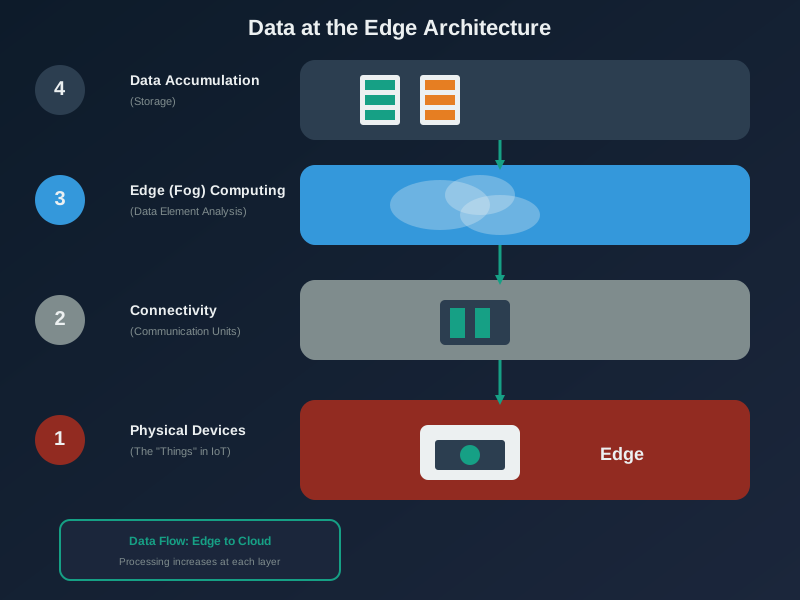
Data at the Edge Architecture
Four layers of data at the edge Level 4: Data accumulation: Persistent storage keeps synchronized history ready for cloud access.
- Level 1: Physical devices: Sensors and actuators generate the raw data that starts the pipeline.
- Data starts on physical devices, gets analyzed locally, and accumulates upward into storage for later synchronization.
Major section
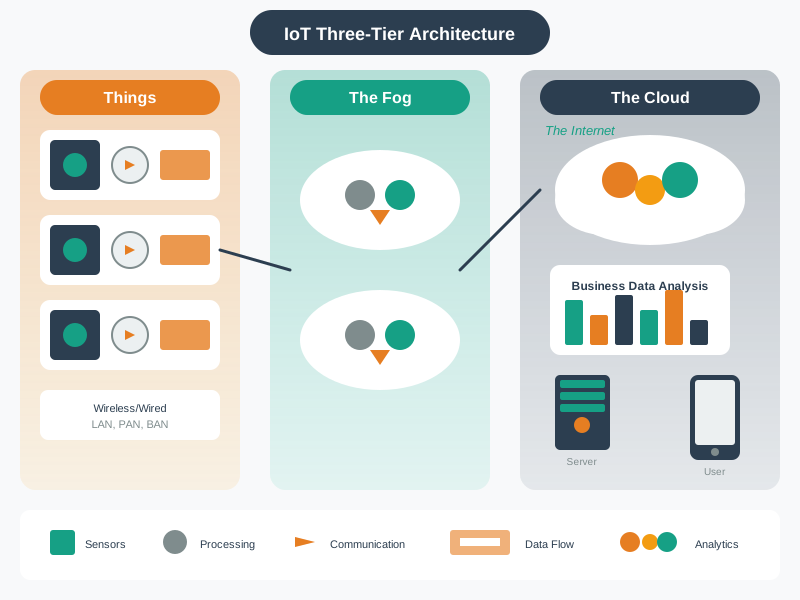
IoT System Architecture
The cloud: Internet-scale services provide analytics, servers, and user-facing applications.
- Data flows upward from things to fog to cloud, while analytics and control insight can flow back down.
- Understanding how data flows through each layer and where processing occurs is essential for designing efficient, scalable systems.
Major section
Factory Edge or Cloud Choice
Management needs to decide between edge processing (local analysis with alerts) versus cloud processing (centralized analysis).
- The plant has a 100 Mbps internet connection.
- Verdict: Cloud path fails the 50 ms safety requirement.
- Result: Edge-hybrid architecture saves $4,831 (41%) over 3 years while meeting the critical 50 ms latency requirement that pure cloud cannot achieve.
Deck summary
Key takeaways
The long study needs a saved period, enough detail, and a review trail.
- The warning needs a response time, a local safe action, and a maximum age for its input.
- The mathematical gist.: The chapter's 1,000 Hz, 16-bit stream is 16 kbps (2,000 B/s) per sensor and has a 98.1 dB ideal converter ceiling.
- Four layers of data at the edge Level 4: Data accumulation: Persistent storage keeps synchronized history ready for cloud access.
- The cloud: Internet-scale services provide analytics, servers, and user-facing applications.
Retrieval practice
Recall check

Data Dora says: answer from memory, then check your reasoning.
Q1A pipeline needs a 20 ms emergency shutdown on vibration sensors plus weekly predictive-maintenance model training. Where should each function primarily run?
Show answer
Answer: A Latency-critical safety logic runs at the edge; compute-heavy model training runs in the cloud.
Print reference
Answers
Answer key.
- A · Latency-critical safety logic runs at the edge; compute-heavy model training runs in the cloud.