Analytics & ML · Study deck
IoT Edge Models: Cold-Chain Processing
A truck gateway can spot a temperature breach before the cloud replies.
Data Dora is your guide for this deck.

After studying this chapter
Learning objectives
You will be able to:
- Test cold chain edge processing with a concrete scenario and pass criteria.
- Validate three-tier edge design exercise with a concrete scenario and pass criteria.
- test cold chain edge processing with a concrete scenario and pass criteria
- validate three-tier edge design exercise with a concrete scenario and pass criteria
Major section
Cold Chain Edge Processing
With the Level 3 functions named, test whether they still hold up when the network is mobile and compliance-sensitive.
- The system must detect temperature excursions above 8 degrees Celsius within 30 seconds for regulatory compliance.
- The edge gateway investment of $1,750 saves $4,001 per month in cellular costs.
- More critically, the edge architecture detects temperature excursions even when trucks pass through tunnels or rural areas without cellular coverage -- a compliance requirement that cloud-only architectures cannot guarantee.
Major section
Choose the Processing Level
The edge processing reduces data volume by over 99.99% while preserving the diagnostic information needed for predictive maintenance.
- Not all data needs to travel to the cloud.
- Uploading everything would require approximately 23 TB/day in cellular bandwidth.
- Cloud analytics then correlates these summaries across the fleet to predict bearing failures weeks before they occur.
Major section
Application Requirements Summary
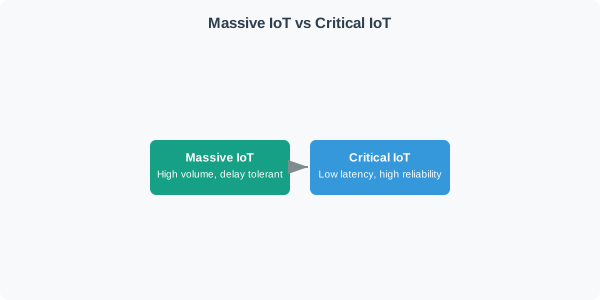
Massive deployments prioritise fleet scale, unit cost, and efficient batch handling; critical systems prioritise bounded latency and local real-time action because delayed decisions can become unsafe.
- Neither branch removes the need for cloud history or edge evidence, but it changes which tier may close the immediate loop.
Major section
Latency vs Bandwidth Matrix
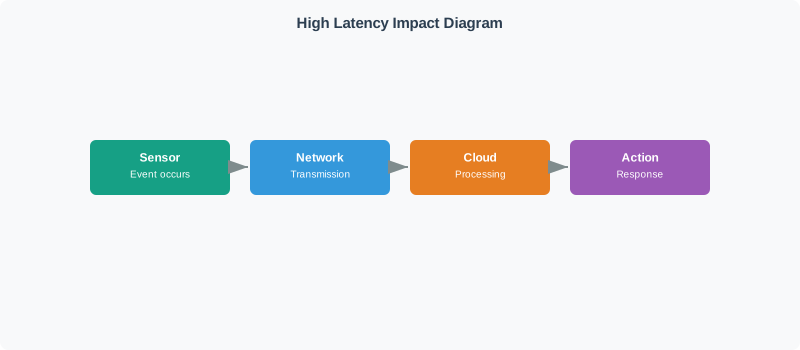
The placement cost is easiest to see as elapsed path, not as an abstract cloud label.
- A: Response must traverse the return path before: Action can occur.
- Those labelled stages are additive and variable, so a safety deadline cannot be justified from compute time alone.
- The optimal processing location depends on both latency sensitivity and data volume.
Major section
Edge Placement Contracts
The reference-model mapping above still needs a concrete placement and evidence contract for the computation continuum.
- Both occupy physical, connectivity, and acquisition responsibilities, but their capacity, latency, resilience, and evidence contracts are deliberately different.
Deck summary
Key takeaways
With the Level 3 functions named, test whether they still hold up when the network is mobile and compliance-sensitive.
- The edge processing reduces data volume by over 99.99% while preserving the diagnostic information needed for predictive maintenance.
- Massive deployments prioritise fleet scale, unit cost, and efficient batch handling; critical systems prioritise bounded latency and local real-time action because delayed decisions can become unsafe.
- The placement cost is easiest to see as elapsed path, not as an abstract cloud label.
- The reference-model mapping above still needs a concrete placement and evidence contract for the computation continuum.
Retrieval practice
Recall check 1 of 3

Data Dora says: answer from memory, then check your reasoning.
Q1Place each IoT reference-model responsibility where it lives so you can trace the handoff from physical events to edge decisions and stored records.
Show answer
Answer: A Separate devices and connectivity, edge computation, and data accumulation so you can reason about what crosses each model boundary.
Q2Complete the edge computing data aggregation function:
Show answer
Answer: A Edge aggregation uses a fixed-size deque buffer to maintain a sliding window of readings.
Retrieval practice
Recall check 2 of 3

Data Dora says: answer from memory, then check your reasoning.
Q3In the seven-level IoT Reference Model, a gateway receives raw sensor data from multiple devices and performs three operations: converting device-specific protocols to MQTT, checking if temperature exceeds a safety threshold, and averaging readings over 5-minute windows. At which level do these operations occur?
Show answer
Answer: C Level 3 (Edge Computing) handles three key processing functions: formatting (protocol conversion to MQTT), evaluation (threshold checking for safety alerts), and distillation (5-minute averaging to reduce data volume).
Retrieval practice
Recall check 3 of 3

Data Dora says: answer from memory, then check your reasoning.
Q4A temperature sensor outputs readings in a proprietary binary format. The edge gateway converts each reading to a standardized JSON document with a UTC timestamp and unit label. Which Level 3 processing function does this represent?
Show answer
Answer: B Formatting standardizes data from heterogeneous device-specific formats into consistent representations that downstream systems can process uniformly.
Print reference
Answers
Answer key.
- A · Separate devices and connectivity, edge computation, and data accumulation so you can reason about what crosses each model boundary.
- A · Edge aggregation uses a fixed-size deque buffer to maintain a sliding window of readings.
- C · Level 3 (Edge Computing) handles three key processing functions: formatting (protocol conversion to MQTT), evaluation (threshold checking for safety alerts), and distillation (5-minute averaging to reduce data volume).
- B · Formatting standardizes data from heterogeneous device-specific formats into consistent representations that downstream systems can process uniformly.