Analytics & ML · Study deck
Edge Processing: Filtering Patterns
A vibration node can send every sample or remove noise near the machine.
Data Dora is your guide for this deck.

After studying this chapter
Learning objectives
You will be able to:
- Apply Four Edge Processing Patterns: Implement Filter, Aggregate, Infer, and Store-Forward patterns for different IoT scenarios
- Select Optimal Patterns: Match processing patterns to application requirements based on latency, bandwidth, and reliability needs
- Evaluate Trade-offs: Compare edge ML inference versus cloud ML, and batch processing versus real-time streaming
- Avoid Common Mistakes: Understand when edge processing saves costs versus when it adds unnecessary complexity
Major section
Start With the Story
The site needs a fast alarm, but the central service needs only a short trend and a record of unusual events.
- Sending every raw value may waste power and make an outage harder to manage.
- Edge processing means changing data on or near the device before it travels farther.
- The edge is not always cheaper or safer.
Major section
Edge Processing Patterns
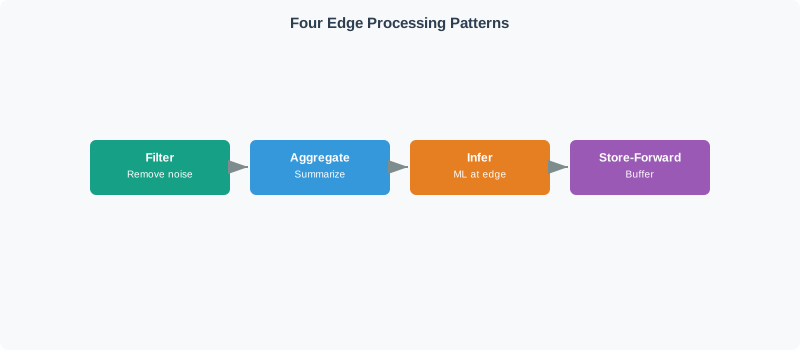
Edge computing employs four primary data processing patterns, but choosing among them requires seeing what each one changes in the data path.
- The first three alter the information or its representation, while store-forward preserves the payload and delays delivery.
Major section
Latency-Based Processing Location
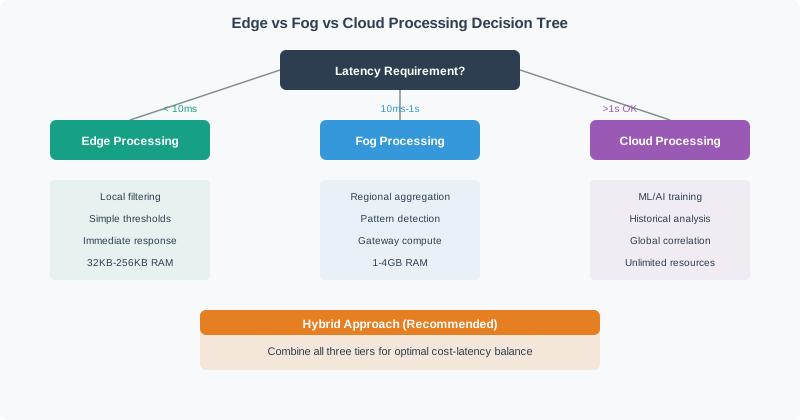
Pattern selection starts with a placement bound.
- The 10ms-1s branch reaches: Fog Processing with 1-4GB RAM for pattern detection and regional aggregation, while >1s OK allows: Cloud Processing to use global correlation, historical analysis, and ML training.
- The final: Hybrid Approach combines tiers rather than erasing their limits.
Major section
Edge Processing Timeline
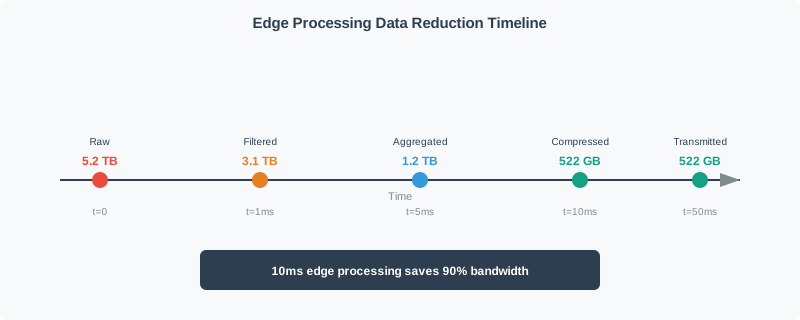
Once placement is chosen, the next question is how much information each local step removes.
- The annotation summarises a 90% bandwidth saving, but each reduction also discards or changes representation.
Deck summary
Key takeaways
The site needs a fast alarm, but the central service needs only a short trend and a record of unusual events.
- Edge computing employs four primary data processing patterns, but choosing among them requires seeing what each one changes in the data path.
- Pattern selection starts with a placement bound.
- Once placement is chosen, the next question is how much information each local step removes.
Retrieval practice
Recall check 1 of 2

Data Dora says: answer from memory, then check your reasoning.
Q1A greenhouse gateway receives 200 humidity readings per second but only needs to act when humidity crosses 40% or 80%. Which edge pattern minimizes bandwidth?
Show answer
Answer: A When only threshold crossings matter, the Filter pattern transmits just those events and minimizes bandwidth.
Retrieval practice
Recall check 2 of 2

Data Dora says: answer from memory, then check your reasoning.
Q2Complete the edge data filtering before cloud upload:
Show answer
Answer: A Dead-band filtering at the edge only transmits when the value changes by more than a threshold.
Print reference
Answers
Answer key.
- A · When only threshold crossings matter, the Filter pattern transmits just those events and minimizes bandwidth.
- A · Dead-band filtering at the edge only transmits when the value changes by more than a threshold.