Analytics & ML · Study deck

Edge Cyber-Foraging: Cost and Energy Calculations

A 4K transcode can move heat and delay from a phone to a nearby server.

Data Dora is your guide for this deck.

edgepatternscyber
Data Dora, the module guide, in a scene from this chapter.
iotclass.org

After studying this chapter

Learning objectives

You will be able to:

  • Test putting numbers to it with a concrete scenario and pass criteria.
  • Validate test your understanding with a concrete scenario and pass criteria.
  • Explain when a nearby cloudlet is a better target than local execution or a distant cloud.
  • Compare local and offloaded execution using input size, result size, remote compute, radio energy, and latency.
iotclass.org

Major section

Start With the Decision · Putting Numbers to It
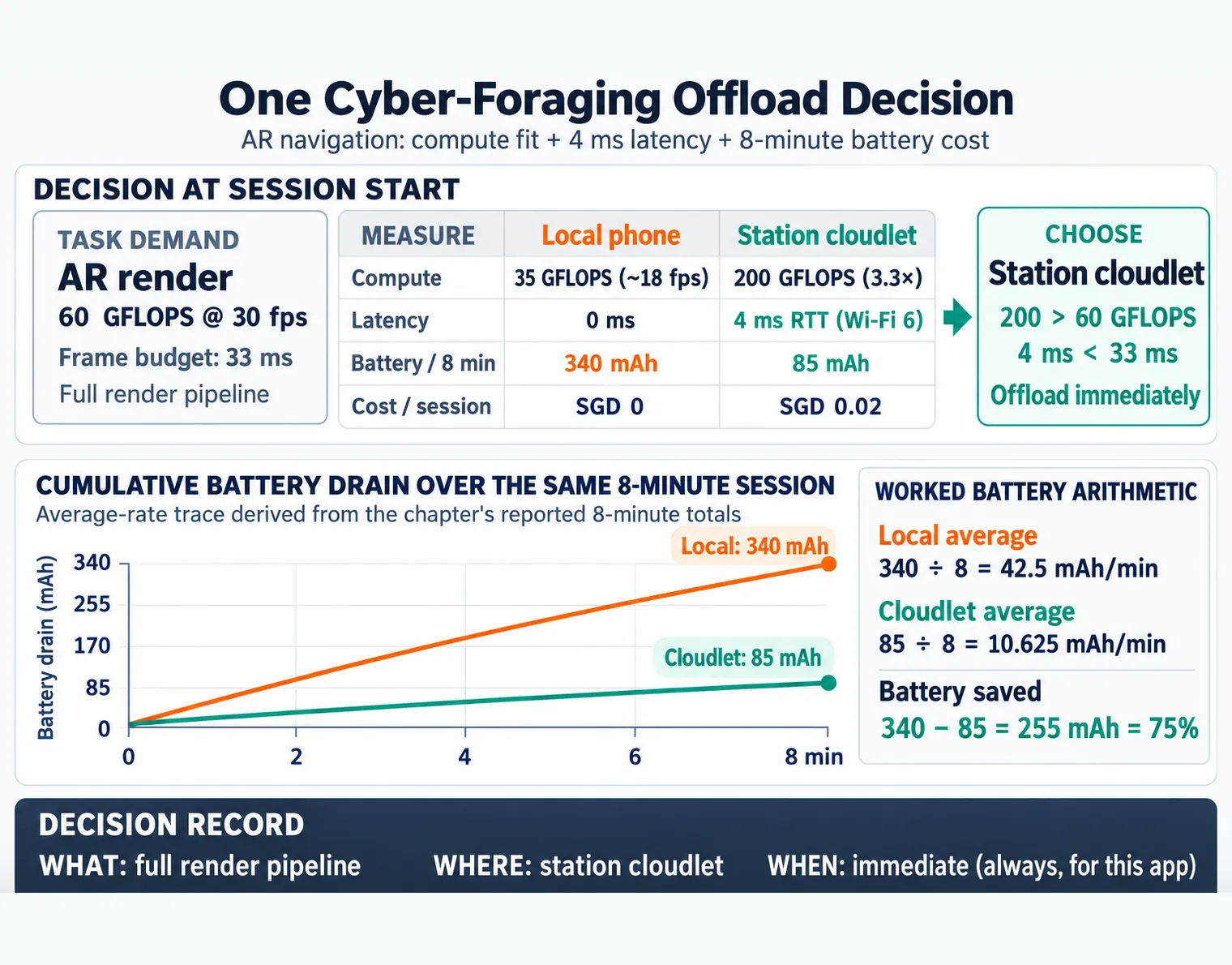
A 4K transcode can move heat and delay from a phone to a nearby server.

  • This justifies the What/Where/When framework: offload CPU-heavy tasks to capable nearby devices when the network is fast.
  • An available surrogate is not automatically a safe offload target.

Numbers to remember

4KA 4K transcode can move heat

Why it matters

This order prevents a nearby node from winning merely because it is present.

Edge caching framework diagram showing three decision dimensions: WHAT (what data or computation to cache or offload), WHERE (which edge nodes to use), and WHEN (timing and triggers).
iotclass.org

Major section

Mobile Figure Summary: What/Where/When · Scavenger System Architecture

Opportunistic networking: A communication paradigm where connections are established whenever nodes come within range of each other, without requiring persistent infrastructure, used to distribute processing in dense IoT environments.

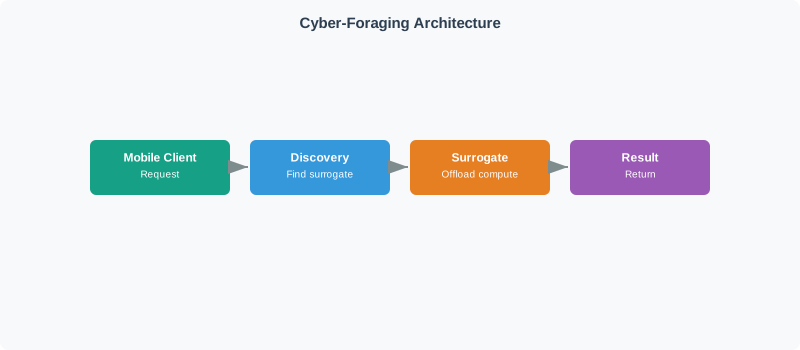
  • The return path carries a result, but the boundary must also carry identity, task limits, errors, and provenance.
Cyber-foraging scavenger system architecture showing heterogeneous network topology with mobile client discovering nearby surrogates via service discovery protocol.
iotclass.org

Major section

Mobile Figure Summary: Scavenger Flow · Network Topology and Device Mix
Scavenger Library: Profiles tasks (CPU, memory, network requirements), discovers surrogates, selects optimal target.

  • RPC Interface: Serializes tasks, transmits to surrogate, receives results.
  • Execution Environment: Sandboxed environment for running client tasks with resource limits.
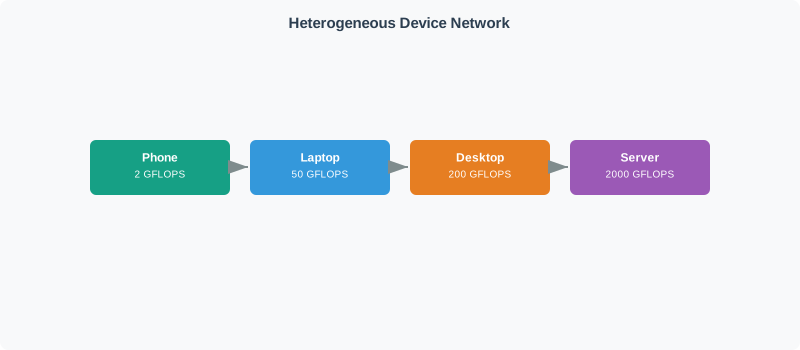
Heterogeneous device network topology showing mobile client surrounded by diverse surrogates with capability-aware task assignment.
iotclass.org

Major section

Edge Caching Strategies

Caching changes both response distance and the evidence needed to decide whether a reused result is still valid.

  • The chapter's caching strategy must therefore couple tier selection with version, TTL, privacy, and invalidation evidence; a hit is useful only when the object remains correct for the decision.

Key terms

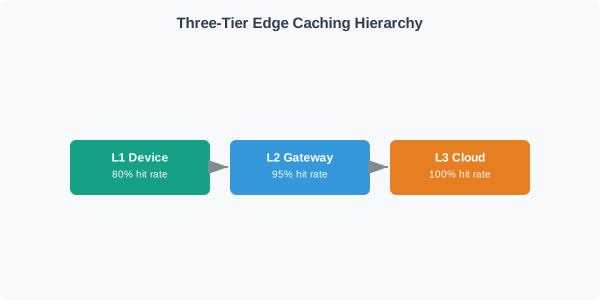
L1 Device
L1 Device is the nearest cache and the diagram marks 80% hit rate before a request climbs to L2 Gateway at 95% hit rate.
Three-tier edge caching hierarchy showing hit rates at each level demonstrating effectiveness of hierarchical caching.
iotclass.org

Major section

Task Profiling · AR Navigation Offloading

The app renders 3D audio-visual overlays in real-time, requiring GPU resources that exceed typical smartphone capabilities.

  • The SGD 48,000 cloudlet investment pays for itself in about 8 months through eliminated cloud GPU costs, plus additional savings from reduced 5G data usage.
  • Key Insight:: Cyber-foraging excels when the offloading environment is predictable.
  • Train stations, airports, and hospitals have fixed infrastructure where cloudlets can be pre-positioned.
iotclass.org

Major section

Cyber-Foraging Offload Contracts

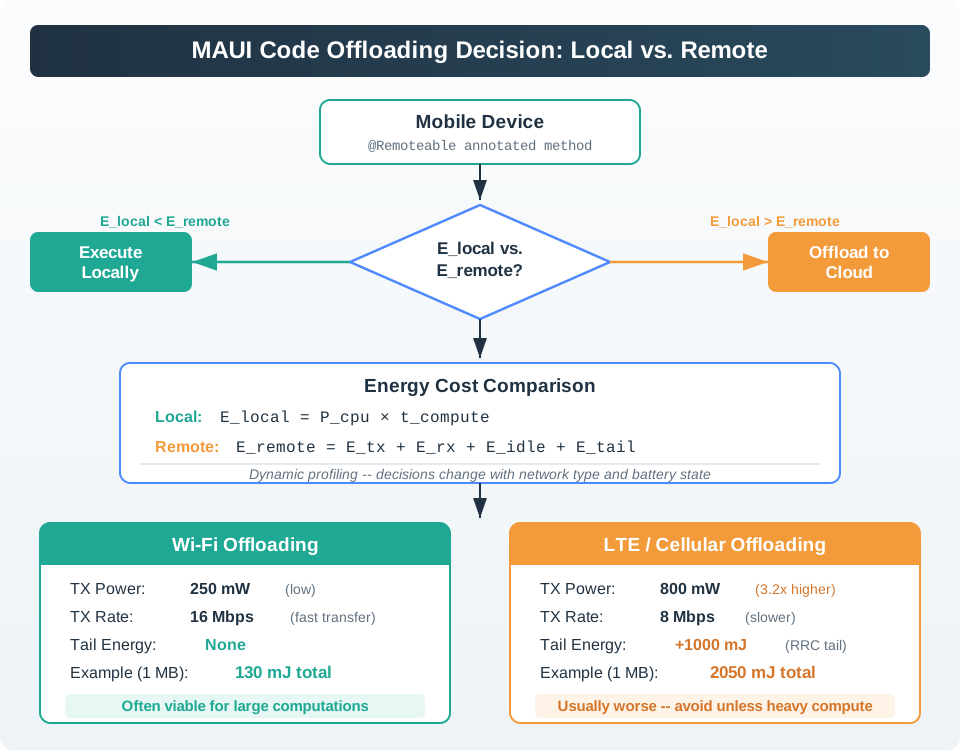
Cyber-foraging only works when the offload decision is measured instead of assumed.

  • Running it on the glasses may drain the battery.
  • Sending every image to a distant service may be too slow or fail when the outside link drops.
  • Offloading means sending a computing job to another machine.
  • The safe choice depends on the repair task.
Key terms

Nearby
Nearby is not always faster or safer.

Numbers to remember

16 MbpsThe : Wi-Fi Offloading example pairs 16 Mbps

Why it matters

The offload decision can change minute by minute because Wi-Fi, cellular, battery state, and cloudlet load change.

Cyber-foraging is a measured break-even decision: offload only when transfer energy and latency are lower than the local compute cost for the task.
iotclass.org

Major section

Concept Relationships · Continue Your Route

Edge Compute Patterns -- Cyber-foraging is an advanced offloading pattern beyond basic filter/aggregate/infer.

  • IoT Reference Model -- Cyber-foraging operates at Level 3 (edge compute) leveraging nearby Level 4 (fog) resources.
  • Edge Fog Computing -- Cloudlets are pre-positioned fog nodes; cyber-foraging discovers opportunistic fog resources.
  • Edge Patterns Practical Guide -- Latency calculator helps decide when offloading saves time vs network overhead.
  • Edge Data Acquisition -- Cyber-foraging offloads processing but still requires edge data collection.
iotclass.org

Deck summary

Key takeaways

A 4K transcode can move heat and delay from a phone to a nearby server.

  • Opportunistic networking: A communication paradigm where connections are established whenever nodes come within range of each other, without requiring persistent infrastructure, used to distribute processing in dense IoT environments.
  • Scavenger Library: Profiles tasks (CPU, memory, network requirements), discovers surrogates, selects optimal target.
  • Caching changes both response distance and the evidence needed to decide whether a reused result is still valid.
  • The app renders 3D audio-visual overlays in real-time, requiring GPU resources that exceed typical smartphone capabilities.
iotclass.org

Retrieval practice

Recall check 1 of 6

Data Dora says: answer from memory, then check your reasoning.

Q1Place each cyber-foraging responsibility where it lives so you can offload urgent work without trusting the wrong surrogate or reusing a stale result.

ANearby Resource Advertisement
BSurrogate Trust and Fit Check
CBounded Task Offload
DVerified Result Cache
Show answer

Answer: A Place each cyber-foraging responsibility where it lives so you can offload urgent work without trusting the wrong surrogate or reusing a stale result.

iotclass.org

Retrieval practice

Recall check 2 of 6

Data Dora says: answer from memory, then check your reasoning.

Q2What is a cloudlet in the context of cyber foraging?

AA nearby edge compute node that accepts offloaded tasks with low network latency.
BA distant cloud database that stores records but never executes application code.
CA battery pack that lets a sensor run its processor at cloud speed.
DAn encryption protocol that sends all device traffic directly to the cloud.
Show answer

Answer: A A cloudlet provides nearby, low-latency computation for devices that should not do every heavy task locally.

iotclass.org

Retrieval practice

Recall check 3 of 6

Data Dora says: answer from memory, then check your reasoning.

Q3Which task is the BEST candidate to offload from a constrained device to a nearby cloudlet?

AA compute-heavy task with small input and output, such as running a large model on one small image, because little data ships but much computation is saved.
BAveraging a multi-gigabyte local file on the cloudlet, because the returned answer is tiny even though the upload dominates time, radio energy, and bandwidth.
CA threshold comparison on one local sensor sample, because its tiny input and output minimize transfer cost while the cloudlet has a faster processor than the device.
DA task that produces a huge annotated video result from a tiny input, because upload size alone determines whether offloading is profitable.
Show answer

Answer: A Heavy compute plus small data is the classic profitable offload case.

iotclass.org

Retrieval practice

Recall check 4 of 6

Data Dora says: answer from memory, then check your reasoning.

Q4A mobile AR application needs to render 3D building overlays during a 30-minute city walking tour. The phone lacks sufficient GPU power for real-time rendering. Which edge offloading strategy is most appropriate?

AProcess discovery via lightweight containers that start in under 2 seconds
BVirtualization on a nearby cloudlet with a dedicated GPU VM
CDirect cloud offloading to a GPU instance in a distant data center
DPre-rendering all views and caching them on the phone before the tour
Show answer

Answer: B Cloudlet virtualization is best for long sessions (30 minutes) with computation-intensive graphical workloads.

iotclass.org

Retrieval practice

Recall check 5 of 6

Data Dora says: answer from memory, then check your reasoning.

Q5An IoT video surveillance system uses a three-tier edge caching hierarchy: device cache, nearby access point cache, and cloud CDN. Approximately what percentage of requests typically need to reach the cloud CDN?

AAbout 80%, because most video requests bypass the device and access-point caches entirely
BAbout 50%, treating local replays and cloud archive requests as equally common request groups
CAbout 5%, assuming the edge caches mostly serve a small, repeatedly watched video set
DAbout 30%, because approximately 70% of traffic is served from edge tiers combined
Show answer

Answer: D see answers page

iotclass.org

Retrieval practice

Recall check 6 of 6

Data Dora says: answer from memory, then check your reasoning.

Q6In a three-tier edge caching hierarchy (device, nearby AP cache, cloud CDN), what is the typical percentage of traffic served from the edge (Tier 1 + Tier 2 combined)?

AAbout 20%
BAbout 50%
CAbout 70%
DAbout 95%
Show answer

Answer: Review the source

iotclass.org

Print reference

Answers 1 of 2

Answer key.

  1. A · Place each cyber-foraging responsibility where it lives so you can offload urgent work without trusting the wrong surrogate or reusing a stale result.
  2. A · A cloudlet provides nearby, low-latency computation for devices that should not do every heavy task locally.
  3. A · Heavy compute plus small data is the classic profitable offload case.
  4. B · Cloudlet virtualization is best for long sessions (30 minutes) with computation-intensive graphical workloads.
iotclass.org

Print reference

Answers 2 of 2

Answer key.

  1. D · In a typical three-tier edge caching hierarchy, about 30% of requests hit the device cache (recently accessed content), 40% hit the nearby access point cache (locally popular content), and only 30% reach the cloud CDN for long-tail or rarely accessed content.
  2. Review the source
iotclass.org