Edge & Fog Computing · Study deck
Edge-Fog Use Cases: Placement Patterns
A safety alert may arrive too late when every sample travels to the cloud.
Edge Eddie is your guide for this deck.

After studying this chapter
Learning objectives
You will be able to:
- Identify the main constraint that makes an edge-fog design useful in a given IoT use case.
- Assign immediate actions, site coordination, and long-term analytics to edge, fog, and cloud tiers.
- Compare industrial, autonomous, privacy-sensitive, infrastructure, field, and energy use cases without relying on universal numeric claims.
- Write a placement record that captures data rate, latency budget, privacy boundary, failure mode, and verification evidence.
Major section
In 60 Seconds
A riverside pump must stop when its intake is blocked.
- A nearby site computer coordinates several pumps, while a remote service compares months of use across the fleet.
- If the stop decision waits for a distant service, a broken link can turn an ordinary fault into damage.
- The system owner must place each duty by consequence.
- Delay stored records.
Major section
In 60 Seconds (continued)
This three-part picture is not a rule that every task belongs in one fixed place.
- Capacity, context, safety, privacy, and upkeep differ by site.
- Those results justify placement more strongly than a domain label or a fast demo.
- Edge and fog use cases are not justified by naming a fashionable domain.
Major section
Use-Case Placement Map
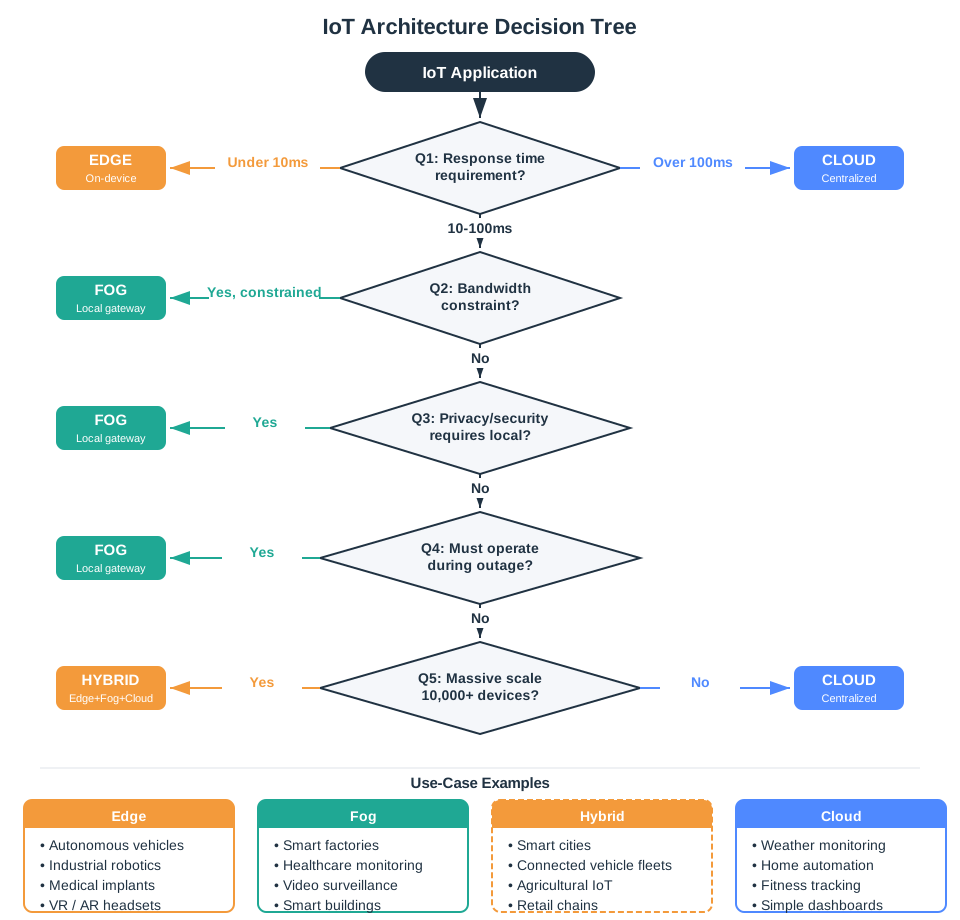
Treat the 10–100 ms branch as an illustrative prompt; measure the actual workload deadline.
- The timing branch is an illustrative prompt.The actual response deadline belongs to the physical workload and site.
- Measure the deadline with the installed path.A generic diagram cannot establish a universal tier threshold.
- Retest when the workload or path changes.Changed sampling, queues, transport, or actuation can change the result.
Major section
Use-Case Placement Map (continued)
The useful question is not "which domain is this?" but "which workload has which constraint?".
- The 10–100 ms branch tests Q2: Bandwidth constraint?, with constrained traffic pointing to FOG; later questions cover local privacy, operation during outage, and massive scale before choosing HYBRID.
- The examples below are illustrations of those branches, so the design decision should preserve the answers rather than copy a domain label.
- Act on immediate sensor context, enforce local safety, filter high-rate data, and keep a defined behavior during upstream outages.
Major section
Pattern 2: Autonomous and Mobile Systems
Immediate perception and control are local; cooperative awareness and route coordination can use nearby infrastructure; fleet learning and compliance reporting can happen later.
- Sensor fusion, obstacle avoidance, stabilization, braking, steering, and emergency fallback should not depend on a cloud response.
- Roadside units, base-station edge nodes, depot gateways, or field stations can coordinate multiple mobile assets and provide local updates.
- Route optimization, model training, policy review, and fleet analytics can use batches, samples, and event evidence after the trip.
Major section
Pattern 3: Privacy-Sensitive Sensing
Cameras, microphones, location traces, health measurements, and building-occupancy streams can expose people.
- Detect, crop, blur, count, classify, or summarize near the sensor so raw sensitive content is not transmitted by default.
- Encryption in transit is necessary but not the same as data minimization.
- If the cloud still receives raw identifiable content, the privacy risk remains.
Major section
Pattern 4: Smart Infrastructure and Buildings
One traffic light can react locally; an intersection controller coordinates approaches; a city platform studies patterns over weeks.
- One room sensor can count occupancy; a building gateway can coordinate HVAC zones; a cloud service can compare energy performance across sites.
- Edge sensors detect local state, fog controllers coordinate corridors or intersections, and cloud analytics plan long-term changes.
- Local alarms and site gateways must keep operating when wide-area connectivity is degraded, with cloud reporting restored when links return.
Major section
Pattern 5: Field, Agriculture, and Remote Operations
Farms, mines, pipelines, offshore sites, and environmental monitoring deployments often have intermittent connectivity, limited power, and large sensing payloads.
- Their edge-fog pattern is less about polished dashboards and more about survivable local behavior.
- Collect batches from field devices, deduplicate readings, schedule uploads, and provide a local operator view.
- Farms and mines are one shape of field deployment.
- Sending that data to the cloud for analysis first is too slow to improve safety and reliability.
Major section
Pattern 5: Field, Agriculture, and Remote Operations (continued)
Pipelines, rail corridors, and wind farms are another: the asset is spread across many kilometers rather than concentrated on one site, so the fog tier's job is covering distance, not just one building.
- Sending all of it to the cloud for analysis and storage is not efficient, and the network latency is not acceptable when a compressor fault needs a fast local response.
- Trackside fog nodes deployed along a rail corridor can analyze track-condition data fast enough to matter for a high-speed train.
- A corridor or farm being "instrumented" does not guarantee reliable backhaul.
Major section
Quantify High-Rate Streams
At 50 cameras × 4 Mbit/s × 86,400 s/day ÷ 8, continuous full-stream upload is 2.16 decimal TB/day.
- The continuous upload example is 2.16 decimal TB/day.This full-day example converts fifty four-megabit camera streams into decimal bytes.
- This is a full-stream upper example.Codec rate, duty cycle, retained samples, and the required evidence change the deployed volume.
- Reduce data only after defining the job.Occupancy counts and queue events can use compact records while approved evidence samples remain reviewable.
Major section
Placement Review Loop
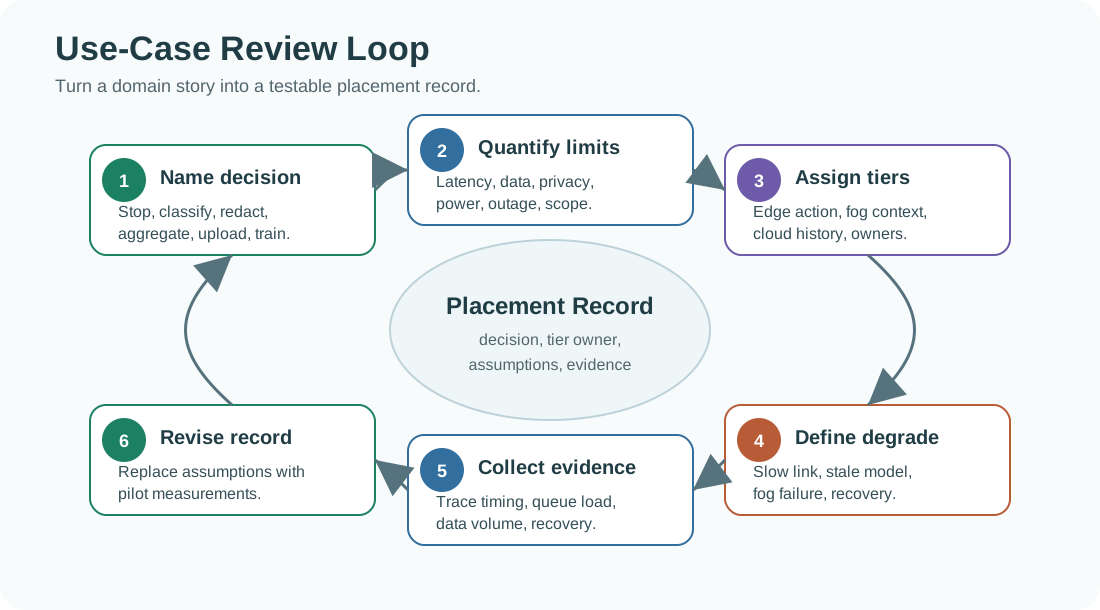
Collect evidence adds timing traces, queue load, data volume, and recovery, and Revise record replaces assumptions with pilot measurements.
- The loop keeps placement tied to observed constraints as the use case evolves.
- A stale record is a hidden architecture risk.
Major section
Worked Example: Site Video Analytics
The business goal is operational analytics, not storing customer video.
- Camera frames are analyzed for occupancy count, queue length, and shelf-gap exceptions.
- The system should avoid transmitting raw customer video except for explicitly approved evidence samples.
- Queue alerts are operationally useful only while the queue still exists.
- Continuous video is a high-volume stream.
Deck summary
Key takeaways
A riverside pump must stop when its intake is blocked.
- This three-part picture is not a rule that every task belongs in one fixed place.
- The same domain can contain edge, fog, and cloud workloads at the same time.
- The useful question is not "which domain is this?" but "which workload has which constraint?".
- Immediate perception and control are local; cooperative awareness and route coordination can use nearby infrastructure; fleet learning and compliance reporting can happen later.
Retrieval practice
Recall check 1 of 6

Edge Eddie says: answer from memory, then check your reasoning.
Q1What should a defensible placement record capture for a new field workload?
Show answer
Answer: A The record links the tier choice to measurable constraints and verification.
Retrieval practice
Recall check 2 of 6
Edge Eddie says: answer from memory, then check your reasoning.
Q2A team says, "This is a smart factory, so everything should run at the edge." What is the best review response?
Show answer
Answer: B Placement follows workload constraints, not the factory label.
Retrieval practice
Recall check 3 of 6
Edge Eddie says: answer from memory, then check your reasoning.
Q3Which task belongs closest to the vehicle rather than at a roadside fog unit or cloud service?
Show answer
Answer: B Immediate control must remain on the vehicle because it depends on current physical context and cannot wait for a network path.
Retrieval practice
Recall check 4 of 6
Edge Eddie says: answer from memory, then check your reasoning.
Q4A 50-camera site would need to upload roughly 2.1 TB/day if every 4 Mbit/s camera stream were sent continuously to the cloud. The approved uplink cannot sustain that raw rate, but operators still need site event coordination, cloud history, and model review. What is the stronger edge-fog placement?
Show answer
Answer: A High-rate streams should be quantified.
Retrieval practice
Recall check 5 of 6
Edge Eddie says: answer from memory, then check your reasoning.
Q5A factory stop loop and a clinic image review both benefit from local work. Why may they choose different placements?
Show answer
Answer: C Placement follows each action’s measured response, data, and trust needs.
Retrieval practice
Recall check 6 of 6
Edge Eddie says: answer from memory, then check your reasoning.
Q6A camera sends raw identifiable video to the cloud over an encrypted link. The team claims the design minimizes private data. What is missing?
Show answer
Answer: B Encryption protects transit, while minimization limits what leaves the site.
Print reference
Answers
Answer key.
- A · The record links the tier choice to measurable constraints and verification.
- B · Placement follows workload constraints, not the factory label.
- B · Immediate control must remain on the vehicle because it depends on current physical context and cannot wait for a network path.
- A · High-rate streams should be quantified.
- C · Placement follows each action’s measured response, data, and trust needs.
- B · Encryption protects transit, while minimization limits what leaves the site.