Edge & Fog Computing · Study deck
Edge-Fog Use Cases: Decision Framework
A site may need a millisecond local stop and a monthly cloud report from the same data.
Edge Eddie is your guide for this deck.

After studying this chapter
Learning objectives
You will be able to:
- Choose edge, fog, or cloud placement from explicit constraints.
- Record the trigger that would force a placement review.
- State a placement decision as a workload claim, not a whole-system slogan.
- Compare edge, fog, cloud, and split ownership by response, data, trust, connectivity, resources, and operations constraints.
Major section
Choosing Edge, Fog, or Cloud
A site may need a local stop within milliseconds and a monthly cloud report from the same data.
- Placement means choosing where each job runs.
- The chosen tier has not earned its role unless degraded behavior is explicit.
- A protocol means an agreed set of rules for exchanging information.
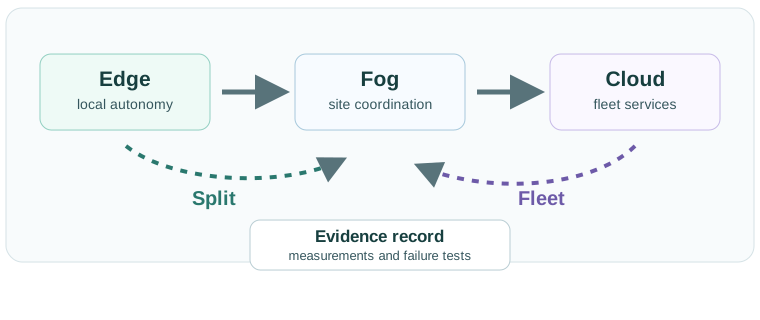
- Edge fits immediate local action.
Major section
Choosing Edge, Fog, or Cloud (continued)
The deeper framework compares timing, privacy, data capacity, cost, governance, support, and retest triggers.
- Edge, fog, and cloud are placement choices for one workload at a time.
- Fog fits site coordination, protocol translation, buffering, aggregation, and local operator context.
- Cloud fits fleet history, governance, analytics, audit, and cross-site comparison.
- A useful failure drill is concrete.
Major section
Choosing Edge, Fog, or Cloud (continued)
Long-term water-use reporting can still live in the cloud.
- The core question is where that workload can be correct, timely, private, and supportable.
- Everyday IoT placement is not a vote for edge, fog, or cloud in general; it is a record for this one job.
- The hard part is proving the boundaries between tiers.
Major section
Choosing Edge, Fog, or Cloud (continued)
The same workload may point to different tiers as the constraints change.
- “Send the decision, not the raw feed — the edge earns its keep in milliseconds and megabytes saved.”.
- A tier choice is credible only when the normal path and the degraded path are both named.
- A single successful path test is not a latency budget.
Major section
Choosing Edge, Fog, or Cloud (continued)
If the design cannot say what continues, what stops safely, what queues, what drops, and what remains explainable, the placement decision is not finished.
- The Split path connects those roles instead of forcing the whole workload into one tier, and the Evidence record captures measurements and failure tests for the chosen division.
- The map therefore turns verbs such as infer, buffer, aggregate, and train into separate ownership claims that can be checked when requirements change.
- A fog gateway may compare nearby pumps, soil sensors, and weather readings to detect site anomalies.
- The hard part of placement is not choosing a tier name.
Major section
Choosing Edge, Fog, or Cloud (continued)
Use each branch value as a prompt for site measurements, then test what continues, stops, queues, or replays.
- Treat the decision tree as a first pass.Its branches organize evidence but do not replace site measurements.
- Measure timing, privacy, capacity, outage, and support constraints.Those workload conditions determine whether a tier can meet its operating promise.
- Test what continues, stops, queues, and replays.The failure boundary decides whether the proposed placement remains useful.
Major section
Concept Relationships
A domain example becomes useful only when it names the constraint that drives placement.
- Edge placement is strongest when local context, safety, outage behavior, or raw data rate makes remote processing unsuitable.
- Fog placement is strongest when several edge devices need shared policy, aggregation, buffering, or site-level context.
- Cloud placement is strongest when the work needs cross-site history, model training, governance, reporting, or slow analytics.
Deck summary
Key takeaways
A site may need a local stop within milliseconds and a monthly cloud report from the same data.
- The deeper framework compares timing, privacy, data capacity, cost, governance, support, and retest triggers.
- Long-term water-use reporting can still live in the cloud.
- The same workload may point to different tiers as the constraints change.
- If the design cannot say what continues, what stops safely, what queues, what drops, and what remains explainable, the placement decision is not finished.
Retrieval practice
Recall check 1 of 3
Edge Eddie says: answer from memory, then check your reasoning.
Q1Which placement claim is most reviewable for an IoT workload?
Show answer
Answer: C A useful placement decision is a workload-level claim supported by constraints, evidence, ownership, and retest conditions.
Retrieval practice
Recall check 2 of 3
Edge Eddie says: answer from memory, then check your reasoning.
Q2A team wants to justify placing a local anomaly alert in a fog gateway. Which record makes that decision easiest to review later?
Show answer
Answer: B A placement record should make the chosen tier, rejected alternatives, proof, degraded behavior, and ownership visible.
Retrieval practice
Recall check 3 of 3
Edge Eddie says: answer from memory, then check your reasoning.
Q3Why should an edge-fog-cloud placement review include failure-boundary tests?
Show answer
Answer: B Boundary tests reveal whether response, state, management, fallback, and evidence ownership still work when a tier or path degrades.
Print reference
Answers
Answer key.
- C · A useful placement decision is a workload-level claim supported by constraints, evidence, ownership, and retest conditions.
- B · A placement record should make the chosen tier, rejected alternatives, proof, degraded behavior, and ownership visible.
- B · Boundary tests reveal whether response, state, management, fallback, and evidence ownership still work when a tier or path degrades.