Edge & Fog Computing · Study deck
Edge-Fog Use Cases: Bandwidth Optimization
A camera can fill an uplink long before its gateway runs out of compute.
Edge Eddie is your guide for this deck.

After studying this chapter
Learning objectives
You will be able to:
- Match use cases to latency, privacy, resilience, and bandwidth drivers.
- Calculate the uplink reduction from filtering or aggregation at the edge.
- Explain why bandwidth optimization is an evidence-budget decision, not only a byte-count decision.
- Identify which data belongs at the edge, fog tier, and cloud after filtering or batching.
Major section
Common Mistakes
A single fog node can become a bottleneck or single point of failure.
- A camera can fill an uplink, the path that sends data away from the site, before its gateway, the device joining networks, runs out of compute capacity, or room to process data.
- The placement guard must reject unsafe choices.
- Capacity, zoning, redundancy, and failover must be explicit.
Major section
Common Mistakes (continued)
It must also show what edge reduction, or sending only selected or compressed results after processing near the camera, saves.
- Saying "factory means edge" or "city means cloud" skips the actual placement work.
- Remote analytics can advise, but immediate safety, protection, and actuation need a local behavior that survives upstream delay or outage.
- Encrypting raw sensitive data before cloud upload still leaves the cloud processing sensitive data.
Major section
Bandwidth Optimization at the Edge
Bandwidth means the amount of data a link can carry in a given time.
- A gateway is a device that passes data between different networks.
- When its link is slow or costly, the gateway cannot send every reading at once.
- The first question is which decision each piece of data supports.
- A summary may erase the exception.
Major section
Bandwidth Optimization at the Edge (continued)
The local system must still send urgent events, mark stale data, and keep enough detail to explain failures.
- Everyday IoT bandwidth design separates urgent facts from useful history and disposable chatter.
- “Send the decision, not the raw feed — the edge earns its keep in milliseconds and megabytes saved.”.
- A queue may replay stale records as fresh.
Major section
Bandwidth Optimization at the Edge (continued)
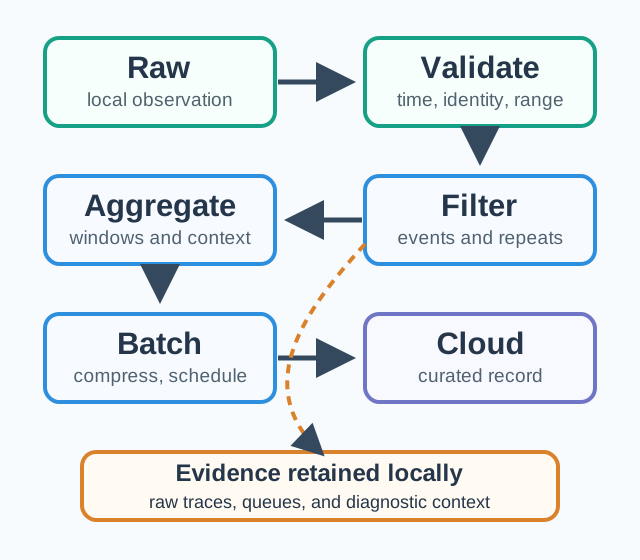
Beneath that path, Evidence retained locally preserves raw traces, queues, and diagnostic context.
- Here Eddie audits the narrow uplink byte by byte: what the gateway decides locally, what truly needs to travel, and what each saving must still prove.
- The bandwidth saving is not the decision by itself.
- A compression step may drop diagnostic detail.
Major section
Bandwidth Optimization at the Edge (continued)
The two outputs matter together: the upstream record limits bandwidth, while the local evidence keeps anomaly and failure claims auditable.
- Routine summaries can flow to the cloud, but alarms, command acknowledgements, loss markers, delayed uploads, and local diagnostic detail need explicit handling.
- For example, a cold-chain gateway might sample temperature every few seconds but upload a five-minute summary during normal operation.
- Owner: who maintains thresholds, queues, storage limits, dashboards, recovery actions, and cloud contracts.
Major section
Bandwidth Optimization at the Edge (continued)
A fog buffer may protect telemetry while starving commands.
- The accepted design is the evidence boundary: routine summaries can support fleet dashboards, while alarms, audit trails, and recovery records need stronger freshness and retention guarantees.
- If you only need the intuition, this layer is enough: reduce traffic only after naming the decision, freshness need, retained evidence, priority rule, backpressure behavior, owner, known limit, and retest trigger.
- Backpressure is the key under-the-hood behavior.
Major section
Bandwidth Optimization at the Edge (continued)
Sensor firmware, validation threshold, sampling rate, device identity, time source, or diagnostic display changes.
- Edge Reduces NoiseValidate readings, reject impossible values, mark missing or stale inputs, and keep local context before sending routine telemetry upstream.
- Fog Adds Site MeaningAggregate nearby devices, prioritize events, batch routine records, and buffer evidence when the upstream path is weak or unavailable.
- Application claim, event threshold, feature recipe, model artifact, window boundary, or dashboard decision changes.
Major section
Bandwidth Optimization at the Edge (continued)
Protocol, backhaul path, queue limit, message priority, gateway firmware, update policy, or command workload changes.
- Cloud Keeps Fleet MemoryReceive the records needed for dashboards, long-term history, model improvement, compliance, rollout policy, and cross-site comparison.
- Optimization Has LimitsFiltering, compression, batching, and summarization can hide rare events, local extremes, fault context, or forensic detail if approved blindly.
- Local storage limit, replay order, loss marker, backpressure behavior, cloud acceptance, ownership, and support procedure.
Major section
Bandwidth Optimization at the Edge (continued)
A bandwidth decision record shows which data is reduced, where the reduction happens, what evidence remains available, how urgent traffic is protected, and which change reopens the review.
- Window length, input set, summary meaning, exception rule, model version, confidence, and what detail operators can no longer infer.
- Data is buffered but replayed late, duplicated, out of order, or without a visible loss boundary.
- Storage size, outage duration assumption, cloud contract, privacy policy, service owner, or recovery procedure changes.
- Telemetry summaries, diagnostics, model traces, firmware downloads, command acknowledgements, and incident records may all share one link.
Major section
Bandwidth Optimization at the Edge (continued)
The design should state which traffic wins when capacity is tight and what lower-priority evidence is retained locally.
- Bandwidth decision record template Decision claim: what cloud, fog, or edge decision the optimized data supports.
- Retest trigger: the exact sensor, sampling, threshold, model, gateway, protocol, backhaul, privacy, dashboard, or application change that reopens review.
- They appear when a reduction boundary changes the meaning, timing, order, custody, or priority of the data.
Major section
Bandwidth Optimization at the Edge (continued)
Meaning BoundaryFiltering and aggregation should state what detail is lost, which exceptions bypass the reduction, and which decisions remain valid.
- Timing BoundaryBatching, retry, backoff, and replay should mark freshness, expiry, and ordering so late records are not mistaken for current state.
- Custody BoundaryLocal retention should preserve source, timestamp, sequence, quality flags, owner, loss markers, and cloud acceptance state.
- Priority BoundaryAlerts, commands, acknowledgements, updates, diagnostics, and routine telemetry need an explicit order when the uplink is constrained.
- The rule is to make every reduction reversible in review even when it is not reversible in data.
Major section
Bandwidth Optimization at the Edge (continued)
Without that visible policy, the cloud may treat a delayed replay as current plant state or miss that lower-priority records were discarded.
- When upload capacity is lower than production rate, the system must decide whether to slow sampling, summarize, drop low-priority records, retain locally, escalate an alarm, or narrow the accepted claim.
- If the raw detail is gone, the record should still show what was reduced, why it was acceptable, what exception path exists, and what field change forces a retest.
- The accepted record should tie reduction rules, priority, retention, replay, owner, known limit, and retest trigger to the decision being supported.
Deck summary
Key takeaways
A single fog node can become a bottleneck or single point of failure.
- It must also show what edge reduction, or sending only selected or compressed results after processing near the camera, saves.
- Bandwidth means the amount of data a link can carry in a given time.
- The local system must still send urgent events, mark stale data, and keep enough detail to explain failures.
- Beneath that path, Evidence retained locally preserves raw traces, queues, and diagnostic context.
Retrieval practice
Recall checks 1 and 2 · Questions 1 and 2

Edge Eddie says: answer from memory, then check your reasoning.
Q1What combines nearby device context without a wide-area round trip?
Show answer
Answer: C Nearby device context can be combined without paying a wide-area round trip.
Q2Complete the placement guard so local action stays at the edge, site context uses fog, and history uses cloud.
Show answer
Answer: A Immediate actuation belongs at the edge.
Retrieval practice
Recall check 2 of 5
Edge Eddie says: answer from memory, then check your reasoning.
Q3Before adding edge filtering to reduce uplink traffic, what should the design review define first?
Show answer
Answer: B Bandwidth optimization should preserve the evidence needed by the accepted edge, fog, and cloud responsibilities.
Retrieval practice
Recall check 3 of 5
Edge Eddie says: answer from memory, then check your reasoning.
Q4What high-volume evidence exists before local filtering or compression?
Show answer
Answer: C It is the high-volume evidence before any local reduction.
Retrieval practice
Recall check 4 of 5
Edge Eddie says: answer from memory, then check your reasoning.
Q5A fog gateway stores records during an outage and uploads them later, but the cloud dashboard does not mark delayed, dropped, duplicated, or replayed data. What is the best under-the-hood response?
Show answer
Answer: C Bandwidth optimization must preserve enough metadata to keep delayed, reduced, and replayed evidence reviewable.
Retrieval practice
Recall check 5 of 5
Edge Eddie says: answer from memory, then check your reasoning.
Q6A gateway creates records faster than it can upload them. What rule must be explicit?
Show answer
Answer: A Backpressure policy prevents silent queues from turning old data into false current state.
Print reference
Answers 1 of 2
Answer key.
- C · Nearby device context can be combined without paying a wide-area round trip.
- A · Immediate actuation belongs at the edge.
- B · Bandwidth optimization should preserve the evidence needed by the accepted edge, fog, and cloud responsibilities.
- C · It is the high-volume evidence before any local reduction.
Print reference
Answers 2 of 2
Answer key.
- C · Bandwidth optimization must preserve enough metadata to keep delayed, reduced, and replayed evidence reviewable.
- A · Backpressure policy prevents silent queues from turning old data into false current state.