Edge & Fog Computing · Study deck

Operational Failure Modes

Picture a site that loses its upstream link, fills a queue, and then sends old commands after reconnection.

Edge Eddie is your guide for this deck.

Edge Eddie, the module guide, in a scene from this chapter.
iotclass.org

After studying this chapter

Learning objectives

You will be able to:

  • Identify eight practical failure modes in edge and fog computing deployments.
  • Explain why retry storms, missing local buffers, and weak failover damage production systems.
  • Design retry, buffering, clock, and management controls that preserve local service during disruption.
  • Write a pitfall review record that captures symptoms, owner, mitigation, and verification evidence.
iotclass.org

Major section

In 60 Seconds

Local operation is safe only when degraded behavior and recovery order are explicit.

  • A gateway means the boundary system that joins local devices to another network or service.
  • Edge and fog deployments fail when teams treat local infrastructure as a small cloud instead of a distributed system with physical constraints.
  • The common failure modes are unclear decision ownership, synchronized retries, weak buffering, untested failover, drifting clocks, unmanaged devices, exposed trust boundaries, and cloud-only observability.
iotclass.org

Major section

Why Edge-Fog Pitfalls Are Different

Cloud-only systems can often centralize failure handling.

  • Edge and fog systems cannot.
  • A device may be in a vehicle, factory cell, clinic, farm field, building closet, or roadside cabinet.
  • The system may need to keep acting while the cloud link is down, while a fog node is rebooting, or while a certificate update is rolling out across only part of the fleet.
iotclass.org

Major section

Pitfall Map

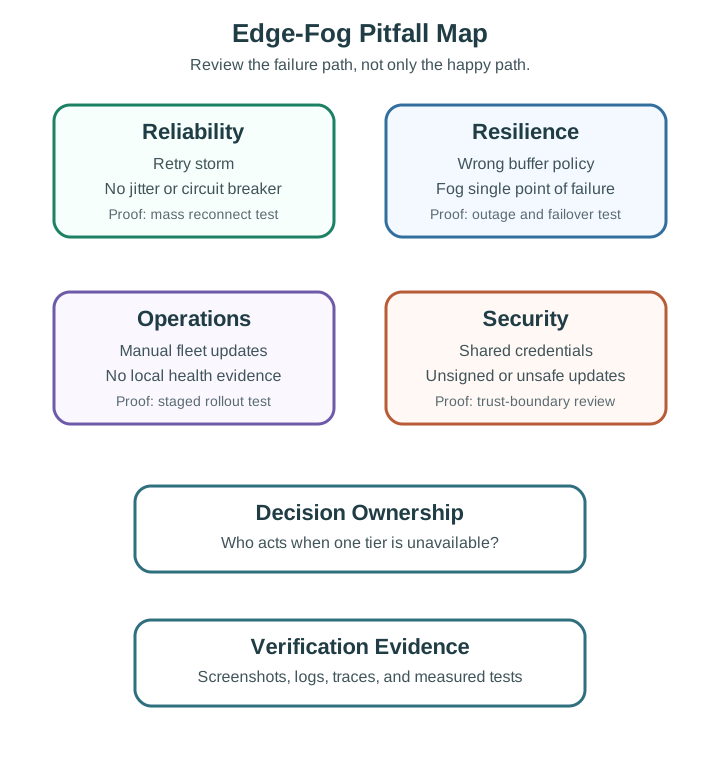
The final Decision Ownership and Verification Evidence boxes require an owner plus logs, traces, screenshots, or measurements for each failure path.

  • It should also name the owner, the mitigation, and the test evidence.
Edge-fog pitfall map.
iotclass.org

Major section

Failure Contract Drill

For one critical workload, name the degraded states before the design review ends: slow, unreachable, stale, overloaded, compromised, and updating.

  • A named failure mode can become a bounded design.
  • An unnamed failure mode becomes an outage.
  • Paper ownership is not enough.
  • Which tier can command actuators, reject unsafe states, or make local decisions without waiting upstream.
iotclass.org

Major section

Pitfall 2: Retry Logic Creates a Recovery Storm

Retries are necessary, but identical retry schedules can create a second outage.

  • If 10,000 devices reconnect at the same deterministic intervals, a fog broker that just recovered can be overloaded again by the recovery traffic.
  • Full jitter means the retry is sampled from the whole current backoff window.
  • Equal jitter keeps a minimum delay and samples from only the upper half of the window.

Key terms

Either
Either is better than no jitter, but a large fleet usually needs maximum spreading during mass recovery.
iotclass.org

Major section

Pitfall 3: The Buffer Preserves the Wrong Data

A local buffer is not enough.

  • It needs a retention policy.
  • During a long disconnection, raw telemetry can fill a queue and evict the alerts that operators need most.
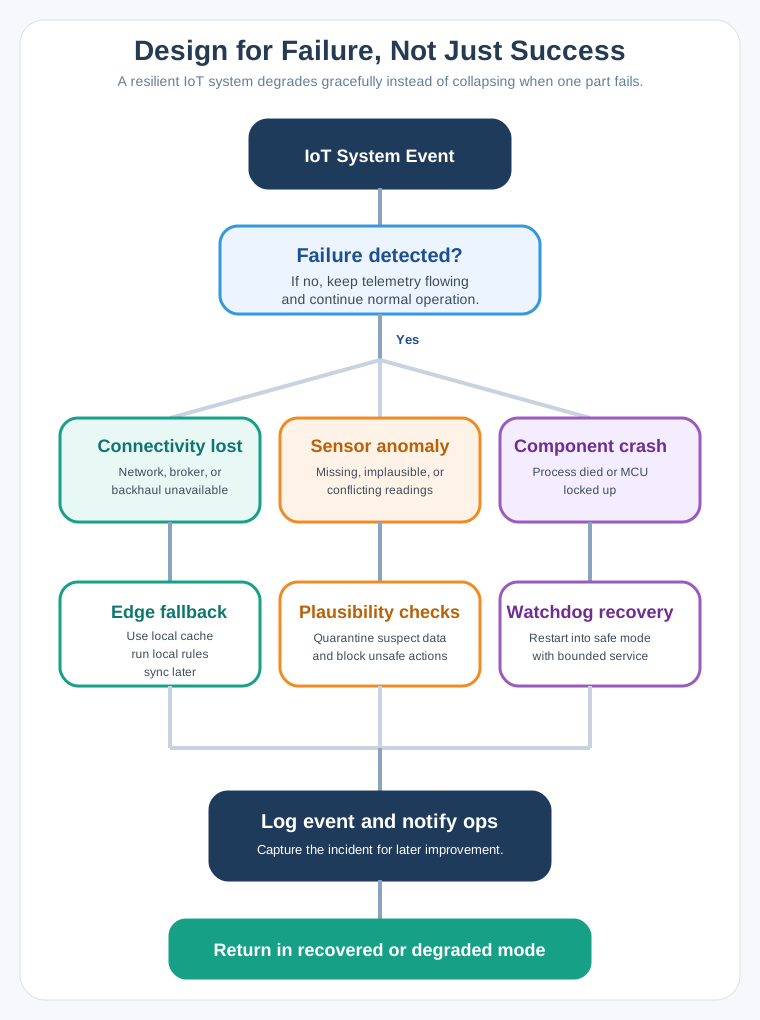
  • Every branch reaches Log event and notify ops.

Why it matters

A buffer policy should be judged inside the wider failure response, because retaining the wrong records can undermine recovery even when storage itself works. @fig-edge-fog-resilience-loop shows where prioritisation and quarantine belong.

Designing for failure: an IoT system detects connectivity loss, sensor anomalies, or component crashes and routes each to a graceful recovery action such as edge fallback or local caching.
iotclass.org

Major section

Pitfall 4: Clock Discipline Is Treated as Optional

Edge and fog logs are useful only when events can be ordered.

  • Cheap oscillators drift, devices reboot without network time, and gateways may receive delayed batches after connectivity returns.
  • Whether the device clock was synchronized, estimated, stale, or unknown.
  • A monotonic counter that helps order records when wall-clock time is suspect.
iotclass.org

Major section

Pitfall 5: The Fog Layer Becomes a Hidden Single Point of Failure

A fog node often starts as a convenient local gateway.

  • If all devices depend on one node and no degraded mode exists, the site has not gained resilience.
  • One node owns traffic while a second receives health and state.
  • Good when a short failover pause is acceptable.

Key terms

Good when failover pause
Good when failover pause is not acceptable, but state conflict rules must be explicit.
iotclass.org

Major section

Pitfall 6: Fleet Management Is Added After Deployment

Small pilots can be managed manually.

  • Production fleets cannot.
  • Once devices are distributed, each update, credential rotation, configuration change, and rollback becomes an operational path.
  • Identity: Each device, gateway, and service has a unique identity and a documented owner.
  • Health: Each node reports version, configuration hash, uptime, resource pressure, and last successful sync.
iotclass.org

Deck summary

Key takeaways

Local operation is safe only when degraded behavior and recovery order are explicit.

  • Cloud-only systems can often centralize failure handling.
  • The final Decision Ownership and Verification Evidence boxes require an owner plus logs, traces, screenshots, or measurements for each failure path.
  • For one critical workload, name the degraded states before the design review ends: slow, unreachable, stale, overloaded, compromised, and updating.
  • Retries are necessary, but identical retry schedules can create a second outage.
iotclass.org

Retrieval practice

Recall check 1 of 5

Edge Eddie says: answer from memory, then check your reasoning.

Q1A cold-chain gateway normally approves compressor commands, but truck sensors must protect cargo while the gateway is rebooting. What is the safest ownership pattern?

ALet the cloud approve every compressor command because its history is complete, even if WAN or gateway reboot delays the response
BGive the edge controller a bounded local protection rule and send evidence to the gateway when it returns
CDisable all local compressor action until the gateway finishes rebooting, even if cargo temperature crosses the safe bound
DStore each compressor command and replay it later as if delayed physical-control commands were still current
Show answer

Answer: B The edge controller can own the immediate safe response, while the fog gateway and cloud still receive evidence for review and fleet learning.

iotclass.org

Retrieval practice

Recall check 2 of 5

Edge Eddie says: answer from memory, then check your reasoning.

Q2A site buffer holds one hour of raw vibration samples. A two-hour network outage happens, and the same buffer is also used for fault alarms. What is the main design risk?

AThe device will automatically compress the first hour, preserve every alarm, and recover the missing samples without priority rules
BLow-value raw samples may evict high-value alarms unless priority and durable retention are designed explicitly
CThe cloud can reconstruct every missing raw sample after reconnect, even if it was never retained or transmitted
DThe problem is only a visual dashboard delay, not loss of evidence or overwrite of urgent fault records
Show answer

Answer: B A resilient design separates priority classes, preserves alarms first, and defines what routine telemetry can be dropped or aggregated.

iotclass.org

Retrieval practice

Recall check 3 of 5

Edge Eddie says: answer from memory, then check your reasoning.

Q3A production cell requires a local reject decision before a part leaves the inspection station. The fog node can fail over to a standby node in 20 seconds. What should the review flag?

AThe failover is always adequate because a local standby is present, even though the physical line needs decisions immediately
BThe design needs active-active processing or an edge-side fallback rule because the 20-second gap can miss parts
CThe cloud should replay missing reject decisions after the line resumes, even when the affected parts have already moved on
DThe issue is only dashboard visibility, not the continuity of the local control path for parts leaving the station
Show answer

Answer: B For an immediate reject decision, a 20-second service gap is a process failure unless local fallback or near-zero failover is provided.

iotclass.org

Retrieval practice

Recall check 4 of 5

Edge Eddie says: answer from memory, then check your reasoning.

Q4Place each recovery control where it lives so you can diagnose whether a failure should be contained locally, coordinated on site, or reconciled in the cloud.

AEdge Fallback
BFog Failover
CManagement Channel
DCloud Reconciliation
Show answer

Answer: A Place controls at their true recovery boundary so you can separate device safety, site continuity, operational governance, and trustworthy cloud history.

Q5Complete the retry helper so a recovering fog broker is not hit by synchronized retries.

Afor attempt in range(attempts):
Bfor attempt in attempts:
Cwhile attempt in attempts:
Dfor attempt in range(cap_s):
Show answer

Answer: A The loop caps the exponential window and samples a random delay from the whole window.

iotclass.org

Retrieval practice

Recall check 5 of 5

Edge Eddie says: answer from memory, then check your reasoning.

Q6A review finds that every device reports only to the cloud dashboard. There is no local queue-depth metric, no last-sync timestamp, and no retry-state report from the fog node. Which pitfall is most likely?

AObservability ends at the cloud dashboard
BThe buffer has too much capacity
CThe clock is too accurate
DThe cloud has too many users
Show answer

Answer: A The system cannot diagnose local failure modes if local health and retry state are visible only after successful cloud upload.

iotclass.org

Print reference

Answers 1 of 2

Answer key.

  1. B · The edge controller can own the immediate safe response, while the fog gateway and cloud still receive evidence for review and fleet learning.
  2. B · A resilient design separates priority classes, preserves alarms first, and defines what routine telemetry can be dropped or aggregated.
  3. B · For an immediate reject decision, a 20-second service gap is a process failure unless local fallback or near-zero failover is provided.
iotclass.org

Print reference

Answers 2 of 2

Answer key.

  1. A · Place controls at their true recovery boundary so you can separate device safety, site continuity, operational governance, and trustworthy cloud history.
  2. A · The loop caps the exponential window and samples a random delay from the whole window.
  3. A · The system cannot diagnose local failure modes if local health and retry state are visible only after successful cloud upload.
iotclass.org