Edge & Fog Computing · Study deck

Edge, Fog, and Cloud: Architecture

Picture a cold store with door sensors.

Edge Eddie is your guide for this deck.

cloud
Edge Fog Cloud Architecture cover: Eddie balancing workload tokens across edge device, fog node, and cloud architecture blocks.
iotclass.org

After studying this chapter

Learning objectives

Place each workload where its timing, evidence, and recovery requirements can be met.

  • Edge owns immediate physical behaviour, while fog coordinates nearby work.The cold-store alarm must respond locally, while a site computer can combine readings and apply rules across several rooms.
  • Cloud supports fleet history, governance, analytics, and rollout policy.The central service can compare many sites across a year without becoming the required approval point for every immediate local action.
  • Telemetry, commands, management, and recovery need separate ownership.An upward record, downward action, policy update, and outage replay have different authority, timeout, and evidence requirements.
  • Workload placement needs evidence from degraded-path tests.Slow links, full storage, repeated data, clock error, site loss, and recovery must challenge the chosen tier’s operating promise.

I am placing the cold store’s local alarm, shared room readings, and longer fleet history. I need each workload to have an owner and a useful response when the outside connection disappears.

iotclass.org

Major section

In 60 Seconds · Start Simple

Start with the local action, the site’s shared work, and the longer fleet record.

  • The cold-store alarm needs a response that survives an outside outage.Urgent safe action must stay where the missing WAN cannot block the physical warning the site requires.
  • The nearby site computer can combine readings from several rooms.Fog responsibility includes shared rules, short local history, coordination, buffering, and degraded service during the outage.
  • The central service owns the longer cross-site record.Fleet comparisons, reports, central learning, and rollout policy belong to a broader scope than the immediate local warning.
  • Each boundary needs a crossing contract and a failure owner.Source time, quality, rule version, and a path back to the decision must remain available after each handoff.

I am in a cold store whose outside connection has failed. I expect the local warning to remain useful while the site keeps its records for the central service to review after recovery.

iotclass.org

Major section

Architecture Is Owned Paths · Write the Architecture Record
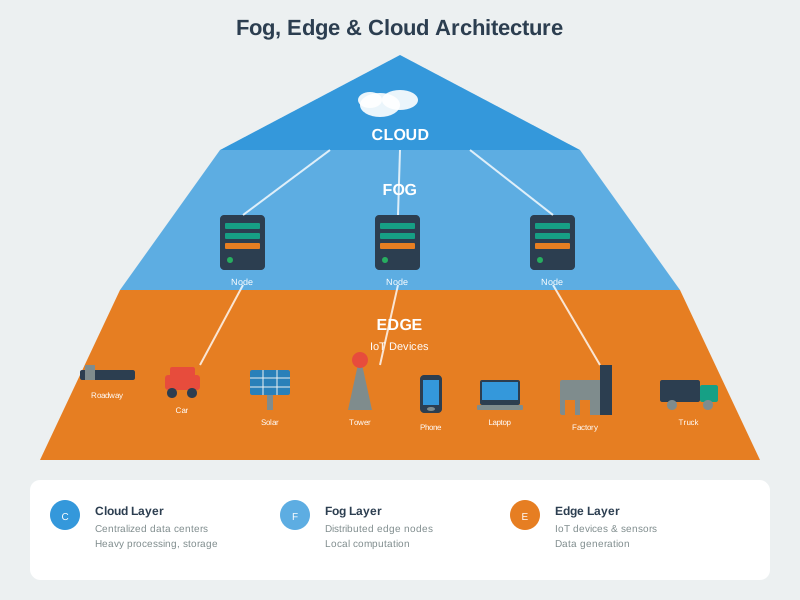
Follow the EDGE band through nearby FOG nodes to CLOUD, assigning responsibility at each tier.

  • The bottom EDGE band has devices with physical observations and actions.Cars, phones, roadway equipment, and factories are sources of data, while immediate local safety needs an explicit owner near the process.
  • Nearby FOG nodes provide local computation, coordination, and buffering.The cold-chain gateway can aggregate rooms, preserve alarm continuity, and hold records while the WAN is unavailable.
  • The CLOUD layer owns central processing and longer fleet storage.Summaries and retained evidence can support cross-site review without making every local response wait for a remote decision.
  • Returning commands need acknowledgement, timeout, and fallback owners.The same tier map must distinguish commands from telemetry and management updates because physical authority differs from record delivery.
Fog, edge, and cloud architecture: edge IoT devices connect through fog nodes to the cloud layer, each tier owning distinct sensing, coordination, and fleet-service roles.
iotclass.org

Activity 1 · Draw it

✎ Separate the paths

I want you to draw who owns the alarm when the outside connection fails.

Sketch edge, fog, and cloud for the cold store. Draw telemetry upward and commands downward. Add a management path for policy updates. Cross out the WAN link and label the local alarm owner, buffer, and recovery path.

4 minutes · Pen and paper · Answer: Activity 1

Your answer
iotclass.org

Major section

Translation, replay, and version boundaries

Protocol translation must preserve meaning, authority, and evidence across an outage.

  • Unit normalisation must preserve timing, synchronisation, quality, and source identity.The water-station gateway needs a reviewable record contract when it translates local device readings into fleet events.
  • Buffered telemetry needs replay rules for event and arrival time.The chapter’s 12,000-record backlog can arrive out of order with live data unless the gateway marks replay state and quality.
  • Old commands must expire instead of replaying like historical readings.A delayed pump instruction can affect physical equipment, so its acceptance rule must differ from the storage rule for old telemetry.
  • Adapter, policy, and firmware versions need visible rollback boundaries.A failed certificate or model update must have a rollback rule rather than leaving recovery hidden behind a successful telemetry path.

I am reviewing the remote water-monitoring gateway after a WAN outage. I keep the original timing and quality on replayed records, expire old pump commands, and check the visible version and rollback path for failed updates.

iotclass.org

Major section

Edge, Fog, and Cloud: The Three Tiers

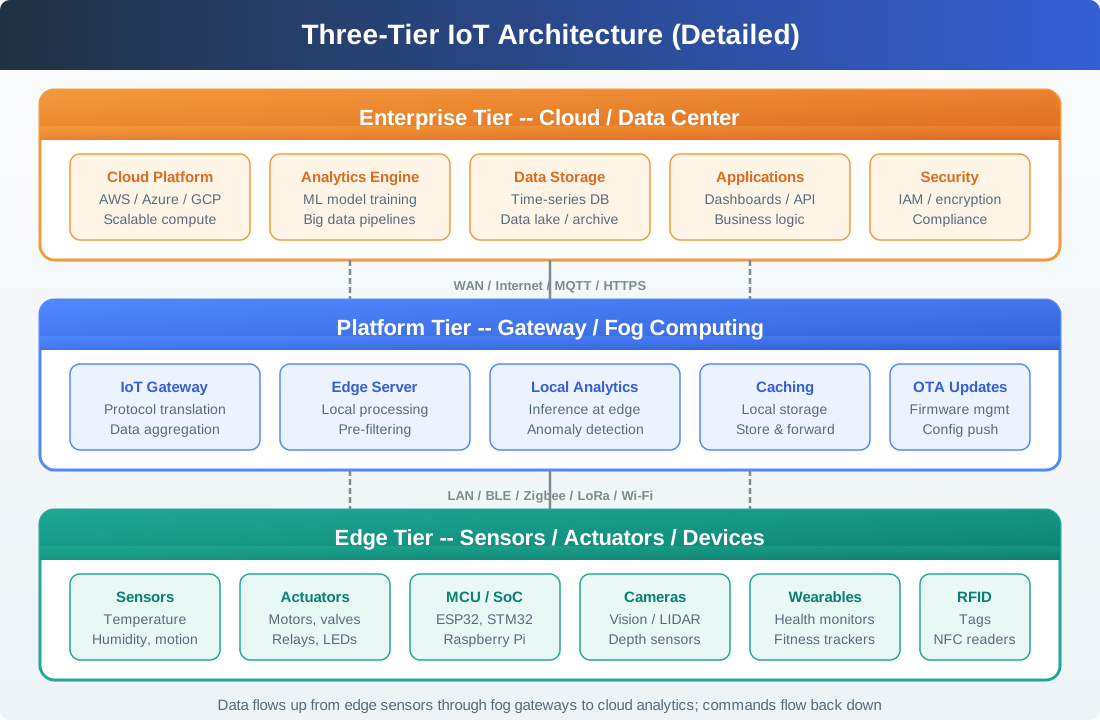
Read upward from Device Tier through Gateway / Fog to Enterprise Tier to compare responsibilities.

  • The Device Tier has sensors and actuators connected through local links.LAN and PAN paths carry physical observations and actions before the diagram reaches gateway or enterprise responsibilities.
  • Gateway and fog services own translation, filtering, inference, and caching.The middle tier can coordinate nearby workloads and OTA delivery while retaining local evidence and rules.
  • The Enterprise Tier has training, storage, dashboards, and identity governance.Cloud compute and long-term records support fleet analysis, model training, and broader compliance responsibilities.
  • Fleet services cannot establish dependable immediate response by themselves.The local workload still needs timing, authority, fallback, and recovery evidence even when the cloud tier has ample processing capacity.
Three-tier IoT architecture roles
iotclass.org

Major section

Workload scope and the failure it must survive

Choose placement by the scope of the work and the failure it must survive.

  • Edge can own filtering, safety interlocks, and first response beside equipment.The dock sensor can handle noisy events locally when an outside outage must not prevent its immediate behaviour.
  • Fog can own shared site views, aggregation, bridging, and outage buffers.A nearby gateway can coordinate multiple devices and maintain local policy when remote services become unavailable.
  • Cloud can own cross-site reporting, training, history, and governed updates.Those workloads need fleet scope rather than placing every device’s time-critical decision on a remote round trip.
  • Placement also needs support, monitoring, update, and recovery ownership.A tier that works in a demonstration may still fail the operating requirement if nobody can patch, observe, or restore its workload.

I am assigning the warehouse dock sensor’s noisy-event filtering and the site’s shared alerts. I keep first response near the equipment, coordinate nearby work at fog, and send curated history for fleet analysis.

iotclass.org

Major section

The pump’s 235 ms and 29 ms response paths

A shorter control path can remove network delays without accelerating the sensor itself.

  • The measured cloud example has a 235 ms total.The chapter’s sensing, uplink, cloud-work, and return terms are 18 + 85 + 42 + 90 ms for this pump path.
  • The local example has a 29 ms total.The same 18 ms sensing time combines with 4 ms gateway evaluation and a 7 ms fieldbus command.
  • Local placement can remove remote transit and queueing from the deadline.The architecture does not speed up sensing; it removes WAN and remote-service terms when the gateway holds the required rule and state.
  • Asynchronous upload can preserve fleet evidence after the local decision.The gateway still needs the event, raw window, decision version, acknowledgement, and explicit local safety checks in its record.

I am timing the chapter’s pump-protection path with its authenticated cutoff rule and actuator interlock. I compare the cloud round trip with local rule evaluation, then keep fleet evidence upload outside the protection deadline.

iotclass.org

Activity 2 · Predict

✎ Break the WAN link

I want you to predict the local action and the cloud evidence separately.

The pump gateway holds an authenticated cutoff rule and actuator interlock. On paper, predict what happens to protection and fleet records when the WAN fails. Name the evidence and policy checks needed when connectivity returns.

3 minutes · Pen and paper · Answer: Activity 2

Your answer
iotclass.org

Major section

Timing markers and slow-case evidence

Timing evidence must include the slow cases and the return path to the actuator.

  • Timing evidence needs the physical event and validated-sample markers.Sensor dynamics, conversion scheduling, firmware queues, and debounce can affect the first interval even after the decision moves locally.
  • The record must continue through cloud decision and physical acknowledgement.Cloud ingress, decision completion, command receipt, and the final response establish the outbound and return path costs.
  • Weak radio, WAN loss, and cloud overload need repeated measurements.Retries, backhaul, queues, and service load can create long tails, so an average alone cannot establish the protection deadline.
  • A dependable local loop needs bounded queues and tested fallback.Policy-version custody and evidence reconciliation after connectivity returns must accompany the shorter measured response path.

I am tracing the pump event from physical change to actuator acknowledgement. I repeat the same timing record under weak radio, WAN loss, and cloud overload to test the slow cases as well as the nominal path.

iotclass.org

Major section

The workload placement record

Write a placement record that another operator can test and maintain.

  • The record must name behaviour before the product or tier.Filtering readings, raising an alarm, coordinating a site, storing history, and delivering updates can require different placements in the same system.
  • Each workload needs timing, privacy, bandwidth, reliability, power, and support constraints.A preferred tier cannot establish fit without the measured or testable requirement that makes the workload useful.
  • The normal and degraded paths need a named operating owner.The greenhouse fan must have defined action and retained evidence when the upstream link is healthy, slow, or absent.
  • Placement evidence needs a measurement, rollback rule, and retest trigger.Another operator must be able to monitor, update, recover, and revisit the workload instead of inheriting an unexplained box label.

I am writing the greenhouse fan’s placement record before choosing a gateway or cloud product. I keep the requirement, normal path, outage path, owner, and recovery evidence together so another operator can repeat the trial.

iotclass.org

Major section

Different paths make different promises

Separate what a working path proves from the claims it leaves untested.

  • Telemetry upload cannot establish command safety or dashboard freshness.A delivered reading does not prove local autonomy, field usefulness, or the age of the value displayed after an outage.
  • Command delivery needs authorisation, timeout rules, and safe degraded behaviour.The reviewed path must still establish whether the physical action is allowed and timely when connectivity changes.
  • Management delivery needs versions, staged rollout evidence, and rollback controls.Credentials, firmware, models, and policies must have a recovery path beyond demonstrating that an artifact reached the device.
  • Health reports need stale-data rules and reconciliation evidence.Reporting recovery status cannot establish that every local decision was correct or that no record was lost during the outage.

I am reviewing a successful cold-store telemetry upload alongside its command and management routes. I keep the proof for each route separate so an uploaded reading cannot stand in for safe actuation or a recoverable update.

iotclass.org

Major section

Local alarm continuity and dashboard freshness

Recovery can succeed locally while leaving the fleet view misleading.

  • A continuing local alarm cannot establish fresh cloud readings.The dashboard’s old values need timestamps and stale-data warnings even when the fog gateway preserved local alarm continuity.
  • Buffered records need markers that distinguish replay from live arrival.The water-monitoring backlog can take another 20 minutes to replay at 10 records per second, mixing recovery traffic with new data.
  • Timing, outage status, and quality must survive gateway and dashboard handoffs.The health and recovery path needs enough context to explain whether a displayed value is current, buffered, or stale.
  • Queue, clock, reconciliation, and display changes require freshness retests.An earlier recovery result cannot establish correct stale-data behaviour after the rules that order or present records have changed.

I have a cold-store alarm that kept working while the cloud connection was down. I now inspect the fleet display because a continuing local response does not prove its restored readings are fresh.

iotclass.org

Deck summary

Key takeaways

Approve a placement only when its owner, boundary, and degraded behavior are explicit.

  • Immediate response, site coordination, and fleet memory need appropriate scope.Edge, fog, and cloud are workload roles whose timing and operating requirements matter more than product labels.
  • Telemetry, commands, management, and recovery need distinct responsibilities.A record moving upward cannot establish the authority, acknowledgement, timeout, or rollback contract of a path moving downward.
  • Translation must preserve units, timing, quality, identity, and versions.The water-station gateway needs enough evidence to retain meaning through normalisation, buffering, replay, policy changes, and update recovery.
  • Rollout needs tests for outages, replay, stale policy, and queue pressure.The placement claim must include a normal path, degraded response, owner, measurement, and retest trigger before broader operation is accepted.

I return to the cold store’s alarm, site coordination, and fleet history with the outage results. I can identify each workload’s owner and the separate evidence for telemetry, commands, management, and recovery.

iotclass.org

Retrieval practice

Recall check 1 of 6

Edge Eddie says: answer from memory, then check your reasoning.

Q1A diagram labels one box edge, one box fog, and one box cloud. What must the architecture review ask next?

AWhich workloads, data paths, command paths, management paths, and failure behaviors each tier owns.
BOnly whether the cloud database has enough storage for all records.
CNothing else, because tier names prove that the deployment will recover correctly.
DOnly whether every device uses the same protocol as the cloud service.
Show answer

Answer: A The labels are useful only when the responsibilities and paths are explicit.

iotclass.org

Retrieval practice

Recall check 2 of 6

Edge Eddie says: answer from memory, then check your reasoning.

Q2An architecture diagram shows telemetry upload but does not show firmware updates, certificates, policy changes, model rollout, or rollback. Which path is missing?

AThe dashboard access path, because technicians need an interface to inspect versions and request updates.
BOnly the raw sensor protocol, because update authority, certificates, model rollout, and rollback are implementation details.
CThe management path, because configuration, identity, policy, software, model versions, health, and rollback need their own contract.
DThe return channel on the telemetry connection, because the same connection can carry configuration and software downloads.
Show answer

Answer: C Management is an architecture path, not an afterthought.

iotclass.org

Retrieval practice

Recall check 3 of 6

Edge Eddie says: answer from memory, then check your reasoning.

Q3Place each architecture role where it lives so you can decide which work must stay local and which controls govern the whole fleet.

AEdge
BCold archive
CFleet billing
DPolicy review
Show answer

Answer: A The edge handles immediate behavior, fog coordinates nearby systems, and cloud governance carries fleet services plus the management path so you can place latency, trust, and operations deliberately.

iotclass.org

Retrieval practice

Recall check 4 of 6

Edge Eddie says: answer from memory, then check your reasoning.

Q4A team says an IoT design is ready because the architecture diagram labels one box as edge and another as cloud. What should the placement review ask next?

AWhich workload runs at each tier, which requirement drove that placement, and what evidence proves the expected behavior
BWhich reference architecture uses the same tier labels, so the team can justify the design through an established pattern.
COnly whether the cloud service has enough storage, because local control and site coordination are unrelated to placement.
DWhether the edge hardware has enough compute and memory headroom to absorb the planned local processing as it grows.
Show answer

Answer: A Placement is a workload claim backed by evidence, not a label on a diagram.

iotclass.org

Retrieval practice

Recall check 5 of 6

Edge Eddie says: answer from memory, then check your reasoning.

Q5A warehouse system needs immediate local alarms, a technician dashboard for the site, and long-term fleet analysis across many warehouses. Which placement record is most reviewable?

ACloud handles alarms, site dashboards, and fleet analytics in one service, with measured server response times and a shared operations owner to simplify maintenance.
BEdge handles the alarm decision, fog handles site aggregation and technician views, and cloud handles long-term fleet analytics, with evidence and fallback rules for each path.
CEach sensor handles alarm decisions, serves a technician view, and retains its history, while planners combine exported sensor records when they need fleet comparisons.
DChoose fog only and postpone alarm fallback, cloud analytics, update ownership, monitoring evidence, and support responsibility until after rollout.
Show answer

Answer: B The record separates workloads by requirement and assigns evidence to each tier.

iotclass.org

Retrieval practice

Recall check 6 of 6

Edge Eddie says: answer from memory, then check your reasoning.

Q6A fog gateway keeps local alarms running during a cloud outage, but the cloud dashboard later shows old values without a stale-data warning. Which boundary should be reviewed first?

AThe sensor sampling path, because a frozen reading could leave the cloud displaying an old value despite a working alarm loop.
BOnly cloud storage capacity, because retained storage volume is the only cause of stale displays after an outage.
CThe health and recovery path: timestamps, stale-data rules, outage reporting, buffering, reconciliation, and dashboard freshness behavior.
DNo boundary needs review because local alarms continued during the outage and dashboard freshness is a separate cosmetic detail.
Show answer

Answer: C Local alarms may have continued, but the dashboard claim depends on freshness and recovery evidence.

iotclass.org

Print reference

Answers 1 of 2

Answer key.

  1. A · The labels are useful only when the responsibilities and paths are explicit.
  2. C · Management is an architecture path, not an afterthought.
  3. A · The edge handles immediate behavior, fog coordinates nearby systems, and cloud governance carries fleet services plus the management path so you can place latency, trust, and operations deliberately.
  4. A · Placement is a workload claim backed by evidence, not a label on a diagram.
  5. B · The record separates workloads by requirement and assigns evidence to each tier.
iotclass.org

Print reference

Answers 2 of 2

Answer key.

  1. C · Local alarms may have continued, but the dashboard claim depends on freshness and recovery evidence.
iotclass.org

Print reference

Activity 1 answer

Model answer.

Draw it: Edge devices sense. Fog coordinates the site, preserves alarm continuity, and buffers records while the WAN is unavailable. Cloud retains fleet history and update policy. Telemetry and commands use separate arrows; management carries updates. Recovery replays buffered evidence with explicit ordering and ownership.

iotclass.org

Print reference

Activity 2 answer

Model answer.

Predict: The local protection loop can continue using its authenticated rule and interlock. Fleet upload waits for connectivity; the gateway retains event evidence for replay. Recovery needs source timing, decision version, acknowledgement, replay order, and checks that local policy remained valid.

iotclass.org