Edge & Fog Computing · Study deck

Edge, Fog, and Cloud: Operating at Scale

Imagine twenty shops that each set a freezer limit locally while a central team also sends a new limit.

Edge Eddie is your guide for this deck.

cloudtopics
Edge Eddie, the module guide, in a scene from this chapter.
iotclass.org

After studying this chapter

Learning objectives

You will be able to:

  • Design local discovery and failover paths without making the cloud registry a runtime dependency for every device.
  • Classify state by authority, merge behavior, and safety impact.
  • Identify trust boundaries and tier-specific security controls across edge, fog, and cloud.
  • Choose where advanced workloads belong and define graceful degradation for each placement.
iotclass.org

Major section

In 60 Seconds · Start Simple

One shop loses its outside link during the change.

  • When it returns, two valid records disagree.
  • Telemetry means facts a device sends so its state can be observed.: Keep the source, time, unit, quality, and software version with each fact.
  • A delayed record must not look like a new event.

Key terms

Telemetry
Telemetry means facts a device sends so its state can be observed. Keep the source, time, unit, quality, and software version with each fact.
Advanced edge-fog-cloud design
Advanced edge-fog-cloud design is production design.
iotclass.org

Major section

Minimum Viable Understanding · Most Valuable Understanding

Discovery is a dependency.: Devices need a local way to find services, a remembered last-known-good path, and an operational registry that does not become a runtime single point of failure.

  • Security follows trust boundaries.: Edge, fog, and cloud each need independent identity, least privilege, update controls, logging, and key management.
  • Orchestration is placement plus fallback.: Workload scheduling is useful only when the fallback behavior is defined for overloaded, offline, or outdated tiers.
  • Observability must work locally.: Operators need queue depth, retry rate, clock drift, model version, policy version, and dropped-record signals even when cloud dashboards are stale.
iotclass.org

Major section

Advanced Production Map · Service Discovery and Failover
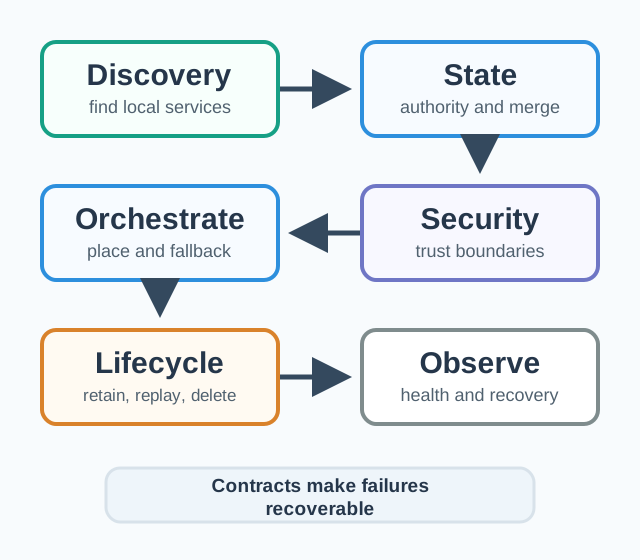
The closing label, Contracts make failures recoverable, connects the map to the chapter's production claim: each concern needs an owner and a failure contract, not simply a tier name.

  • Devices find local services, remember usable paths, and fail over without depending on a remote lookup for every reconnection.

Key terms

Discovery
Discovery is the way devices find the services they need.
Advanced edge-fog-cloud production concerns
iotclass.org

Major section

State Authority and Consistency · Security and Trust Boundaries
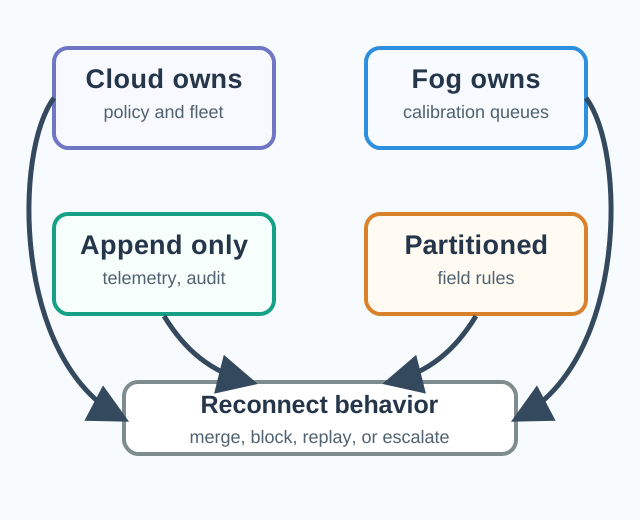
Network partitions are normal in distributed IoT.

  • A site may keep operating while the cloud view is stale.
  • The important question is not whether divergence can happen; it is which state may diverge, who may change it, and how the system reconciles afterward.
  • The cloud receives a replica, not the source of truth.

Key terms

Conflict handling
Conflict handling is mostly about ordering, deduplication, late arrival, and retention.
Security-in-depth
Security-in-depth is not a slogan here; it is a placement requirement.
State authority patterns across edge, fog, and cloud
iotclass.org

Major section

Orchestration and Placement Fallback · Observability, Updates, and Governance · Decision Record

A safety command path, credential update, or audit ledger usually needs stronger authority than an opportunistic swarm can provide.

  • BitTorrent-style swarms, tree overlays, and multi-tree overlays are useful analogies because they make the tradeoff visible.
  • The throughput model must match the shared medium.
  • Hysteresis makes the client less reactive.

Key terms

Mixing the classes
Mixing the classes is harder: one user's apparently beneficial move can change another user's incentive and create an endless improvement path.

Why it matters

Some workloads can move; others should remain fixed because their safety or evidence requirements depend on local placement.

iotclass.org

Major section

Fleet Operations and Edge Autonomy · Label the Diagram: Advanced Concerns · Code Challenge: State Authority Classifier

One edge device is a programming problem; a fleet is an operations problem.

  • At scale, the design must deploy, update, monitor, and recover many constrained nodes that are intermittently connected and often unreachable by a technician.
  • The decision is not "Kubernetes everywhere." A tiny sensor may only need signed firmware and a rollback slot.
  • Advanced autonomy is a reconciliation problem.

Numbers to remember

14.4 MBor about 14.4 MB, before indexes, signatures, and retry metadata are counted.
iotclass.org

Major section

2. Making the Cloud Registry a Runtime Dependency · 3. Using One Merge Rule for Every State Class

A registry is useful for operations, inventory, and governance.

  • A local device should still have a way to reconnect to a valid local service during cloud isolation.
  • Last-write-wins, cloud-wins, fog-wins, manual review, and append-only records each fit different semantics.
  • A single universal rule eventually loses important information.
iotclass.org

Major section

Summary · Key Takeaway

Advanced edge-fog-cloud design is about production contracts, not extra layers.

  • Discovery needs local operation, cached valid paths, and operational visibility.
  • Fog nodes are sensitive trust boundaries when they decrypt, aggregate, cache, or decide.
  • Orchestration must include fallback behavior for outages, overload, and version drift.
  • Observability must show local health and recovery status, not only cloud dashboard state.
iotclass.org

Deck summary

Key takeaways

One shop loses its outside link during the change.

  • Discovery is a dependency.: Devices need a local way to find services, a remembered last-known-good path, and an operational registry that does not become a runtime single point of failure.
  • The closing label, Contracts make failures recoverable, connects the map to the chapter's production claim: each concern needs an owner and a failure contract, not simply a tier name.
  • Network partitions are normal in distributed IoT.
  • A safety command path, credential update, or audit ledger usually needs stronger authority than an opportunistic swarm can provide.
iotclass.org

Retrieval practice

Recall check 1 of 5

Edge Eddie says: answer from memory, then check your reasoning.

Q1A proof-of-concept works at one site. Before expanding to many sites, what should the architecture team define first?

AA fixed rule that moves every workload to the cloud before site constraints are reviewed
BA single global gateway configuration that ignores topology, links, and recovery differences
CDefine production contracts first.
DA dashboard redesign that reports uptime before runtime contracts are made explicit
Show answer

Answer: C Multi-site production failures usually come from implicit contracts: devices cannot find services, state conflicts are undefined, credentials are overbroad, fallback behavior is missing, or local health signals are invisible.

iotclass.org

Retrieval practice

Recall check 2 of 5

Edge Eddie says: answer from memory, then check your reasoning.

Q2A device can reach its local network, but the local DNS server is unavailable. The fog gateway is still healthy. Which discovery design is most resilient?

AStop local operation until the cloud registry and local DNS both become reachable again
BUse cached local fallback and report it later.
CConnect to any host that answers on the gateway port and skip certificate checks during failover
DDelete the cached gateway address whenever DNS fails so all routing starts from scratch
Show answer

Answer: B A resilient device has more than one local path and reports fallback use so operators can fix the discovery dependency later.

iotclass.org

Retrieval practice

Recall check 3 of 5

Edge Eddie says: answer from memory, then check your reasoning.

Q3A fog node decrypts device messages so it can aggregate, filter, and apply local policy. What security implication follows?

AThe fog node cannot be compromised because network encryption removes the need for local controls
BTreat the fog node as a sensitive trust boundary.
CCloud controls alone are enough because the fog node only applies policy and filters events locally
DAll edge devices should share the fog node private key to make failover simpler across the site
Show answer

Answer: B If the fog node reads payloads to do useful work, it must be treated as a sensitive processing point with its own controls.

iotclass.org

Retrieval practice

Recall check 4 of 5

Edge Eddie says: answer from memory, then check your reasoning.

Q4A site-level analytics workload normally runs on a fog gateway. During WAN outage, the cloud dashboard is unavailable but local control must continue. What should the orchestration plan specify?

AStop the local workload because dashboards cannot receive results, even when local control depends on it
BMove every workload to the cloud automatically whenever the fog node detects a WAN outage
CKeep local workload running and queue cloud summaries.
DDelete queued summaries so the fog node never shows backlog after connectivity returns to normal
Show answer

Answer: C The fallback plan preserves local operation, protects cloud-bound data for later replay, and gives operators visibility while the cloud view is stale.

iotclass.org

Retrieval practice

Recall check 5 of 5

Edge Eddie says: answer from memory, then check your reasoning.

Q5Place each production concern where it lives so you can contain failures across edge, fog, and cloud boundaries.

ADiscovery
BCold archive
CBilling report
DScreen layout
Show answer

Answer: A Separate discovery, state coordination, and protected recovery so you can locate participants, resolve truth, and diagnose failures without blurring trust boundaries.

Q6Complete the classifier that assigns an authority model to different state classes:

Aif state_class in {'fleet_policy', 'access_rule'}:
Bif state_class == 'temperature_sample':
Cif state_class is None:
Dif state_class in {'edge', 'cloud'}:
Show answer

Answer: A Fleet policy and access rules usually need cloud authority, physical calibration and site queues often need fog authority, and telemetry or audit events should be append-only with ordering and deduplication.

iotclass.org

Print reference

Answers 1 of 2

Answer key.

  1. C · Multi-site production failures usually come from implicit contracts: devices cannot find services, state conflicts are undefined, credentials are overbroad, fallback behavior is missing, or local health signals are invisible.
  2. B · A resilient device has more than one local path and reports fallback use so operators can fix the discovery dependency later.
  3. B · If the fog node reads payloads to do useful work, it must be treated as a sensitive processing point with its own controls.
iotclass.org

Print reference

Answers 2 of 2

Answer key.

  1. C · The fallback plan preserves local operation, protects cloud-bound data for later replay, and gives operators visibility while the cloud view is stale.
  2. A · Separate discovery, state coordination, and protected recovery so you can locate participants, resolve truth, and diagnose failures without blurring trust boundaries.
  3. A · Fleet policy and access rules usually need cloud authority, physical calibration and site queues often need fog authority, and telemetry or audit events should be append-only with ordering and deduplication.
iotclass.org