Edge & Fog Computing · Study deck
Model Optimization for Edge AI
Picture a camera near a factory belt that must spot a cracked part before it moves on.
Edge Eddie is your guide for this deck.

After studying this chapter
Learning objectives
You will be able to:
- Explain: If the representative data misses night images, vibration spikes, clipped audio windows, or rare sensor poses, the activation range can be too narrow and real inputs may saturate after conversion.
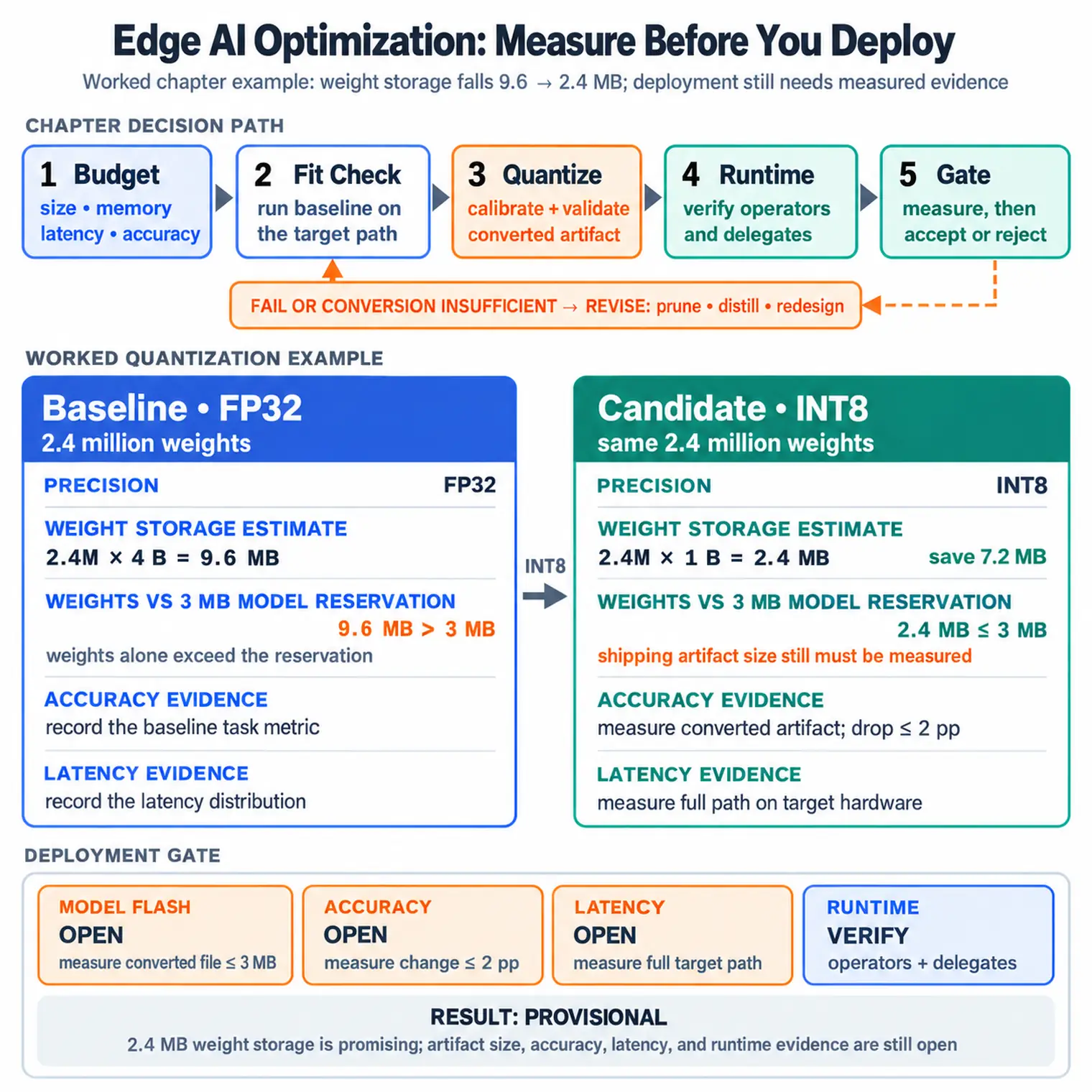
- Explain: Storing the same weights as INT8 uses about 2.4 MB, saving 7.2 MB before activation memory, tensor arenas, preprocessing buffers, or update staging are counted.
- Explain: The mathematical gist: For weights in [−0.50,0.50], symmetric int8 uses s=0.50/127=0.0039370 and σq=s/12=0.0011365.
- Explain post-training quantization, quantization-aware training, pruning, distillation, and operator fusion.
Major section
In 60 Seconds
The original program works on a large office computer.
- The camera has less memory, less power, and only a moment to decide.
- The engineer should first save a trusted set of test images and record the large program's results.
- Include poor light, dust, motion, and parts near the decision limit.
Major section
In 60 Seconds (continued)
A faster result is not a win if it hides more dangerous defects or cannot be supported after an update.
- A single average can hide that the new version misses the rare crack the system was built to find.
- Another engineer should be able to repeat the release decision without a private notebook.
- If the new version is unsure, it may stop the belt, request a closer look, or mark the part for manual review.
Major section
In 60 Seconds (continued)
If the error, heat, or response time crosses that line, return to the known version and keep the failed record.
- This simple test does not explain every way a learned model can be reduced.
- Under the Hood explains number size, removed connections, teaching from a larger model, and hardware-specific changes.
- Edge AI model optimization is a measured conversion process, not a promise that every model becomes tiny and fast.
Major section
Phoebe's Field Notes: Why "0.236 to 60" Is Not a Rounding Accident · Start Simple
The mathematical gist: For weights in [−0.50,0.50], symmetric int8 uses s=0.50/127=0.0039370 and σq=s/12=0.0011365.
- That one pass does not replace calibration and task-level validation.
Major section
Start With the Deployment Budget · Optimization Techniques
Accuracy gate: task metric, validation split, edge cases, confidence threshold, false accept cost, and false reject cost.
- Runtime verifies operators and delegates before the final Gate says measure, then accept or reject.
- This order protects task quality while locating the specific device limit each optimization is meant to relieve.
- Removes individual weights.
Major section
Quantization · Small Quantization Example
where x is the floating value, s is the scale, and z is the zero point.
- Those depend on activations, operators, runtime kernels, delegates, memory layout, and calibration data.
- Weights are quantized, while some activations may remain floating point.
- Weights and activations use integer representations.
- Weights use half precision.
Major section
Pruning · Pruning Trap
Pruning removes model capacity that appears unnecessary for the task.
- Removes channels, filters, layers, attention heads, or blocks.
- The result can be exported as a smaller dense model, which is usually easier for MCUs and edge runtimes.
- Sets individual weights to zero.
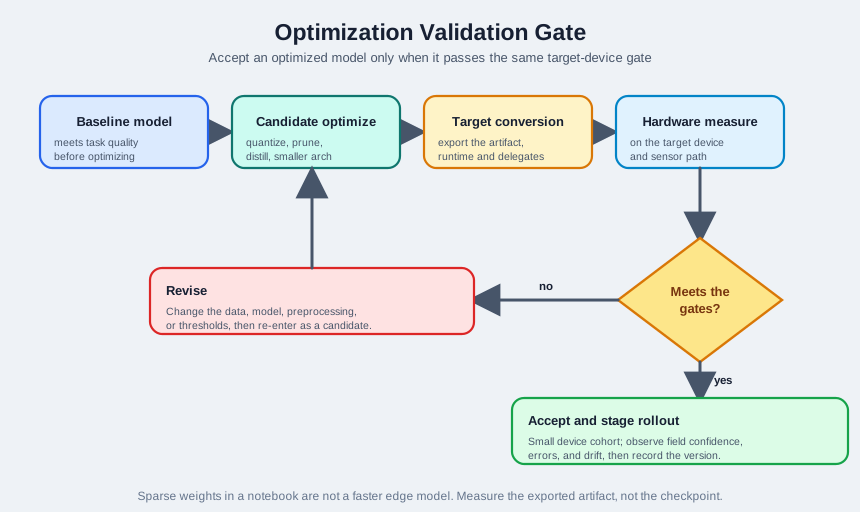
- Baseline: Train or select the model that already meets task quality.
Major section
Knowledge Distillation · Distillation Is Not Weight Copying
Knowledge distillation uses a larger teacher model to train a smaller student model.
- Eddie records the original board result before swapping one model part.
- The candidate then goes through the target converter and runs beside the real sensor and power meter.
- The lights keep quality, speed, memory, and energy as separate checks.
Major section
Compiler and Runtime Optimization · Unsupported Operator Trap
Freezes training-only behavior, removes unused nodes, locks input shapes when possible, and checks that preprocessing matches training.
- Optimization is not complete when the model converter produces a file.
- Edge runtimes can change performance more than the model transformation itself.
- Unsupported operators may fall back to CPU and dominate latency.
Major section
Deep Dive: Proving the Optimization Trade
Structured pruning needs the same proof.
- An optimization is a trade only after the numbers close.
- A model with 2.4 million FP32 weights uses about 9.6 MB for weights alone.
- If a 24 million-MAC inference removes 25 percent of channels, the dense work target falls to about 18 million MACs.
Major section
Deep Dive: Proving the Optimization Trade (continued)
Storing the same weights as INT8 uses about 2.4 MB, saving 7.2 MB before activation memory, tensor arenas, preprocessing buffers, or update staging are counted.
- At 5 inferences per second, that is 90 million MACs/s instead of 120 million MACs/s.
- If the representative data misses night images, vibration spikes, clipped audio windows, or rare sensor poses, the activation range can be too narrow and real inputs may saturate after conversion.
- If the range is too wide, the step size becomes coarse and borderline classes can drift.
Major section
Common Pitfalls · Reference Path
Calibration that misses real sensor conditions can produce a model that works in a notebook and fails in the field.
- Unstructured zeros do not help if the exported artifact and runtime still execute dense kernels.
- Weights may fit in flash while intermediate activations exceed RAM.
- Image resize, feature extraction, filtering, or normalization may dominate the latency path.
Deck summary
Key takeaways
The original program works on a large office computer.
- A faster result is not a win if it hides more dangerous defects or cannot be supported after an update.
- If the error, heat, or response time crosses that line, return to the known version and keep the failed record.
- The mathematical gist: For weights in [−0.50,0.50], symmetric int8 uses s=0.50/127=0.0039370 and σq=s/12=0.0011365.
- Accuracy gate: task metric, validation split, edge cases, confidence threshold, false accept cost, and false reject cost.
Retrieval practice
Recall check 1 of 5

Edge Eddie says: answer from memory, then check your reasoning.
Q1A team wants to quantize a model before defining the target memory, latency, operator, and accuracy budgets. What is the main risk?
Show answer
Answer: B Optimization has to be judged against deployment constraints, not against a generic file-size reduction.
Retrieval practice
Recall check 2 of 5
Edge Eddie says: answer from memory, then check your reasoning.
Q2A model fits memory but the sensor transfer dominates response time. Which optimization should be tried first?
Show answer
Answer: C The measured bottleneck is outside model computation.
Retrieval practice
Recall check 3 of 5
Edge Eddie says: answer from memory, then check your reasoning.
Q3How should the smaller model be assessed after the threshold errors increase?
Show answer
Answer: A The issue is numeric behavior near the decision boundary, so calibration and QAT are appropriate next checks.
Retrieval practice
Recall check 4 of 5
Edge Eddie says: answer from memory, then check your reasoning.
Q4In post-training INT8 quantization, what does representative calibration data set?
Show answer
Answer: D Representative calibration data sets activation ranges so scale and zero point can map float values into the int8 range before deployment validation.
Q5What anchors accuracy, latency and model-size comparisons before TinyML optimization?
Show answer
Answer: C It anchors every accuracy, latency, and size comparison.
Retrieval practice
Recall check 5 of 5
Edge Eddie says: answer from memory, then check your reasoning.
Q6Complete a TensorFlow Lite post-training quantization setup that uses representative data.
Show answer
Answer: A Post-training integer quantization uses a TFLite converter, default optimization, and representative data so activation ranges are calibrated before conversion.
Print reference
Answers 1 of 2
Answer key.
- B · Optimization has to be judged against deployment constraints, not against a generic file-size reduction.
- C · The measured bottleneck is outside model computation.
- A · The issue is numeric behavior near the decision boundary, so calibration and QAT are appropriate next checks.
- D · Representative calibration data sets activation ranges so scale and zero point can map float values into the int8 range before deployment validation.
- C · It anchors every accuracy, latency, and size comparison.
Print reference
Answers 2 of 2
Answer key.
- A · Post-training integer quantization uses a TFLite converter, default optimization, and representative data so activation ranges are calibrated before conversion.