Edge & Fog Computing · Study deck

Edge AI: Deployment Validation and Runtime Design

A model that scores well in a notebook may fail on the target device.

Edge Eddie is your guide for this deck.

Edge Eddie, the module guide, in a scene from this chapter.
iotclass.org

After studying this chapter

Learning objectives

You will be able to:

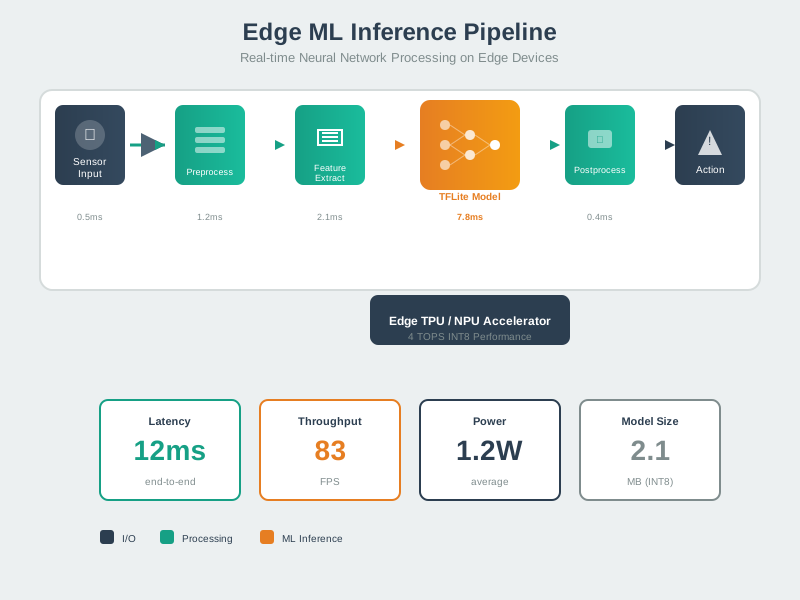
  • Explain: The example reports 12 ms end-to-end latency, 83 FPS throughput, 1.2 W average power, and a 2.1 MB INT8 model alongside a 4 TOPS Edge TPU or NPU label.
  • Explain: A release record should name the training dataset, model hash, quantization settings, preprocessing version, minimum confidence, fallback policy, rollback trigger, and operator who can pause or resume the rollout.
  • Explain: In production, the application also needs camera exposure control, a preprocessing version, a confidence threshold, a reject-lane action, a hold-for-review path, and evidence upload rules.
iotclass.org

Major section

Deployment Pipeline

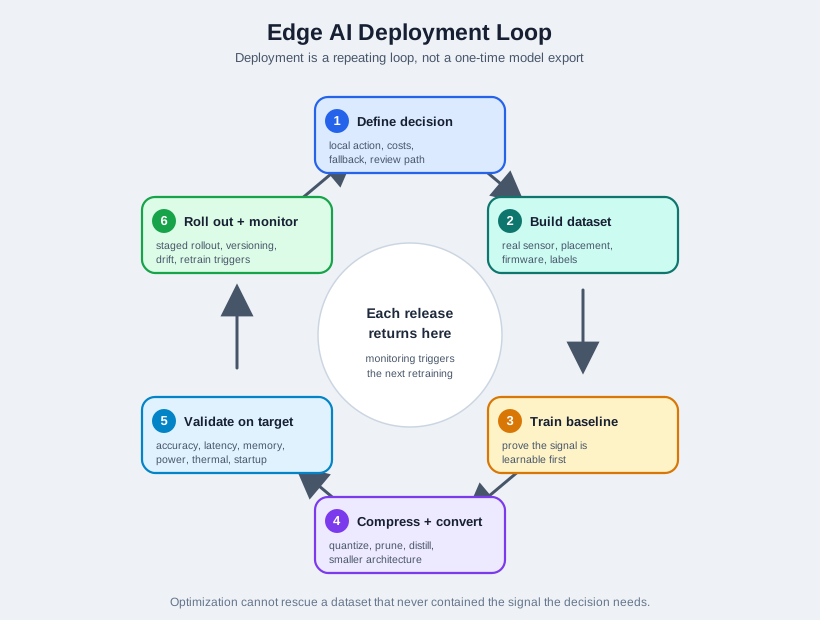
Edge AI deployment is a loop, not a one-time model export.

  • Train baseline first proves the signal, after which Compress + convert may quantize, prune, or distil.
  • Validate on target covers accuracy, latency, memory, power, thermal state, and startup; Roll out + monitor adds versions, drift, and retraining triggers.

Why it matters

Because monitoring returns to the next decision, a dataset or field failure can revise the entire pipeline rather than being hidden by another optimization pass.

The edge AI deployment loop runs clockwise through define the decision, build the dataset, train a baseline, compress and convert, validate on target, and roll out and monitor, with monitoring triggering the next retraining.
iotclass.org

Major section

Target-Device Validation

An edge AI project is not production-ready until it passes target-device tests.

  • Model footprint: Flash, RAM, tensor arena, activation buffers, runtime libraries, and model metadata fit with headroom.
  • Input robustness: Lighting, vibration, noise, temperature, placement, calibration, and sensor aging are represented in validation.
  • Fallback behavior: The device has an explicit behavior when confidence is low, the model is missing, memory is exhausted, or the runtime fails.
iotclass.org

Major section

Monitoring and Drift

Edge models drift when the world changes.

  • The model is local, but the monitoring plan must still be fleet-wide.
  • A change in one counter is a prompt to inspect lighting, placement, process, thresholds, or labels before retraining automatically.
  • This connects field monitoring to the chapter's evidence loop: diagnose the changed boundary, choose a bounded correction, and validate the replacement on the target.
iotclass.org

Major section

Common Pitfalls

Training and deployment must use the same preprocessing.

  • Small image, audio, or feature differences can dominate model behavior.
  • The device must define what happens when confidence is low, the model fails to load, the sensor is unhealthy, or storage is full.
  • Edge inference without sampled evidence and operator feedback becomes hard to improve after release.
iotclass.org

Major section

Deep Dive: Operating the Edge AI Lifecycle
An edge AI application is more than a trained network.

  • The model is one controlled artifact inside that pipeline, alongside the preprocessing version, confidence policy, local action, evidence rules, fleet inventory, rollback path, and review workflow.
  • For example, a packing line may start with a defect classifier that works well in the lab.

Key terms

Data drift
Data drift is a change in the input distribution, such as new lighting, a replaced sensor, a new season, or a changed product mix.
Concept drift
Concept drift is a change in the relationship itself, so the mapping the model learned is no longer correct.
Edge machine-learning inference pipeline from sensor input through preprocessing, neural network inference, postprocessing, action, and device metrics
iotclass.org

Major section

Deep Dive: Operating the Edge AI Lifecycle (continued)

If alert volume jumps after a lens is cleaned or a light is replaced, monitoring should surface that drift before operators lose trust.

  • The example reports 12 ms end-to-end latency, 83 FPS throughput, 1.2 W average power, and a 2.1 MB INT8 model alongside a 4 TOPS Edge TPU or NPU label.
  • A small latency budget makes the operating boundary concrete.
  • The fix is a loop, not a patch.
iotclass.org

Major section

Deep Dive: Operating the Edge AI Lifecycle (continued)

Those numbers describe this pictured configuration only, but the arrangement makes the general lesson clear: monitor input, transformation, inference, decision, and device cost as one versioned pipeline.

  • In production, the application also needs camera exposure control, a preprocessing version, a confidence threshold, a reject-lane action, a hold-for-review path, and evidence upload rules.
  • If the model sees a low-confidence image, the safe behavior may be to hold the item and store the frame, not to force a reject.
  • Adding an 80 ms cloud round trip would miss the physical action window even if model accuracy were identical.
iotclass.org

Major section

Deep Dive: Operating the Edge AI Lifecycle (continued)

If signals stay inside limits, the release widens by site or region.

  • A release record should name the training dataset, model hash, quantization settings, preprocessing version, minimum confidence, fallback policy, rollback trigger, and operator who can pause or resume the rollout.
  • A practical rollout might start with ten devices on one production cell.
  • Without that evidence loop, drift becomes an unexplained local complaint instead of a measurable lifecycle event.
iotclass.org

Major section

Summary

Edge AI applications should be selected from measurable latency, privacy, bandwidth, autonomy, and operational-value evidence.

  • Visual inspection, predictive maintenance, audio/event detection, and privacy-preserving sensing are common but different application families.
  • The deployment loop includes use-case definition, data collection, baseline modeling, optimization, target-device validation, staged rollout, monitoring, and retraining.
  • Production systems need model versioning, rollback, cloud monitoring, evidence collection, and drift review.
iotclass.org

Deck summary

Key takeaways

Edge AI deployment is a loop, not a one-time model export.

  • An edge AI project is not production-ready until it passes target-device tests.
  • Edge models drift when the world changes.
  • Training and deployment must use the same preprocessing.
  • An edge AI application is more than a trained network.
iotclass.org

Retrieval practice

Recall check 1 of 6

Edge Eddie says: answer from memory, then check your reasoning.

Q1A team wants to quantize and deploy a model before confirming that the raw sensor data can distinguish good and bad cases. What should happen first?

AValidate the use case and baseline model with representative data
BPick the smallest model possible and hope deployment data improves it
CDisable monitoring to reduce bandwidth
DSkip labels because edge inference is local
Show answer

Answer: A The deployment loop starts with a measurable decision and representative data.

iotclass.org

Retrieval practice

Recall check 2 of 6

Edge Eddie says: answer from memory, then check your reasoning.

Q2A visual inspection model was validated in one lighting setup. After a maintenance change, alert volume changes sharply even though the product did not change. What should the monitoring system suspect?

AInput drift caused by a sensor, lighting, placement, or process change
BThe model is permanently solved because it ran locally
CThe cloud is irrelevant and no evidence should be collected
DThe safest response is to hide the alert change
Show answer

Answer: A Edge AI monitoring should detect environmental, sensor, process, and data drift.

iotclass.org

Retrieval practice

Recall check 3 of 6

Edge Eddie says: answer from memory, then check your reasoning.

Q3Complete the edge inference gate:

Afeatures = device.preprocess(sample)
Bfeatures = sample.delete()
Cfeatures = policy.minimum_confidence
Dfeatures = model.rollback()
Show answer

Answer: A A safe edge inference gate preprocesses the sample consistently, runs the model, stores evidence for low-confidence cases, uses a safe fallback, reports compact events, and returns the predicted label only after checks pass.

iotclass.org

Retrieval practice

Recall check 4 of 6

Edge Eddie says: answer from memory, then check your reasoning.

Q4A deployed image classifier slowly loses accuracy over several months. Its code, model hash, and runtime are unchanged. What should the team do first?

ARestart every device and ignore confidence or input distributions because unchanged code means unchanged accuracy
BLet each device adapt locally without review uploads, version tracking, or rollback
CCheck for data or concept drift with confidence/input trends and reviewed field samples, then retrain and stage a rollout
DReduce packet size and network latency before checking class mix, environment changes, or labeled field samples
Show answer

Answer: C Silent accuracy loss on unchanged code points to data or concept drift.

iotclass.org

Retrieval practice

Recall check 5 of 6

Edge Eddie says: answer from memory, then check your reasoning.

Q5What is the strongest reason to reject an edge AI deployment even if the model accuracy looks good in the lab?

AThe system uses cloud monitoring for model health and controlled rollout evidence
BThe application sends compact events instead of raw data after local inference
CThe model has not been validated on the actual target device and sensing environment
DThe project avoids generic financial claims and uses site-specific evidence instead
Show answer

Answer: C Edge AI quality depends on target-device and site validation.

iotclass.org

Retrieval practice

Recall check 6 of 6

Edge Eddie says: answer from memory, then check your reasoning.

Q6A low-confidence model result could trigger a physical reject action on a production line. What should the edge application do?

AAlways act as if the confidence were high, even when the action could reject physical product
BUse the defined safe fallback, such as human review, hold lane, or evidence capture
CDelete the sample so no one sees the uncertainty or can review why the model hesitated
DDisable monitoring to avoid false alarms and hide low-confidence cases from retraining
Show answer

Answer: B Edge AI systems need confidence policy and safe fallback behavior for uncertain results, especially when the action affects physical operations.

iotclass.org

Print reference

Answers 1 of 2

Answer key.

  1. A · The deployment loop starts with a measurable decision and representative data.
  2. A · Edge AI monitoring should detect environmental, sensor, process, and data drift.
  3. A · A safe edge inference gate preprocesses the sample consistently, runs the model, stores evidence for low-confidence cases, uses a safe fallback, reports compact events, and returns the predicted label only after checks pass.
  4. C · Silent accuracy loss on unchanged code points to data or concept drift.
iotclass.org

Print reference

Answers 2 of 2

Answer key.

  1. C · Edge AI quality depends on target-device and site validation.
  2. B · Edge AI systems need confidence policy and safe fallback behavior for uncertain results, especially when the action affects physical operations.
iotclass.org