Edge & Fog Computing · Study deck
Edge AI: Application Fit and Constraints
An edge model earns its place only when local action beats cloud delay or exposure.
Edge Eddie is your guide for this deck.

After studying this chapter
Learning objectives
You will be able to:
- Select edge AI application candidates from latency, privacy, bandwidth, autonomy, and operational-value evidence.
- Compare visual inspection, predictive maintenance, audio/event detection, and privacy-preserving sensing patterns.
- Design an edge AI deployment loop from data collection through monitoring and retraining.
- Identify target-device validation requirements for model size, memory, latency, power, and fallback behavior.
Major section
In 60 Seconds
Bandwidth is how much data a link can carry.
- Latency is the time a result takes to arrive.
- Edge AI is useful when the decision is more valuable near the sensor than in a remote cloud call.
- Good applications need local latency, offline continuity, privacy control, bandwidth reduction, or site-level autonomy.
Major section
Phoebe's Field Notes: Two Different Things Called "Quantization"
The mathematical gist: A 30 fps camera has a 15.0 Hz Nyquist limit, so a 22.0 Hz vibration can appear as a false 8.00 Hz wobble.
- Frame rate protects motion identity; ADC depth protects brightness detail; later model quantisation repairs neither.
Major section
Start Simple
Waiting for a far service may take too long or fail when the link is down.
- Local work can cut delay and data use, but it spends device power and is harder to update.
- Remote work is easier to share, yet it depends on the link.
- Model placement depends on the application case, its control deadline, and the checks available at the edge.
Major section
Minimum Viable Understanding
Edge AI is an inference placement choice: Training usually stays in the cloud or workstation; inference runs near the data source.
- The application drives the hardware: A wake-word detector, a vibration monitor, and a multi-camera inspection line need different sensors, accelerators, memory, power, and update processes.
- Target-device validation is mandatory: Accuracy measured in a notebook is not enough; validate latency, memory, thermal behavior, power, and failure mode on the deployed device class.
- Monitoring continues after deployment: Edge models can drift when lighting, equipment, firmware, placement, or user behavior changes.
Major section
Application Map
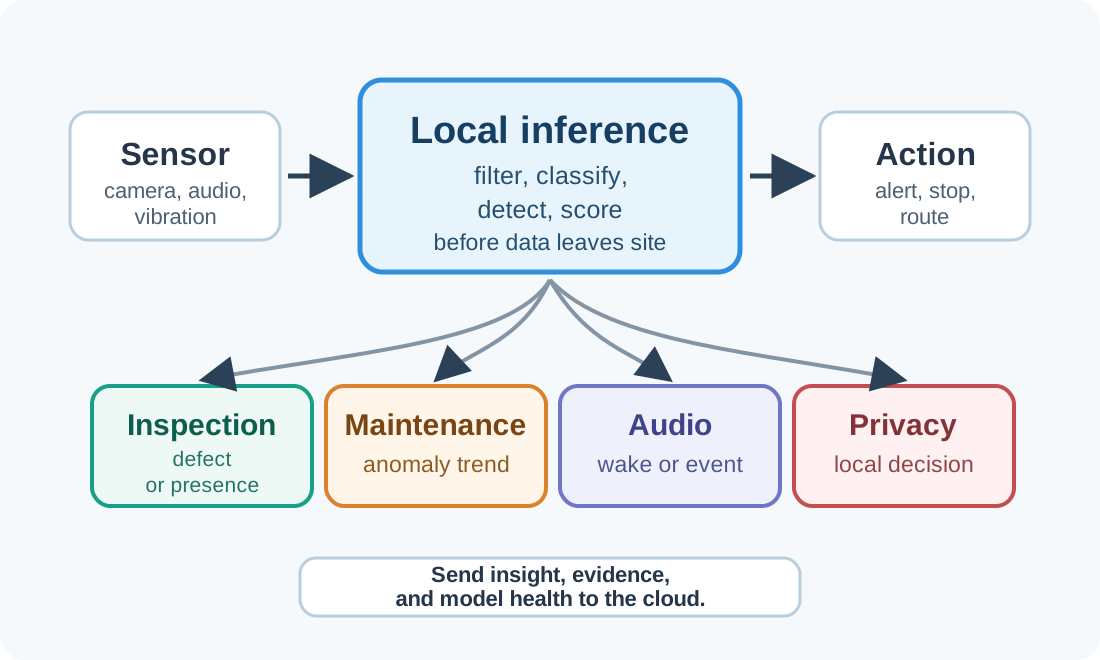
Edge AI applications are easier to reason about when you separate the sensing path, local inference path, action path, and cloud evidence path.
- This split is the main pattern: raw data supports a fast local act, while a small record supports later review across the fleet.
- The device or gateway classifies, detects, scores, or filters data before sending anything upstream.
Major section
When Edge AI Is a Good Fit
The decision must happen before a conveyor, vehicle, operator, process, or device state changes.
- The site must keep filtering, detecting, or protecting equipment when cloud connectivity is delayed or unavailable.
- Images, audio, health signals, location, or occupancy data should be minimized before it leaves the device or site.
- The raw stream is large, frequent, or expensive to transmit, but the useful result is small.
Major section
Application Family 1: Visual Inspection
Visual inspection is a strong edge AI candidate when image volume is high and the action needs to happen near the line, station, vehicle, or gate.
- False rejects can waste product or slow production.
- Missed defects can reach customers or downstream processes.
- Both costs must be included.
Major section
Application Family 2: Predictive Maintenance
Predictive maintenance works best when the edge model catches a local pattern that is costly to stream continuously and meaningful to maintenance teams.
- Normal, watch, inspect soon, stop safely, schedule service, collect high-resolution evidence, or escalate to expert review.
- Failure examples are often rare.
- A model trained only on normal operation may need anomaly detection, expert labels, and careful alert thresholds.
Major section
Application Family 4: Privacy-Preserving Sensing
Some applications are primarily about reducing raw data exposure rather than controlling a machine.
- Local inference does not automatically make a system privacy-preserving.
- Logs, samples, labels, and update data can still leak sensitive information.
- This pattern connects the local model to the chapter's operating loop: monitor useful outcomes without quietly rebuilding the sensitive data stream that edge placement was meant to avoid.
Deck summary
Key takeaways
Bandwidth is how much data a link can carry.
- The mathematical gist: A 30 fps camera has a 15.0 Hz Nyquist limit, so a 22.0 Hz vibration can appear as a false 8.00 Hz wobble.
- Waiting for a far service may take too long or fail when the link is down.
- Edge AI is an inference placement choice: Training usually stays in the cloud or workstation; inference runs near the data source.
- Edge AI applications are easier to reason about when you separate the sensing path, local inference path, action path, and cloud evidence path.
Retrieval practice
Recall check 1 of 5

Edge Eddie says: answer from memory, then check your reasoning.
Q1An edge model begins to miss new field conditions. Which loop can improve it without losing the local safety path?
Show answer
Answer: C The cloud evidence path supports retraining while the device keeps a bounded local action.
Retrieval practice
Recall check 2 of 5
Edge Eddie says: answer from memory, then check your reasoning.
Q2A camera application sends every frame to the cloud, but operators only need an alert when a rare defect appears. Which evidence most strongly supports moving inference to the edge?
Show answer
Answer: C A strong edge AI candidate converts high-volume sensor streams into low-volume decisions, especially when latency, privacy, bandwidth, autonomy, or site operations matter.
Retrieval practice
Recall check 3 of 5
Edge Eddie says: answer from memory, then check your reasoning.
Q3A predictive maintenance project has months of normal vibration data but almost no confirmed failure examples. What is the safest early modeling approach?
Show answer
Answer: C Many industrial maintenance systems start with normal-behavior baselines and human-reviewed anomalies because confirmed failure labels are rare.
Retrieval practice
Recall check 4 of 5
Edge Eddie says: answer from memory, then check your reasoning.
Q4A building occupancy system runs person detection locally and sends only counts to the cloud. What remaining privacy risk still needs review?
Show answer
Answer: D Privacy-preserving edge AI must govern raw data, debug artifacts, labels, logs, timestamps, uploads, and retention policy.
Retrieval practice
Recall check 5 of 5
Edge Eddie says: answer from memory, then check your reasoning.
Q5An image model looks accurate on a laptop. Which test makes it a candidate for the field device?
Show answer
Answer: A Device limits and failure behavior can differ from notebook results.
Print reference
Answers 1 of 2
Answer key.
- C · The cloud evidence path supports retraining while the device keeps a bounded local action.
- C · A strong edge AI candidate converts high-volume sensor streams into low-volume decisions, especially when latency, privacy, bandwidth, autonomy, or site operations matter.
- C · Many industrial maintenance systems start with normal-behavior baselines and human-reviewed anomalies because confirmed failure labels are rare.
- D · Privacy-preserving edge AI must govern raw data, debug artifacts, labels, logs, timestamps, uploads, and retention policy.
Print reference
Answers 2 of 2
Answer key.
- A · Device limits and failure behavior can differ from notebook results.