Analytics & ML · Study deck
Radio Gateway Aggregation
Picture twenty cold-room sensors sending values through one edge box.
Data Dora is your guide for this deck.

After studying this chapter
Learning objectives
You will be able to:
- Explain why radio transmission usually dominates battery-powered edge acquisition.
- Design adaptive sampling, batching, and in-network aggregation policies that reduce uplink traffic.
- Preserve min, max, count, event flags, sequence metadata, and queue-health fields so summaries remain interpretable.
- Evaluate the latency, detail loss, and aliasing risks introduced by low-power gateway policies.
Major section
Start With the Story
The system owner must decide what may be combined and what must remain separate.
- Reducing data must not hide the one event that drives a safe action.
- A remote service may compare sites, but each hand-off must preserve source, time, unit, quality, and version.
- This opening does not choose every summary or radio.
Major section
Phoebe's Field Notes: Why the Freezer's 10-Second Sample Rate Can Alias
The mathematical gist: A 10-second freezer schedule samples at 0.1 Hz, so it can represent only changes up to 0.05 Hz.
- A three-second door transient is about 0.333 Hz and aliases to 0.033 Hz, a false slow wobble.
Major section
Radio Dominates Battery Drain
On a battery-powered sensor node, the intuition that "computing costs energy" is misleading.
- The real energy hog is the radio: transmitting data can cost as much energy as executing thousands of instructions.
- This single fact reshapes the whole acquisition strategy -- the goal is to transmit less, even if that means computing more.
Major section
Radio Dominates Battery Drain (continued)
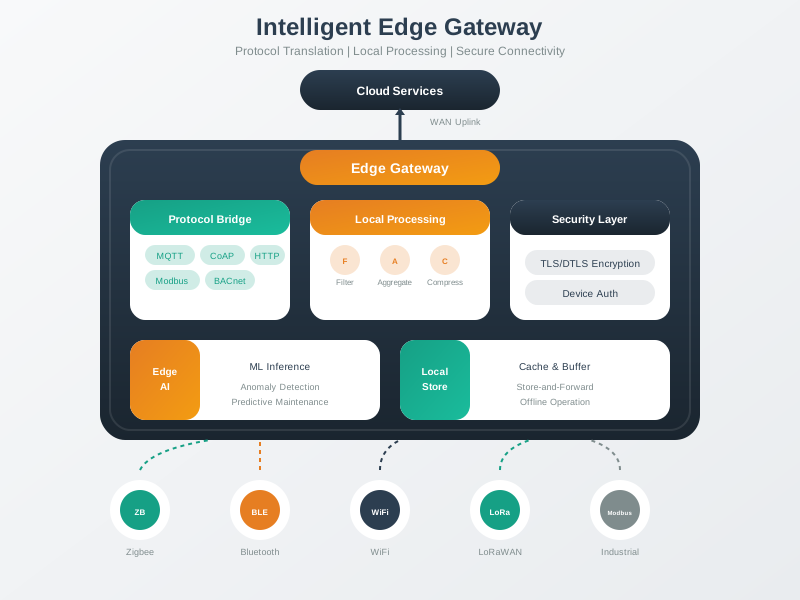
The local network decides which radio path is cheap enough for the payload.
- The sensor did not become magical; it simply stopped waking and talking so often.
- Intuition: talking is expensive, thinking is cheap.
- The power lesson is therefore architectural, not only electrical.
- The gateway decides what must cross the costly backhaul.
Major section
Adaptive Sampling and Aggregation
A practical design starts by writing the radio schedule before the analytics pipeline.
- For each measurement family, decide the minimum rate needed to avoid missing the phenomenon, the event trigger that justifies an immediate send, and the heartbeat interval that proves the node is still alive.
- The cloud still receives enough information to reconstruct equipment state, while the radio avoids hundreds of routine packets.
- The gateway then becomes the place where repeated local readings are turned into evidence.
Major section
Adaptive Sampling and Aggregation (continued)
A freezer temperature sensor might sample every 10 seconds locally, but send only when temperature moves more than 0.5 C, when a door-open event occurs, or when the hourly heartbeat is due.
- For maintenance dashboards, min/max and count often matter as much as the mean; for alarms, the event flag may matter more than the average.
- If each raw reading is a compact 20-byte payload, the naive hour is about 24 kB before radio overhead and acknowledgements.
- A summary message with mean, min, max, count, timestamps, and a health flag might be under 80 bytes.
Major section
Energy-Saving Tradeoffs
Energy reduction is never free.
- A radio wake-up has fixed overhead: the oscillator starts, the transceiver locks, the MAC may listen or join, the packet is sent, and acknowledgements or retries may follow.
- Batching ten readings into one wake-up can save much of that fixed cost.
- Aggregation has a different cost.
- Adaptive sampling also needs a guardrail.
Major section
Energy-Saving Tradeoffs (continued)
The gateway can reduce data, but it should also report what it reduced and which assumptions were active.
- A mean is compact and useful for trends, but it is lossy.
- If a motor bearing temperature is 40 C for 59 minutes and 95 C for one minute, the hourly mean may look harmless while the peak was the maintenance signal.
- More batching means more energy saved and more delay -- a direct trade-off.
Major section
Energy-Saving Tradeoffs (continued)
A node that samples slowly during stable periods can miss a short transient if the signal changes faster than the reduced sampling rate can observe.
- Each summary should carry the number of raw readings represented, the time range covered, and whether any local queue overflow, retry limit, or sensor error occurred.
- Without those fields, the cloud cannot distinguish "stable temperature" from "gateway dropped half the batch." Energy savings are only useful when the downstream interpretation remains honest.
- Adaptive sampling can aliasSlowing the sample rate during a fast transient can miss or alias it (the Nyquist rule still applies).
Major section
Energy-Saving Tradeoffs (continued)
It works because the system chooses which information can be delayed, summarized, or ignored.
- Batching costs latencySending many readings in one radio wake-up amortises the fixed cost of powering the radio on, but holds data back until the batch is sent.
- Adapt on the signal's real dynamics and keep a minimum floor rate so fast events are not lost.
- The gateway's job is to decide what is worth the energy to send.
Deck summary
Key takeaways
The system owner must decide what may be combined and what must remain separate.
- The mathematical gist: A 10-second freezer schedule samples at 0.1 Hz, so it can represent only changes up to 0.05 Hz.
- On a battery-powered sensor node, the intuition that "computing costs energy" is misleading.
- The local network decides which radio path is cheap enough for the payload.
- A practical design starts by writing the radio schedule before the analytics pipeline.
Retrieval practice
Recall check 1 of 3

Data Dora says: answer from memory, then check your reasoning.
Q1On a battery sensor node, which activity typically dominates the energy budget, and what strategy follows?
Show answer
Answer: B Local filtering, batching, and aggregation reduce the expensive radio work.
Retrieval practice
Recall check 2 of 3
Data Dora says: answer from memory, then check your reasoning.
Q2Why does in-network aggregation at a gateway reduce energy across the system?
Show answer
Answer: B Gateway aggregation cuts the number and size of costly upstream transmissions.
Retrieval practice
Recall check 3 of 3
Data Dora says: answer from memory, then check your reasoning.
Q3A node saves energy by only transmitting the hourly mean temperature. What important risk does this create?
Show answer
Answer: B A mean alone can discard peaks, so summaries should preserve extremes or events when those decisions matter.
Print reference
Answers
Answer key.
- B · Local filtering, batching, and aggregation reduce the expensive radio work.
- B · Gateway aggregation cuts the number and size of costly upstream transmissions.
- B · A mean alone can discard peaks, so summaries should preserve extremes or events when those decisions matter.