Analytics & ML · Study deck
Edge Acquisition: Missing Data and Field Design
A gateway translates and protects traffic correctly, but the field link still disappears and readings arrive late or not at all.
Data Dora is your guide for this deck.

After studying this chapter
Learning objectives
You will be able to:
- Explain: It also connects the field gateway to the application's API contract, completing the end-to-end route from sampled signal to a request whose source, meaning, and permissions can be reviewed.
- Explain: That record lets the class separate three checks that are often confused in demos: the sensor was read, the gateway kept the reading, and the server received the same timestamped value.
- Explain: Together, the four diagrams connect the chapter's running argument: a gateway is not merely a radio bridge; it preserves signal meaning while controlling volume, outages, protocol differences, and trust boundaries.
Major section
AI-Generated Data Acquisition Diagrams
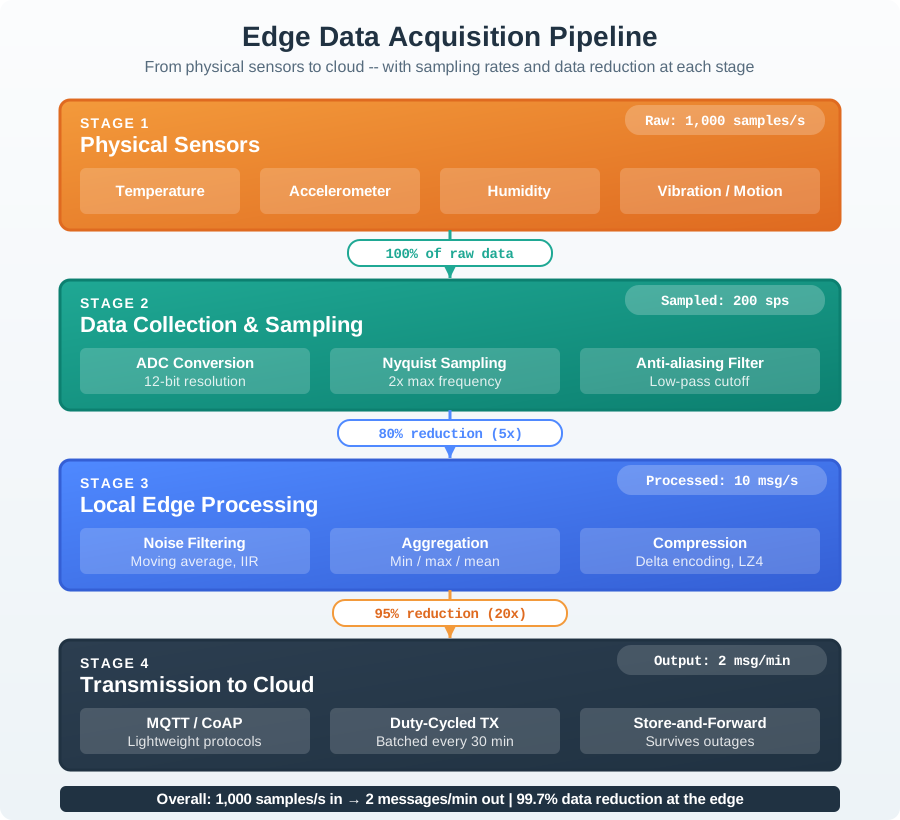
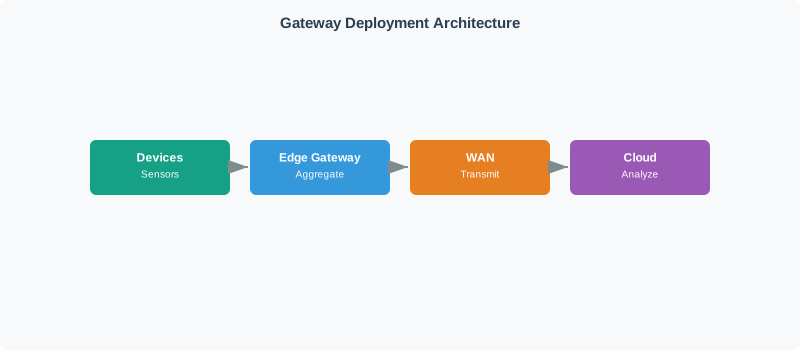
The chapter has treated acquisition, reduction, and gatewaying as separate design decisions.
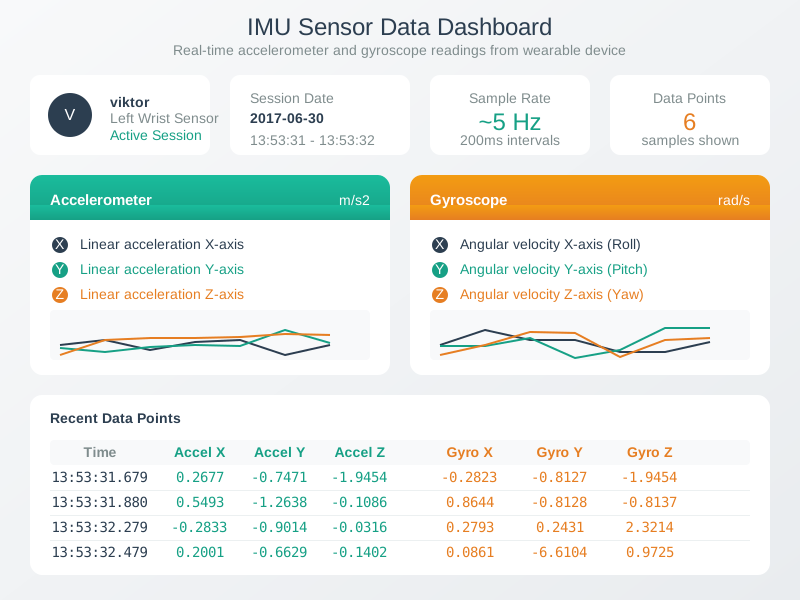
- The high-rate source behind that need becomes concrete in the time-series diagram in Figure: Accelerometer and Gyroscope Data.
- The dense, related traces show why raw forwarding is expensive and why reduction must preserve decision-relevant motion.
Major section
AI-Generated Data Acquisition Diagrams (continued)
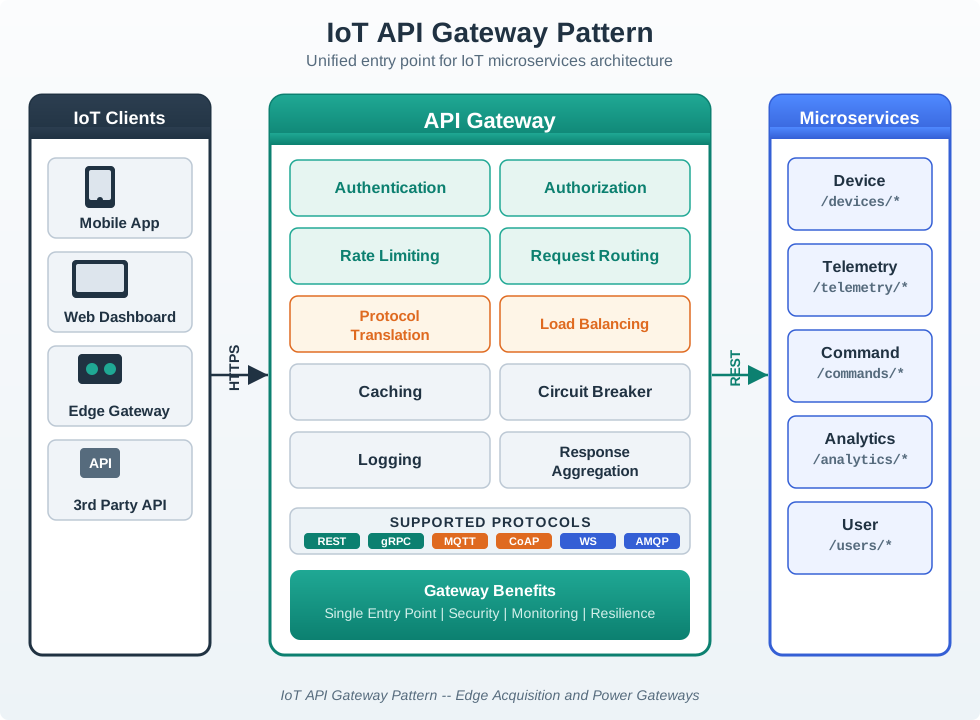
The final service boundary is shown in the API integration diagram in Figure: API Gateway Integration.
- The sequence shows that a syntactically valid conversion is not yet an admissible request: identity and schema checks still have to protect the service boundary.
- It also connects the field gateway to the application's API contract, completing the end-to-end route from sampled signal to a request whose source, meaning, and permissions can be reviewed.
- Together, the four diagrams connect the chapter's running argument: a gateway is not merely a radio bridge; it preserves signal meaning while controlling volume, outages, protocol differences, and trust boundaries.
Major section
Store-and-Forward Gateway Exercise
That record lets the class separate three checks that are often confused in demos: the sensor was read, the gateway kept the reading, and the server received the same timestamped value.
- The photograph does not itself prove reliability; it locates the resources the tasks must exercise.

Try it: Store-and-Forward Gateway Exercise in the chapter
Major section
LoRaWAN Soil Sensor Battery
A precision agriculture deployment uses LoRaWAN soil moisture sensors in vineyards.
- temperature extremes: Vineyard sees -5°C to +40°C.
- Rationale: Soil moisture changes slowly (hourly data unnecessary).
- Cost: $0 (firmware update only, no hardware changes).
- Temperature derating is critical (battery capacity drops 40-60% at freezing).
Major section
Include Transmission Energy
Battery life should be 3+ years!" In field testing, collars die after 3 months.
- Actual battery life: 3400 mAh ÷ 6.126 mAh/hour = 555 hours = 23 days (matches field failure at 3 months with temperature derating + inefficiencies).
- New battery life: 3400 mAh ÷ 0.784 mAh/hour = 4337 hours = 6.0 months (still needs work).
- Cellular idle current (5 mA) is 100x higher than deep sleep (50 μA) - keep modem off.
Major section
Concept Relationships
Transmission dominates power budget (10-100x more than sensing); batching is highest-leverage optimization.
- Edge Data Acquisition: Architecture: Non-IP Things require gateways; power budgets vary by device category.
- Edge Compute Patterns: Edge processing reduces transmission (saves power); offloading to fog/cloud (costs power).
- Data Quality and Preprocessing: Gateway store-and-forward ensures zero data loss (vs gaps during outages).
Deck summary
Key takeaways
The chapter has treated acquisition, reduction, and gatewaying as separate design decisions.
- The final service boundary is shown in the API integration diagram in Figure: API Gateway Integration.
- That record lets the class separate three checks that are often confused in demos: the sensor was read, the gateway kept the reading, and the server received the same timestamped value.
- A precision agriculture deployment uses LoRaWAN soil moisture sensors in vineyards.
- Battery life should be 3+ years!" In field testing, collars die after 3 months.
Retrieval practice
Recall check 1 of 3

Data Dora says: answer from memory, then check your reasoning.
Q1A factory has 200 Modbus sensors (RS-485) that need to send data to AWS IoT Core (MQTT). The edge gateway loses internet connectivity 3-4 times per day for 5-10 minutes. Which gateway capability is MOST critical for this deployment?
Show answer
Answer: B With frequent 5-10 minute outages, store-and-forward buffering is most critical.
Retrieval practice
Recall check 2 of 3

Data Dora says: answer from memory, then check your reasoning.
Q2A gateway connects Modbus (RS-485) sensors to AWS IoT Core (MQTT). Which gateway function performs the *protocol bridging* needed for interoperability?
Show answer
Answer: D A.
Retrieval practice
Recall check 3 of 3

Data Dora says: answer from memory, then check your reasoning.
Q3Place each edge-gateway responsibility where it lives so you can budget energy and preserve a trustworthy record through an intermittent uplink.
Show answer
Answer: A budget energy and preserve a trustworthy record through an intermittent uplink.
Q4Complete the edge computing data aggregation function:
Show answer
Answer: A Edge aggregation uses a fixed-size deque buffer to maintain a sliding window of readings.
Print reference
Answers
Answer key.
- B · With frequent 5-10 minute outages, store-and-forward buffering is most critical.
- D · A.
- A · budget energy and preserve a trustworthy record through an intermittent uplink.
- A · Edge aggregation uses a fixed-size deque buffer to maintain a sliding window of readings.