Analytics & ML · Study deck

Edge Acquisition: Power and Gateway Functions

This first route builds the power ledger and defines the translation, buffering, and security functions a non-IP gateway must own.

Data Dora is your guide for this deck.

edgepowergateways
Data Dora, the module guide, in a scene from this chapter.
iotclass.org

After studying this chapter

Learning objectives

You will be able to:

  • Calculate Power Budgets: Compute battery life for IoT devices based on duty cycling and transmission patterns
  • Design Duty Cycling Strategies: Configure active, transmit, and sleep cycles and evaluate their impact on battery longevity
  • Explain Gateway Functions: Describe how gateways enable non-IP devices to participate in IoT networks through protocol translation
  • Implement Store-and-Forward: Design and assess reliable data pipelines that survive network outages
iotclass.org

Major section

Start With the Story

A small change can alter wake time or cause more retries.

  • The team wants a full season of life, but a bench test shows only the current used during one quick reading.
  • A duty cycle is the share of time spent active compared with the full period.
  • This first budget is a useful estimate, not a life guarantee.
iotclass.org

Major section

Start With the Story (continued)

A protocol is the agreed set of rules used for an exchange.: LoRaWAN is a long-range, low-power set of network rules for small radio messages.

  • Its reach can help a field unit, but retries, receive windows, and poor coverage still spend energy.
  • A gateway is the unit that links the field radio network to another service.
  • The sensor should keep the fact with its source, time, unit, and quality.
iotclass.org

Major section

Start With the Story (continued)

It should send later without hiding the gap or sending the same event as new.

  • The old life claim must not follow the product without a new check.
  • Under the Hood follows missing data, admission rules, battery chemistry, and failure cases that a simple average cannot show.
  • A device has produced messy evidence, an analytic step is about to change an alert or control decision, and someone has to explain why the result should be trusted.
iotclass.org

Major section

External Nano-Power Timer and Load Disconnect

A TPL5110-class arrangement has two power domains.

  • Deep sleep still leaves the MCU, regulator, sensor bias network, and board leakage connected to the battery.
  • The timer remains connected to the battery at nanoamp-class quiescent current.
  • Its DRV output controls a MOSFET or load switch feeding the MCU, sensors, and radio.
iotclass.org

Major section

External Nano-Power Timer and Load Disconnect (continued)

When the sampling interval is minutes or hours, an external timer can make a stronger boundary: it powers the load only for one acquisition transaction, then physically disconnects that load after firmware reports completion.

  • For the TPL5110 specifically, DRV low turns the external MOSFET on and DRV high turns it off; other timer/load-switch combinations may use the opposite polarity.
  • The energy ledger must include the always-on timer and switch leakage.
  • The active burst still dominates, but the example shows why board leakage belongs beside the timer data-sheet number.
iotclass.org

Major section

External Nano-Power Timer and Load Disconnect (continued)

A 10 microamp regulator or programming interface left across the battery would materially change the result even though the MCU is physically off.

  • For the TPL5110, a missing DONE does not leave the load on indefinitely.
  • The device holds the load on for the programmed interval minus roughly 50 ms, then forces DRV high for the final 50 ms before the next cycle.
  • That maximum-on window is a hardware recovery boundary, but it may be far longer than the application's safe fault time.
iotclass.org

Major section

Phoebe's Field Notes: Why Battery Life Is a Charge Ledger

The optimized 5-second sense and 2-second transmit states average about 0.111 mA and reach roughly 2.56 years.

  • Cold derating, leakage, and load-voltage sag must still be subtracted.

Numbers to remember

0.111 mA2-second transmit states average about 0.111 mA
iotclass.org

Major section

Gateway Functions for Non-IP Devices

The header can meet sensors or controllers through local electrical interfaces; the Linux-capable compute and network ports can buffer records, translate protocols, keep logs, and establish secure upstream sessions.

  • The board itself does not guarantee any of those behaviors.
  • Once the node can survive on battery, ask whether its data can cross protocols and outages.
A Raspberry Pi 4 exposes the two sides of a field gateway: the 40-pin GPIO header can meet local sensor and control interfaces, while USB, Ethernet, RAM, and a Linux-capable processor support protocol translation, buffering, logs, and network services.
iotclass.org

Major section

Security Functions

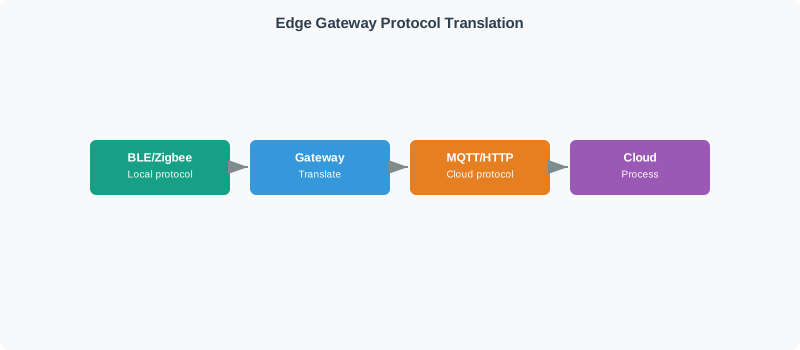
The gateway diagram in Figure: Edge Gateway Protocol Translation and Cloud Connectivity brings protocol translation, buffering, and security into one route so the trust checks can be placed before data or commands cross the boundary.

  • Security is therefore not a final wrapper around translated data.
A remote water-valve node moves from deep sleep through secure boot and authenticated communication to a reserved-energy recovery path.
iotclass.org

Deck summary

Key takeaways

A small change can alter wake time or cause more retries.

  • A protocol is the agreed set of rules used for an exchange.: LoRaWAN is a long-range, low-power set of network rules for small radio messages.
  • It should send later without hiding the gap or sending the same event as new.
  • A TPL5110-class arrangement has two power domains.
  • When the sampling interval is minutes or hours, an external timer can make a stronger boundary: it powers the load only for one acquisition transaction, then physically disconnects that load after firmware reports completion.
iotclass.org

Retrieval practice

Recall check 1 of 2

Data Dora says: answer from memory, then check your reasoning.

Q1An IoT device has a 2500 mAh battery. It draws 25 mA when active, 120 mA when transmitting, and 0.01 mA in deep sleep. Current design: active 30 s/hour, transmit 10 s/hour, sleep the rest. Proposed optimization: active 5 s/hour, transmit 2 s/hour, sleep the rest. What is the approximate battery life improvement factor?

AApproximately 2x improvement
BApproximately 3x improvement
CApproximately 4x improvement
DApproximately 5x improvement
Show answer

Answer: D Compute average current for each duty cycle and compare lifetimes.

iotclass.org

Retrieval practice

Recall check 2 of 2

Data Dora says: answer from memory, then check your reasoning.

Q2In the battery-life scenario, which design change typically yields the biggest lifetime improvement for low-power IoT nodes?

AIncrease sensor sampling rate and transmit every sample immediately, assuming accuracy gains offset the extra radio time
BUse larger packets and longer TX windows so each packet carries more bytes, even though every transmission lasts longer
CReduce transmission frequency/duration by batching data and maximizing deep sleep
DRemove timestamps from readings to save a few bytes, while keeping the same wake schedule and radio transmit count
Show answer

Answer: C A.

iotclass.org

Print reference

Answers

Answer key.

  1. D · Compute average current for each duty cycle and compare lifetimes.
  2. C · A.
iotclass.org