Analytics & ML · Study deck

Edge Acquisition: Control Paths and Bandwidth

A cloud command and an edge alarm do not share the same safe delay.

Data Dora is your guide for this deck.

edge
Data Dora, the module guide, in a scene from this chapter.
iotclass.org

After studying this chapter

Learning objectives

You will be able to:

  • Explain: The widening orders-of-magnitude gap means one forwarding policy cannot fit every source: sparse events may travel intact, periodic measurements may be batched, and continuous media often needs local selection or inference.
  • Explain: This connects sample timing to the chapter's running design decision: faster acquisition must be justified by signal bandwidth or decision latency, then paid for with storage, radio energy, or local reduction.
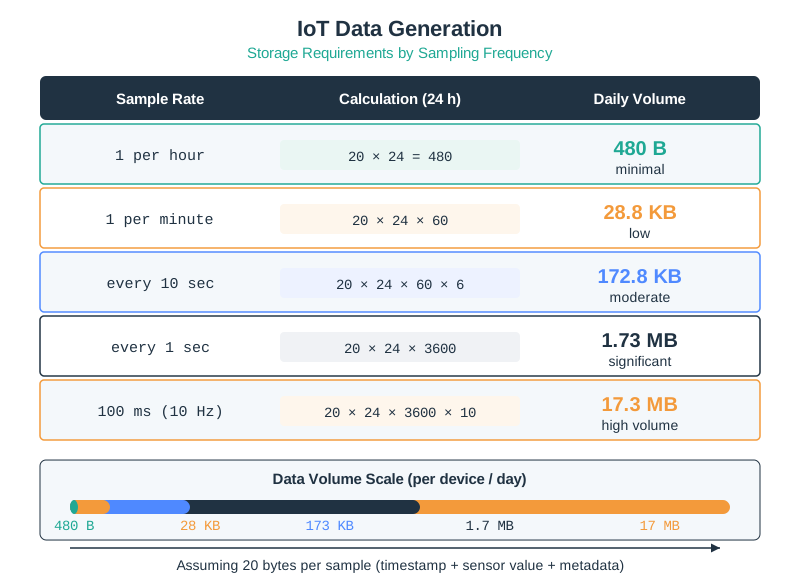
  • Explain: Each tenfold increase in frequency produces ten times as many 20-byte records, so the visual growth is arithmetic rather than a property of a particular sensor.
iotclass.org

Major section

Cloud and Edge Control Paths

The: DESIGN INFERENCE explains that central history is simple, but a WAN failure interrupts the decision unless a safe fallback exists.

  • That split improves continuity but makes gateway update and replay ownership explicit.
  • The latency chips and continuity ledger show why urgency, sensitivity, and replay needs—not data volume alone—set placement.
Cloud-centric cold-store path from a temperature sensor through an IP gateway and cloud rule to an actuator, with WAN continuity called out as the trade-off.
iotclass.org

Major section

Data Generation Patterns

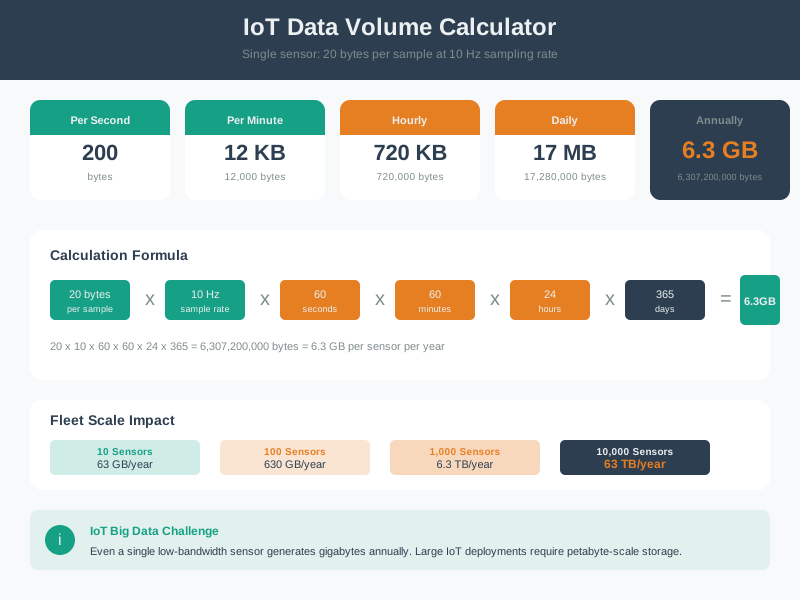
Understanding data generation patterns is essential for designing efficient edge acquisition systems.

  • Different device types produce vastly different data volumes and require different handling strategies.
  • This carries the category model into the running acquisition narrative by turning device capability into a bandwidth, storage, and processing obligation.
Data generation statistics for IoT devices
iotclass.org

Major section

Mobile figure summary

Big Things: Servers and PLCs have full IP connectivity, so they can upload structured data directly to the cloud.

  • Small IP Things: Smart cameras and other embedded devices connect over Wi-Fi or cellular and can pre-filter data before upload.
Data generation rates and volumes comparison table
iotclass.org

Major section

Mobile figure summary (continued)

Non-IP Things: Simple sensors use Zigbee, BLE, Modbus, or similar buses and rely on a nearby gateway for translation and aggregation.

  • Connectivity path: Non-IP sensor -> gateway -> cloud, while Big Things and Small IP Things can usually reach the cloud without protocol translation.
  • Each tenfold increase in frequency produces ten times as many 20-byte records, so the visual growth is arithmetic rather than a property of a particular sensor.
  • This connects sample timing to the chapter's running design decision: faster acquisition must be justified by signal bandwidth or decision latency, then paid for with storage, radio energy, or local reduction.
iotclass.org

Major section

Data Volume by Device Type

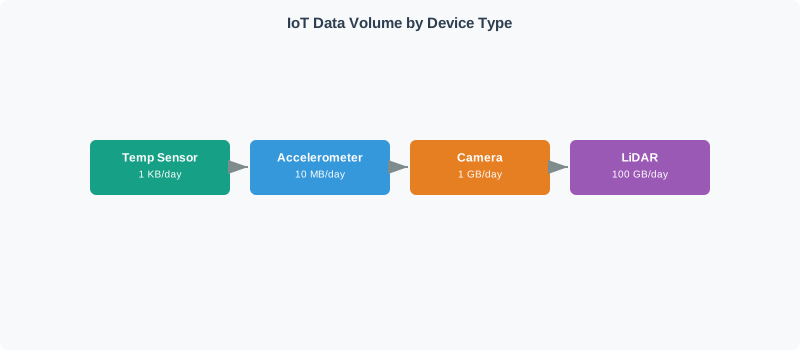
This view shows how data generation rates vary dramatically by device type, driving different edge processing strategies.

  • The widening orders-of-magnitude gap means one forwarding policy cannot fit every source: sparse events may travel intact, periodic measurements may be batched, and continuous media often needs local selection or inference.
iotclass.org

Major section

Inertial Measurement Example

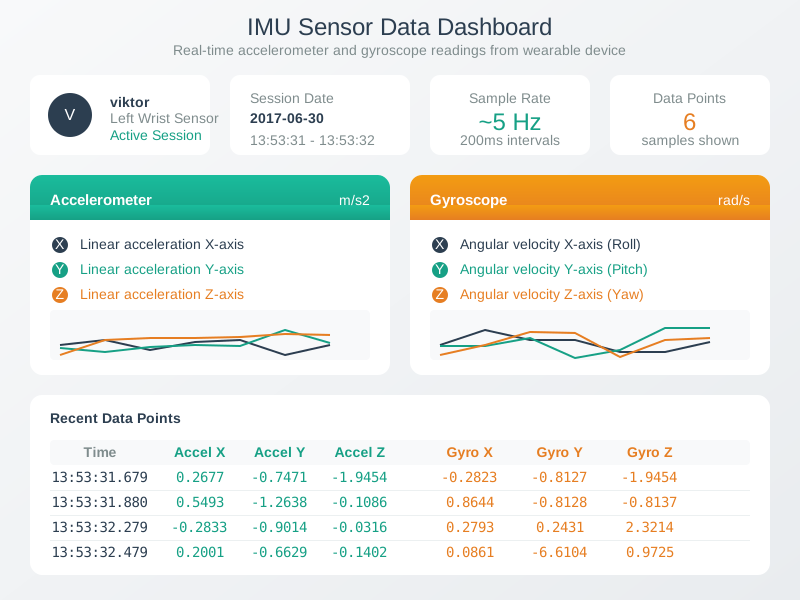
High-frequency sensors like accelerometers and gyroscopes demonstrate why edge aggregation is critical.

  • Accelerometer changes combine motion and gravity; gyroscope changes record rotation.
  • A motion event can therefore span several axes and both sensor types, which is why a single average may erase useful structure.
Accelerometer and gyroscope example sensor data
iotclass.org

Major section

Mobile figure summary

Edge aggregation reduces this to statistical summaries at 1 Hz.

  • Accelerometer axes: X, Y, and Z linear acceleration are tracked together to capture movement and gravity.
  • Edge takeaway: High-frequency six-axis data is useful locally, but the transmission layer should send aggregated summaries instead of every raw sample.
  • Transmitting raw data as 16-bit integers would require ~1.2 KB/s -- unsustainable for battery-powered devices on LPWAN networks.

Numbers to remember

1 HzEdge aggregation reduces this to statistical summaries at 1 Hz.
iotclass.org

Deck summary

Key takeaways

The: DESIGN INFERENCE explains that central history is simple, but a WAN failure interrupts the decision unless a safe fallback exists.

  • Understanding data generation patterns is essential for designing efficient edge acquisition systems.
  • Big Things: Servers and PLCs have full IP connectivity, so they can upload structured data directly to the cloud.
  • Non-IP Things: Simple sensors use Zigbee, BLE, Modbus, or similar buses and rely on a nearby gateway for translation and aggregation.
  • This view shows how data generation rates vary dramatically by device type, driving different edge processing strategies.
iotclass.org

Retrieval practice

Recall check 1 of 2

Data Dora says: answer from memory, then check your reasoning.

Q1A cold-store WAN link fails while the compressor still needs control decisions. Which design preserves the local decision path?

ASend the sensor directly to cloud history
BWait for the remote event replay
CEvaluate the rule at the edge gateway
DEvaluate the rule in cloud analytics
Show answer

Answer: C The edge path connects gateway decisions to a local actuator while cloud analytics receive evidence separately.

iotclass.org

Retrieval practice

Recall check 2 of 2

Data Dora says: answer from memory, then check your reasoning.

Q2A gateway serves continuous high-volume sources and sparse event-driven sensors. What should guide its bandwidth plan?

APlan storage from the number of categories
BCompare volume, transmission rhythm, and connectivity
CGroup sources by their direct IP capability
DAssign equal upload capacity to each device
Show answer

Answer: B The device-class comparison connects these properties to bandwidth, storage, and processing needs.

iotclass.org

Print reference

Answers

Answer key.

  1. C · The edge path connects gateway decisions to a local actuator while cloud analytics receive evidence separately.
  2. B · The device-class comparison connects these properties to bandwidth, storage, and processing needs.
iotclass.org