Specialized Architectures · Study deck
Duty-Cycling and Topology Management
Picture flood sensors spread along a river.
Blueprint Bina is your guide for this deck.

After studying this chapter
Learning objectives
You will be able to:
- Explain: The node may wake long enough to sense a value, but not long enough to receive from a child node, forward to a parent, or align with a neighbor's listen window.
- Explain: An underwater sensor field is one example: nodes drift with the current and radio does not propagate, so connectivity itself has to be discovered rather than planned in advance.
- Explain: If the relay sleeps through the leaf node's send window, the topology is not merely slower; it produces a missing-evidence state that the dashboard must show.
- Explain: The topology lesson is concrete.
Major section
Start With the Sleeping Network
A leaf wakes, measures, sends once, and sleeps.
- One leaf is later asked to relay readings from two others, but it keeps the old sleep plan.
- The new path now exists on paper and is absent when a child tries to send.
- Long life is not success if the warning arrives too late.
Major section
Start With the Sleeping Network (continued)
A relay needs time to receive and time to forward, not only time for its own sample.
- A distant record can support later review, but it should not hide a stale or missing event.
- This opening does not choose one shape or sleep plan.
- The architecture is acceptable only when the evidence survives the schedule and the topology change.
Major section
In 60 Seconds
This chapter is a section overview.
- Duty cycling and topology management are connected decisions.
- A node can save stored energy by sleeping, but a sleeping node cannot receive, forward, acknowledge, or sense unless the schedule makes that possible.
- It keeps claims bounded and gives a review pattern for deciding whether a duty-cycle schedule and topology role fit together.
Major section
Why These Decisions Belong Together
A duty-cycle decision that looks reasonable for a single node can fail at the topology level.
- The node may wake long enough to sense a value, but not long enough to receive from a child node, forward to a parent, or align with a neighbor's listen window.
- A topology decision can also change the duty-cycle plan.
- A leaf sensing node may wake briefly and return to sleep.
Major section
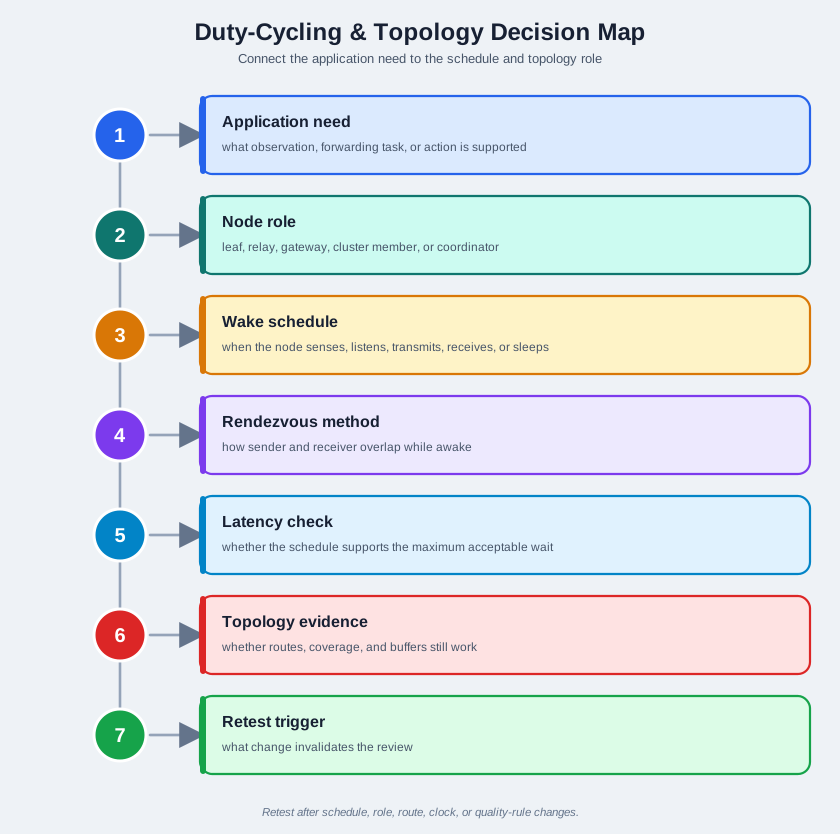
Decision Map
The local energy target is only useful if the network can still carry the required evidence.
- The latency check tests the maximum wait, while topology evidence tests the route, coverage, and buffer behaviour.
- The final retest trigger records what change invalidates that result.
Major section
Topology Roles And Wake Requirements
A leaf sensing node mainly observes a local condition and sends a record.
- Its review focuses on sensing interval, stale-data rule, communication attempt, and what happens when the receiver is unavailable.
- A relay node forwards readings for other nodes.
- Its schedule must include receive windows for children or neighbors and transmit windows toward the next hop.
Major section
Topology Roles And Wake Requirements (continued)
A relay schedule that only considers its own sensing task is incomplete.
- The review should state whether it is always available for the exercise, scheduled, buffered, or replaced by another recovery path.
- A member can often use a simpler schedule.
- A cluster head needs evidence for member collection, aggregation, forwarding, and role-change behavior.
Major section
Specialized Pattern: Self-Organizing Virtual Topology
The pattern is worth naming because it makes the general principle concrete: the wake schedule is not chosen first and checked against topology afterward.
- Some environments make static role assignment impractical.
- An underwater sensor field is one example: nodes drift with the current and radio does not propagate, so connectivity itself has to be discovered rather than planned in advance.
- The topology evidence — which neighbor will stay reachable longest — is what decides the wake schedule.
Major section
Review Evidence
A duty-cycle and topology review begins with the application need and acceptable latency, then records the node role and whether that role can change.
- It pairs the wake schedule and active states with the communication rendezvous method, expected route or neighbour, and buffering behaviour when that neighbour is unavailable.
- Quality rules must keep stale, missing, duplicate, and rejected data distinct.
- The evidence should include a known reading reaching the expected next step and a failed or unavailable case, not only the normal path.
Major section
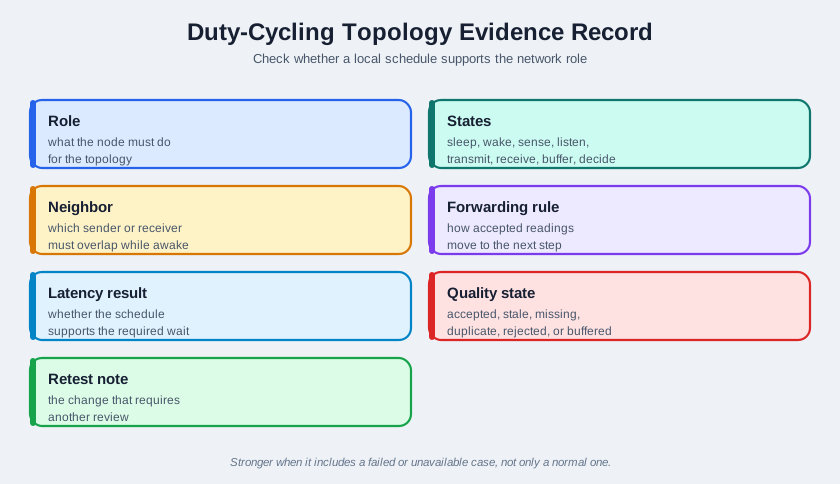
Evidence Record
The evidence record should show how a local schedule supports a network role.
- The latency result tests the permitted wait, and the quality state preserves whether the record was accepted, stale, missing, duplicated, rejected, or buffered.
- End at the retest note, which makes a later role, route, clock, or schedule change reopen the decision instead of silently inheriting old evidence.
Major section
Worked Review: Scheduled Relay
Topology role: The middle node is a relay.
- Scenario: a small network uses one relay node between a sensing node and a gateway.
- Concrete example: a greenhouse leaf node measures soil moisture, a shelf-mounted relay forwards accepted records, and a gateway uploads the review stream.
- It must receive from the sensing node and forward toward the gateway.
Major section
Worked Review: Scheduled Relay (continued)
If the relay sleeps through the leaf node's send window, the topology is not merely slower; it produces a missing-evidence state that the dashboard must show.
- Application need: The network must preserve a periodic status reading for later review.
- Wake schedule: The relay has a listen window for the sensing node and a separate forward window for the gateway.
- The schedule record states what happens when either neighbor is unavailable.
Major section
Worked Review: Scheduled Relay (continued)
Rendezvous check: The sensing node sends a known test record during the relay listen window.
- The relay forwards that record during the gateway window without dropping source identity, unit, timestamp, or validity state.
- Latency and quality: The review compares the observed wait with the application need.
- If the record arrives late, duplicated, stale, or missing, the state is recorded rather than hidden.
Major section
Common Mistakes
A node can sense successfully while the route fails.
- Leaf nodes, relays, gateways, and cluster heads have different availability needs.
- Transmission only works when the receiver is awake or a valid buffer/retry rule exists.
- A lower active fraction is not automatically better.
- The schedule must still support the application wait time.
Major section
Research Frontier: Nanonetworks And Underwater Networks
Molecular nanonetworks, electromagnetic nanonetworks, and underwater acoustic networks use different carriers, channel models, clocks, node capabilities, and evidence.
- They belong together here only as a comparison exercise in how a physical medium changes topology and duty-cycle assumptions.
- The topology lesson is concrete.
- A radio-style always-on neighbor table is a weak assumption when propagation delay is long, contacts move, energy is scarce, or the carrier itself diffuses.
Major section
Summary
Duty cycling controls availability.
- Topology management assigns the roles that need availability.
- A schedule is reviewable only when it fits the node role, communication rendezvous, forwarding path, latency requirement, quality-state behavior, and retest trigger.
- A schedule that works for a periodic review path may not work for faster response, a new relay role, a different neighbor set, or a changed quality rule.
Deck summary
Key takeaways
A leaf wakes, measures, sends once, and sleeps.
- A relay needs time to receive and time to forward, not only time for its own sample.
- This chapter is a section overview.
- A duty-cycle decision that looks reasonable for a single node can fail at the topology level.
- The local energy target is only useful if the network can still carry the required evidence.
Retrieval practice
Recall check 1 of 3

Blueprint Bina says: answer from memory, then check your reasoning.
Q1A leaf node is promoted to relay, but it keeps its old schedule: wake, sense locally, transmit once, and sleep. What must change for the relay role to be credible?
Show answer
Answer: B Topology roles determine wake obligations.
Retrieval practice
Recall check 2 of 3
Blueprint Bina says: answer from memory, then check your reasoning.
Q2A leaf sensing node wakes briefly and records a local value correctly. The same node is then assigned as a relay, but its schedule is not changed to include receive windows for child nodes or a forwarding window toward the gateway. What is the strongest review finding?
Show answer
Answer: C Duty-cycling and topology management must be reviewed together because a node role change changes wake, receive, forwarding, latency, and quality-state requirements.
Retrieval practice
Recall check 3 of 3
Blueprint Bina says: answer from memory, then check your reasoning.
Q3A team uses a short-range radio simulator to claim that an underwater acoustic deployment will meet its latency and localization targets. What is the strongest review finding?
Show answer
Answer: C The model must represent the physical carrier and deployment evidence that drive the claimed result.
Print reference
Answers
Answer key.
- B · Topology roles determine wake obligations.
- C · Duty-cycling and topology management must be reviewed together because a node role change changes wake, receive, forwarding, latency, and quality-state requirements.
- C · The model must represent the physical carrier and deployment evidence that drive the claimed result.