Wireless Sensor Networks · Study deck
WSN Duty Cycle Worked Examples
Treat each duty-cycle example as a small energy ledger.
Packet Pete is your guide for this deck.
After studying this chapter
Learning objectives
You will be able to:
- Explain: A 0.01% duty cycle is below the crossover, so a designer should first audit leakage, sleep-mode selection, regulator quiescent current, pull-up paths, and sensors left biased during sleep.
- Explain: The short chain is: a duty cycle sets an average current, average current divided into battery capacity gives lifetime, and the evidence record states which states were included or excluded.
- Explain: That comparison is only a planning bound: wake-up, listening, self-discharge, temperature, and battery derating still belong in the state ledger before the lifetime claim is accepted.
Major section
In 60 Seconds
Duty-cycle examples are useful when each calculation is tied to an evidence record.
- A reviewable example lists the states, current draw, active interval, cycle length, omitted overhead, average-current result, and retest trigger.
- This chapter uses supplied exercise values only.
- The goal is not to promise an operating interval for a particular node.
Major section
Minimum Viable Understanding
Duty cycle is an active fraction, but average current depends on every state in the cycle.
- Sleep current is small per instant but can dominate a long cycle.
- Wake, listen, guard, and transmit states should not be hidden inside a single active number.
- Weighted mode examples must state how much of the record is spent in each mode.
Major section
Review Pattern
Retest trigger: the change that makes the calculation stale.
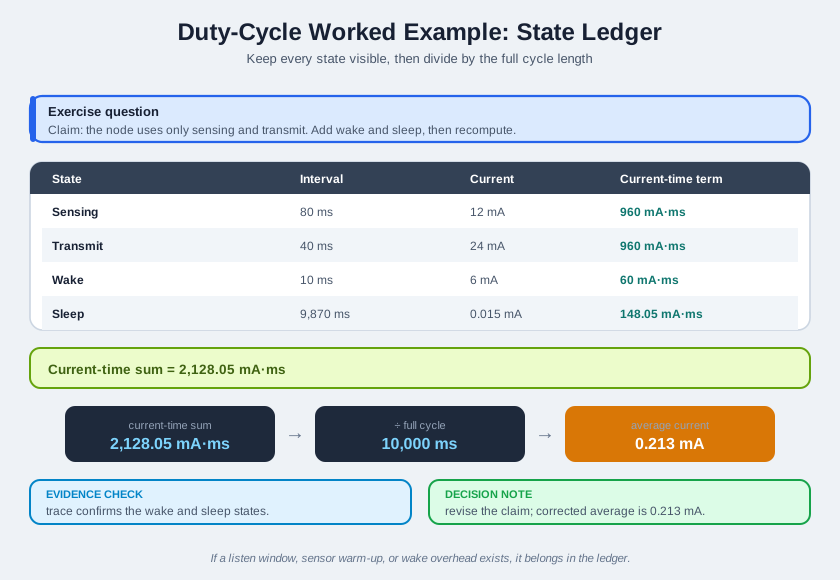
- The table adds wake and sleep, with each interval, current, and current-time term visible.
- Those four terms sum to 2,128.05 mA·ms; dividing by the full 10,000 ms cycle gives 0.213 mA average current.
- Worked examples matter because duty-cycle decisions usually fail in the gap between a neat percentage and an operating record.
Major section
Example 2: Solve For The Cycle Length
Question: A review record gives the maximum average current as 0.080 mA.
- Determine the cycle length that keeps the example at or below that budget.
- Step 3: interpret the answer: The cycle length must be at least about 44.1 s for the supplied values to meet the current budget.
- A shorter cycle can still work if another state is reduced, but that new design needs its own record.
Major section
Example 4: Explain A Measurement Gap
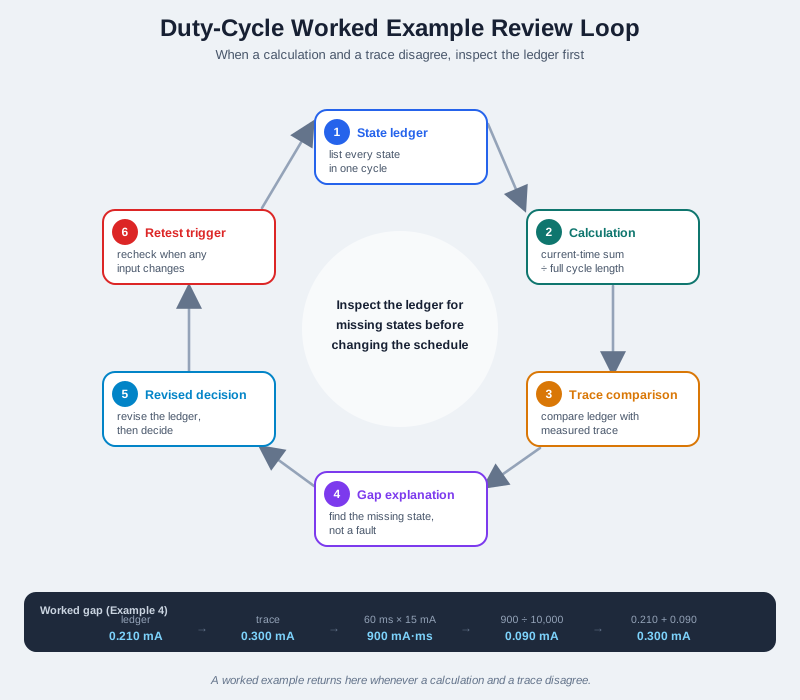
Question: A simple ledger predicts 0.210 mA, but a measured trace shows 0.300 mA.
- Decision: The measured trace is consistent with the missing guard-listen state.
- The gap is 0.300 mA: 0.210 mA = 0.090 mA.
- The final retest trigger matters because a change to the guard interval, radio current, or cycle time invalidates the reconciliation.
Major section
Example 5: Budget A Multi-Component Device
Question: The first four examples ledger one radio's states inside a single repeating cycle.
- A field device usually has several independently switchable subsystems instead of one radio, and the record has to show which combination of subsystems is active, not just how long any one of them runs.
- A cold-chain tracker tag has temperature, vibration, humidity, and light sensors plus a Bluetooth Low Energy (BLE) radio, a GPS receiver, and an LTE radio, each of which can be on or off separately.
- Mode A represents every sensor, the BLE radio, the GPS receiver, and the LTE modem left running.
Major section
Duty Cycle Becomes A Battery-Life Claim
Duty-cycle arithmetic is useful only when it stays tied to the review record.
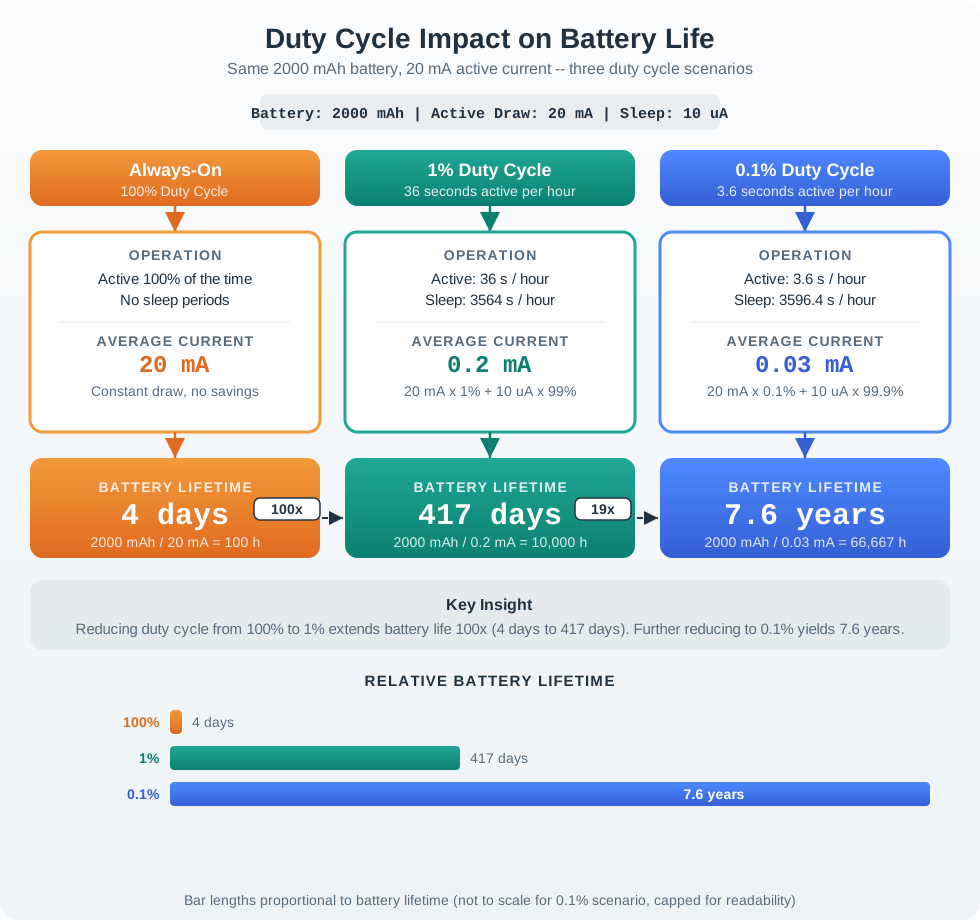
- The short chain is: a duty cycle sets an average current, average current divided into battery capacity gives lifetime, and the evidence record states which states were included or excluded.
- A 2000 mAh battery therefore gives an ideal life of 2000 mAh / 20 mA = 100 h, or about four days.
- The formula is reviewable only when the state rows are visible.
Major section
Duty Cycle Becomes A Battery-Life Claim (continued)
A node that sleeps 99% of the time may move from days to years of operation, but only if the ledger includes wake, listen, transmit, and sleep behavior instead of just the headline active fraction.
- The duty-cycled branch moves most time into sleep, so its average current is far below the active current and the estimate stretches toward years.
- That comparison is only a planning bound: wake-up, listening, self-discharge, temperature, and battery derating still belong in the state ledger before the lifetime claim is accepted.
- A sensor node is the same kind of accounting problem at smaller currents.
Major section
Duty Cycle Becomes A Battery-Life Claim (continued)
The ledger is not extra paperwork; it is the place where hidden always-on behavior becomes visible.
- The same average-current ledger can support an operating-life estimate, but the estimate inherits every assumption in the ledger.
- For a novice, the easiest mental model is a phone that spends most of the day with its screen off.
- Each arithmetic answer is a claim about one record, one set of states, and one evidence source.
Major section
Average Current To Lifetime
Two practical details keep this calculation honest.
- Second, the capacity number is not a perfect fuel tank.
- If active current dominates, shortening transmit time or reducing radio current can move the result.
- If sleep current dominates, a better active routine may barely matter; the useful work is finding leakage, sleep-mode mistakes, or always-on peripherals.
Major section
Sleep Current Sets The Floor
Sleep current becomes the floor on average current, and therefore the ceiling on battery life.
- It also explains why designers scrutinize leakage, brown-out circuitry, and always-on peripherals: at aggressive duty cycles, the microamps you cannot switch off are the whole game.
- The worked numbers are not just a lifetime estimate; they tell you which parameter to optimize next.
- Above that duty cycle, the active burst is still the larger contributor.
Major section
Sleep Current Sets The Floor (continued)
With Iactive = 20 mA and Isleep = 0.005 mA, the crossover is approximately D = 0.005 / (20 + 0.005) = 0.00025, or 0.025%.
- A 0.01% duty cycle is below the crossover, so a designer should first audit leakage, sleep-mode selection, regulator quiescent current, pull-up paths, and sensors left biased during sleep.
- The floor also explains why measurement traces can disagree with tidy ledgers.
- A meter set to average current may hide a short 24 mA transmit pulse, while a slow logging interval may miss a 6 mA wake ramp.
Deck summary
Key takeaways
Duty-cycle examples are useful when each calculation is tied to an evidence record.
- Duty cycle is an active fraction, but average current depends on every state in the cycle.
- Retest trigger: the change that makes the calculation stale.
- Question: A review record gives the maximum average current as 0.080 mA.
- Question: A simple ledger predicts 0.210 mA, but a measured trace shows 0.300 mA.
Retrieval practice
Recall check 1 of 3

Packet Pete says: answer from memory, then check your reasoning.
Q1A node draws 40 mA while active for 2 s and 0.05 mA while asleep for 98 s in each 100 s cycle. What is its average current?
Show answer
Answer: C Average current time-weights each mode: (40*2 + 0.05*98)/100 is about 0.85 mA.
Retrieval practice
Recall check 2 of 3
Packet Pete says: answer from memory, then check your reasoning.
Q2A duty-cycle example predicts 0.210 mA, but a trace shows 0.300 mA. The trace includes a 60 ms guard-listen state at 15 mA in a 10,000 ms cycle. How should the team reconcile the calculated current with the measured trace?
Show answer
Answer: C Worked examples should reconcile calculations with measurement evidence by making omitted states visible in the ledger.
Retrieval practice
Recall check 3 of 3
Packet Pete says: answer from memory, then check your reasoning.
Q3A node already at a 0.01% duty cycle needs longer battery life. Its active current is 20 mA and sleep current 5 uA. Which change helps most, and why?
Show answer
Answer: B I_avg = D*I_active + (1-D)*I_sleep; at very low duty cycles the sleep term dominates, so sleep current sets the lifetime floor and reducing it (deeper sleep, less leakage) helps far more than cutting the already-tiny active fraction.
Print reference
Answers
Answer key.
- C · Average current time-weights each mode: (40*2 + 0.05*98)/100 is about 0.85 mA.
- C · Worked examples should reconcile calculations with measurement evidence by making omitted states visible in the ledger.
- B · I_avg = D*I_active + (1-D)*I_sleep; at very low duty cycles the sleep term dominates, so sleep current sets the lifetime floor and reducing it (deeper sleep, less leakage) helps far more than cutting the already-tiny active fraction.