Specialized Architectures · Study deck
Duty Cycle Fundamentals
Think of a trail sensor that checks for an animal every few seconds.
Blueprint Bina is your guide for this deck.

After studying this chapter
Learning objectives
You will be able to:
- Explain: Social-sensing-based duty-cycle management targets rare-event monitoring, such as submarine or intrusion detection, where a node has to stay ready for an event that is uncommon by definition.
- Explain: The design question is therefore not "how low can the duty cycle be?" but "what wake schedule still preserves the application decision and makes missed or stale evidence visible?".
- Explain: A short event may occur entirely during sleep, and even a successfully stored reading may be too old for the downstream decision by the time it is delivered.
Major section
Start With One Battery Promise
A duty cycle is the share of time the sensor stays active.
- Latency means the delay between an event and the system response.
- A schedule is useful only when those failures still meet the real need.
- The simple average can hide short bursts and changing radio conditions.
- It also cannot prove how a battery ages outdoors.
Major section
Start With One Battery Promise (continued)
Under the Hood explains the models and limits behind those checks.
- A duty cycle is a promise that the node can save energy without hiding the event the system cares about.
- Track when it is awake, what it can observe, when it can communicate, and which evidence shows that the schedule still fits the application.
- That promise is easy to state and hard to prove because sleep, wake, sensing, radio time, buffering, and latency all change the meaning of a reading.
Major section
State Sequence
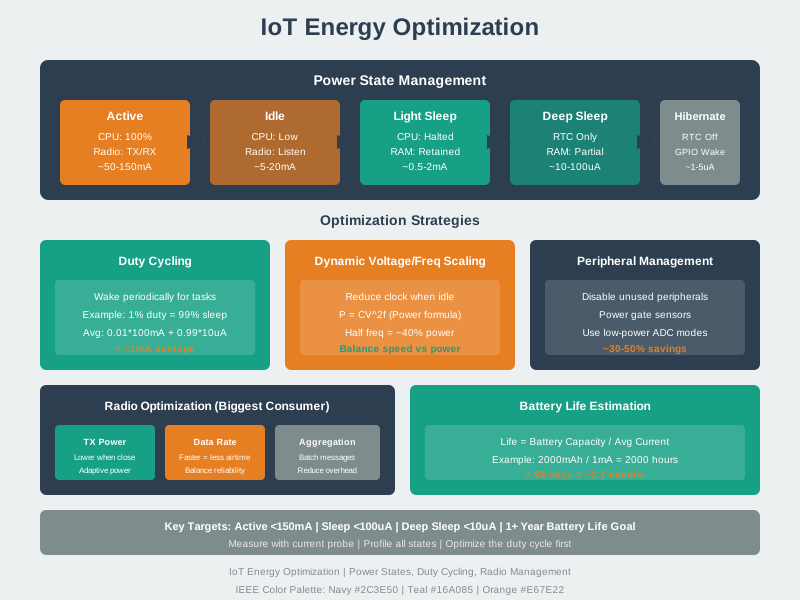
Most duty-cycled nodes repeat a small state sequence, but the energy and availability consequences depend on which states are actually entered.
- Deep sleep gives the smallest representative current but leaves the node unavailable; light sleep and idle restore progressively more circuitry before active work begins.
Major section
Latency And Missed Events
Lower duty cycle usually means the node is unavailable for longer spans.
- Detection latency grows when the node waits longer before checking a condition, while communication latency grows when a sender must wait for the receiver to wake.
- A short event may occur entirely during sleep, and even a successfully stored reading may be too old for the downstream decision by the time it is delivered.
- The design question is therefore not "how low can the duty cycle be?" but "what wake schedule still preserves the application decision and makes missed or stale evidence visible?".
Major section
Rendezvous Patterns
Duty cycling becomes harder when nodes need to communicate.
- Sender and receiver must overlap while awake.
- They fit stable neighborhoods and predictable traffic better than highly variable traffic.
- A sender may use repeated short wake-up signals or listen for a receiver's periodic checks.
- Adaptive schedules change wake behavior after traffic, events, or local state changes.
Major section
Named Adaptive Schemes
Two published approaches show what an adaptive-schedule review record can look like once the "changes schedule" and "returns to normal" conditions are made concrete.
- The energy savings come directly from not transmitting or relaying a reading that would not have changed the decision anyway.
- Social-sensing-based duty-cycle management targets rare-event monitoring, such as submarine or intrusion detection, where a node has to stay ready for an event that is uncommon by definition.
- Ordinary duty-cycle management does not distinguish rare events from regular ones, so a fixed schedule tends to under-sample the event that actually matters.
Major section
Review Record
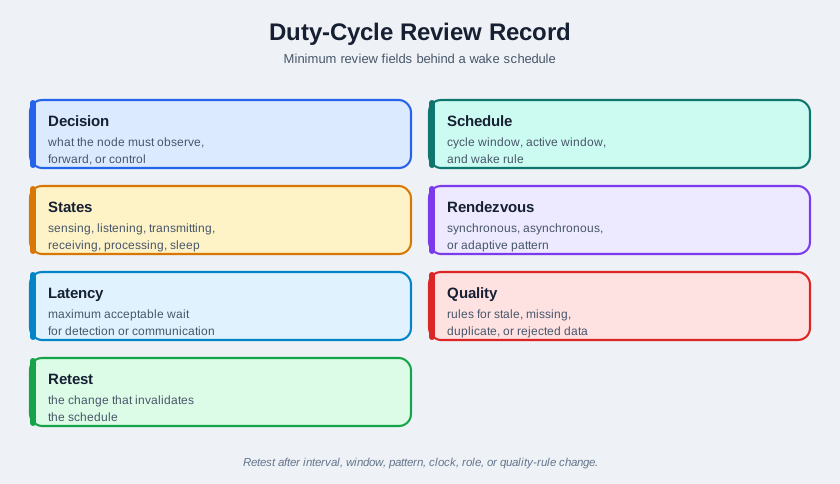
A duty-cycle plan should preserve the reasoning behind the schedule, not just its percentage.
- Finish with quality and retest: stale, missing, duplicate, or rejected records must remain distinguishable, and a changed traffic pattern, role, clock, or response requirement must reopen the review.
Major section
Worked Review: Periodic Condition Check
Scenario: a small sensor node checks a local condition and sends a short status record only when the reading passes the quality rule.
- The review must count the wake and listen states, not only the sensing state.
- Decision: The node needs to support a periodic condition review, not immediate alarm behavior.
- The active window includes wake overhead, sensing, a brief listen check, and optional communication.
- Latency: The acceptable latency is tied to the review interval.
Major section
Common Mistakes
A duty-cycle percentage is incomplete unless its cycle window is defined, and counting sensing time while omitting radio listen time makes even that estimate misleading.
- A symbolic current calculation must not be presented as a measurement.
- Lowering the active window also requires a latency and missed-event check: synchronized schedules must account for clock drift, while asynchronous ones must account for retries.
- Missing or stale data must remain visibly different from a normal reading.
Deck summary
Key takeaways
A duty cycle is the share of time the sensor stays active.
- Under the Hood explains the models and limits behind those checks.
- Most duty-cycled nodes repeat a small state sequence, but the energy and availability consequences depend on which states are actually entered.
- Lower duty cycle usually means the node is unavailable for longer spans.
- Duty cycling becomes harder when nodes need to communicate.
Retrieval practice
Recall check 1 of 2

Blueprint Bina says: answer from memory, then check your reasoning.
Q1A node senses for 10 seconds in each 300-second cycle, but the battery estimate omits a 2-second radio-listen window and wake-up overhead. What should the reviewer do before accepting the estimate?
Show answer
Answer: D Duty-cycle reasoning counts each active and sleep state over the repeating cycle, then checks whether the energy saving preserves communication overlap, latency, and event visibility.
Retrieval practice
Recall check 2 of 2
Blueprint Bina says: answer from memory, then check your reasoning.
Q2A node is configured with a very short active window, but the review record only lists the sensing duration. It does not include wake overhead, listen time, communication retries, stale-data handling, or the latency the application can tolerate. What is the strongest review feedback?
Show answer
Answer: D Duty-cycle fundamentals are reviewable when the active states, sleep state, wake rule, rendezvous behavior, latency need, data-quality rule, and retest trigger are visible.
Print reference
Answers
Answer key.
- D · Duty-cycle reasoning counts each active and sleep state over the repeating cycle, then checks whether the energy saving preserves communication overlap, latency, and event visibility.
- D · Duty-cycle fundamentals are reviewable when the active states, sleep state, wake rule, rendezvous behavior, latency need, data-quality rule, and retest trigger are visible.