Emerging Paradigms · Study deck
DTN Social Routing: Community and Forwarding Decisions
A popular node is not always the best carrier for a given community.
Blueprint Bina is your guide for this deck.
After studying this chapter
Learning objectives
You will be able to:
- Explain: TTL Impact:: Longer TTL values usually improve delivery in sparse networks because a copy has more time to encounter a better carrier or subscriber.
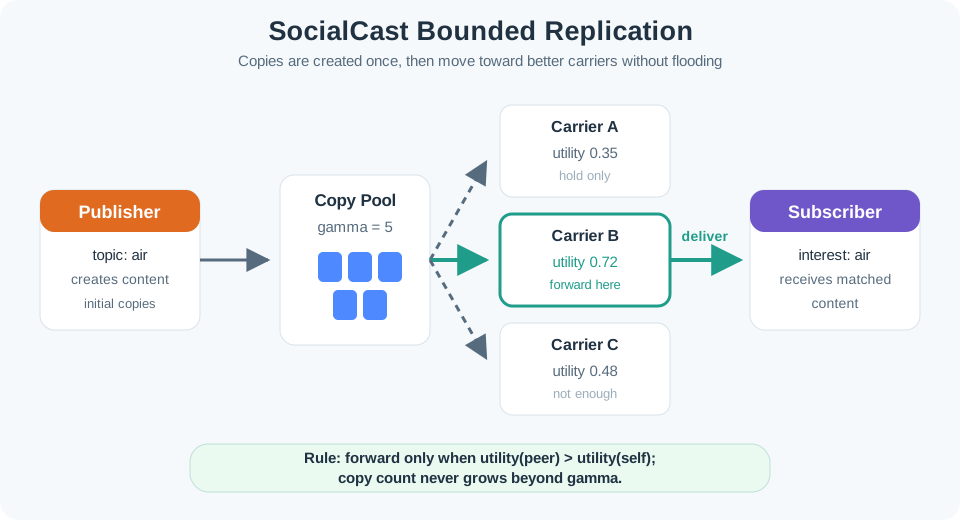
- Explain: b) Bounded replication limits resource consumption while maintaining useful delivery.: Gamma caps the copies, so fewer carriers store and transmit each message.
- Explain: Key Insight: SocialCast uses interest-specific predictions of subscriber colocation and connectivity change, with a hysteresis margin to limit oscillation.
- Explain: Routing decisions based on stale contact history (months old) may be less accurate than routing based on current network state.
Major section
Start With the Decision
A popular node is not always the best carrier for a given community.
- Social routing must balance group relevance, spread, and delivery cost.
- Subscriber participation: Subscribers with high utility can act as carriers.
Major section
Figure Summary: Gamma Trade-off
More replicas improve delivery because more carriers can discover useful contacts.
- In the same illustrative trace, epidemic routing delivers 95% with 800–1,200% overhead.
- TTL Impact:: Longer TTL values usually improve delivery in sparse networks because a copy has more time to encounter a better carrier or subscriber.
- The trade-off is buffer pressure: every extra hour of TTL keeps stale data in constrained devices longer.
Major section
Selection Workflow: Resource-Aware Teaching Score
A transfer decision requires the configured margin; these encounter rates do not establish delivery probability.
- Key Insight: SocialCast uses interest-specific predictions of subscriber colocation and connectivity change, with a hysteresis margin to limit oscillation.
- b) Bounded replication limits resource consumption while maintaining useful delivery.: Gamma caps the copies, so fewer carriers store and transmit each message.
- For battery-constrained IoT devices, this resource efficiency is critical.
Major section
Case Study: Community-Managed Mesh Links
Community Wi-Fi mesh networks are not automatically DTNs, and they are not formal SocialCast deployments.
- Utility function: local operators know which rooftop links, relays, or users are reliable.
- Bounded replication: popular files are cached on a small number of reliable mirrors instead of copied everywhere.
- Design lesson: social routing should be treated as an engineering trade-off, not a magic replacement for connectivity.
Major section
Social Contacts Are Not Stable
Work schedules, commuting patterns, and social behavior change over weeks and months.
- Routing decisions based on stale contact history (months old) may be less accurate than routing based on current network state.
- Betweenness centrality requires global network graph knowledge -- knowing all nodes and their interconnections.
- In a distributed DTN, this information is unavailable.
Major section
Contact Tracking Privacy Risks
Social routing requires nodes to share and track contact history.
- This creates detailed records of who met whom and when -- personal location data.
- Deployments must consider privacy implications and anonymization techniques.
- Publishing contact graphs can reveal sensitive information about individuals' movements.
Deck summary
Key takeaways
A popular node is not always the best carrier for a given community.
- More replicas improve delivery because more carriers can discover useful contacts.
- A transfer decision requires the configured margin; these encounter rates do not establish delivery probability.
- Community Wi-Fi mesh networks are not automatically DTNs, and they are not formal SocialCast deployments.
- Work schedules, commuting patterns, and social behavior change over weeks and months.
Retrieval practice
Recall check 1 of 4

Blueprint Bina says: answer from memory, then check your reasoning.
Q1In SocialCast with gamma=8 copies and configured hysteresis margin ε=0.1, Node A (utility 0.4) is carrying a message for destination D and encounters Node B (utility 0.7). What does Node A do according to the SocialCast forwarding rule?
Show answer
Answer: C SocialCast transfers a copy only when the neighbor's interest-specific utility exceeds the current carrier's by the configured hysteresis margin ε, which avoids oscillation; it delivers directly to interested subscribers when encountered.
Retrieval practice
Recall check 2 of 4

Blueprint Bina says: answer from memory, then check your reasoning.
Q2Place each SocialCast role where it lives so you can explain how a message reaches an interested subscriber without network-wide flooding.
Show answer
Answer: A SocialCast bounds replication at the source, hands copies to socially useful carriers, and delivers when a matching subscriber contact appears so you can audit why each forwarding step exists.
Q3Complete the SocialCast forwarding rule:
Show answer
Answer: A A SocialCast node transfers a copy only when the message has live copies n, time-to-live t has not expired, and peer interest-specific utility p exceeds current utility u by the configured hysteresis margin epsilon.
Retrieval practice
Recall check 3 of 4

Blueprint Bina says: answer from memory, then check your reasoning.
Q4In context-aware routing, what is the primary purpose of the utility function U(X, D)?
Show answer
Answer: Review the source
Q5Why does SocialCast use bounded replication (gamma copies) instead of unlimited replication like epidemic routing?
Show answer
Answer: Review the source
Retrieval practice
Recall check 4 of 4

Blueprint Bina says: answer from memory, then check your reasoning.
Q6A delivery vehicle (Vehicle B) passes city hall 3 times per day. Another vehicle (Vehicle A) passes it once per week. Using SocialCast's forwarding rule, what happens when Vehicle A carrying a message for city hall encounters Vehicle B?
Show answer
Answer: Review the source
Print reference
Answers 1 of 2
Answer key.
- C · SocialCast transfers a copy only when the neighbor's interest-specific utility exceeds the current carrier's by the configured hysteresis margin ε, which avoids oscillation; it delivers directly to interested subscribers when encountered.
- A · SocialCast bounds replication at the source, hands copies to socially useful carriers, and delivers when a matching subscriber contact appears so you can audit why each forwarding step exists.
Print reference
Answers 2 of 2
Answer key.
- A · A SocialCast node transfers a copy only when the message has live copies n, time-to-live t has not expired, and peer interest-specific utility p exceeds current utility u by the configured hysteresis margin epsilon.
- Review the source
- Review the source
- Review the source