Emerging Paradigms · Study deck

DTN Social Routing: Contact and Utility Models

A delay-tolerant node must choose a carrier before an end-to-end path exists.

Blueprint Bina is your guide for this deck.

adhocsocialrouting
Blueprint Bina, the module guide, in a scene from this chapter.
iotclass.org

After studying this chapter

Learning objectives

You will be able to:

  • Apply Context-Aware Routing: Use utility functions based on mobility, colocation, and resources
  • Design SocialCast Protocols: Implement social network-based forwarding with bounded replication
  • Calculate Utility Functions: Combine colocation probability, mobility scores, and resource levels
  • Optimize Forwarding Decisions: Select carriers based on delivery likelihood rather than flooding
iotclass.org

Major section

Begin With a Better Carrier

A protocol means an agreed set of rules for passing data.

  • One phone has a report for the clinic.
  • Copying it to every phone may waste space and power.
  • A better first choice may be a person who often reaches the clinic or meets people who do.
  • A popular carrier can become busy or reveal private patterns.
iotclass.org

Major section

Begin With a Better Carrier (continued)
Past contact can guide a choice, but people change shifts, routes, and habits.

  • Fewer copies save resources but may miss a rare path.
  • This simple story does not prove that social ties stay stable or that the score is fair.
  • Those deeper routes test the carrier rule before it becomes field policy.
  • The report expires tomorrow.
iotclass.org

Major section

Begin With a Better Carrier (continued)

A stopped copy is not always a failure; it may be the rule protecting the rest of the service.

  • Jo has more contacts but rarely goes near the clinic.
  • Lee may be the best next carrier.
  • Lee starts a new shift.
  • The old score may fail at once.
iotclass.org

Major section

Begin With a Better Carrier (continued)

If the report arrives, count the cost as well as the win.

  • The field record should stay easy to read.
  • It should say why one carrier won.
  • It should show the facts used that day.
  • It should show who did not get a fair chance.
iotclass.org

Major section

Start With the Node That Usually Meets the Right People

Social routing starts from an observation: in many mobile systems, contacts are not random.

  • Some devices, vehicles, people, or gateways regularly meet the communities that need the message.
  • For IoT deployments, that pattern can make forwarding more selective than flooding.
  • The routing question becomes whether past contact evidence is strong enough to trust the carrier with the next copy.
iotclass.org

Major section

Smart Messenger Service

"Instead of telling EVERYONE my message like in epidemic routing," said Temperature Terry, "what if I only tell people who are LIKELY to meet the person I'm trying to reach?".

  • the microcontroller snapped his fingers. "Like if you need to send a message to the school librarian, don't give copies to random strangers -- give it to kids who go to that school every day!".
  • the LED added, "And the best part is: you only make 5-10 copies instead of hundreds.
  • For battery-powered sensors, that savings means years more battery life!
iotclass.org

Major section

Key Concepts

Social Centrality: Node's position in a social network graph; highly central nodes (hubs) interact with many others and make better message carriers.

  • SimBet Routing: Combines social similarity (common contacts) and betweenness centrality to select next-hop carriers.
  • Bubble Routing: Messages stay in source community until a node with higher global centrality can carry them to the destination community.
  • Contact History: Past encounter records used to predict future contacts; stored in encounter tables indexed by node ID and time.

Why it matters

Homophily: Tendency for people to contact socially similar others; enables community-based routing to outperform random routing.

iotclass.org

Major section

Checkpoint: CAR Utility

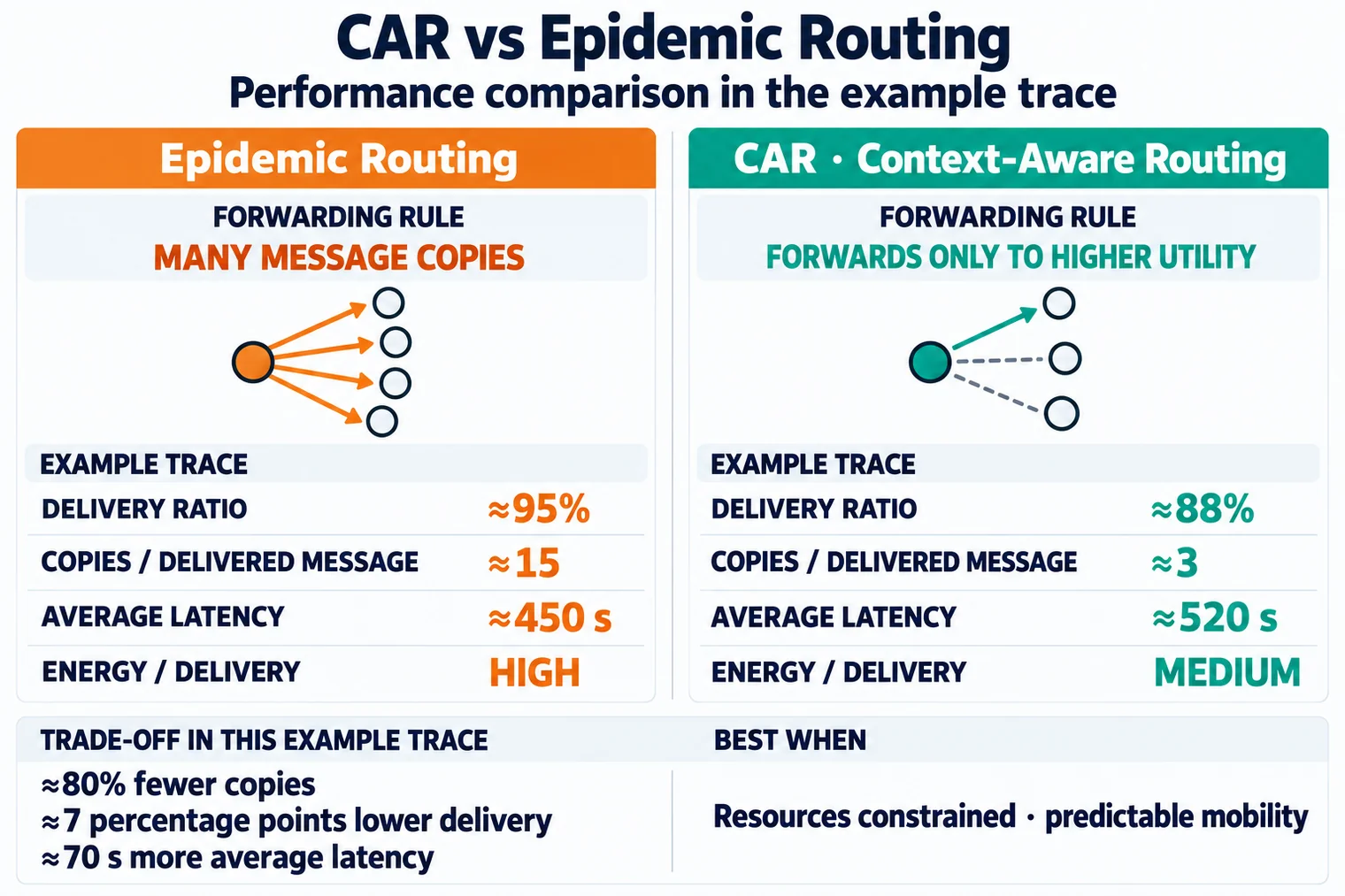
Energy per delivery: epidemic is high because many nodes carry copies; CAR is medium because it forwards selectively.

  • Delivery ratio: epidemic reaches about 95%; CAR reaches about 88%.
  • Average latency: epidemic is faster in this trace, about 450 seconds versus 520 seconds.

Numbers to remember

95%Delivery ratio: epidemic reaches about 95%
88%CAR reaches about 88%.
CAR versus epidemic routing trade-off for disconnected IoT networks
iotclass.org

Deck summary

Key takeaways

A protocol means an agreed set of rules for passing data.

  • Past contact can guide a choice, but people change shifts, routes, and habits.
  • A stopped copy is not always a failure; it may be the rule protecting the rest of the service.
  • If the report arrives, count the cost as well as the win.
  • Social routing starts from an observation: in many mobile systems, contacts are not random.
iotclass.org

Retrieval practice

Recall check 1 of 2

Blueprint Bina says: answer from memory, then check your reasoning.

Q1A DTN deployment forwards bundles through staff devices using contact-history scores. Delivery falls after staff schedules change. Which record should be reviewed first?

AThe forwarding record covering history-decay window, utility weights, replica budget, buffer policy, and privacy-approved contact evidence.
BOnly the payload encryption keys on the staff devices, because intact encryption shows the routing layer is still healthy.
COnly the original epidemic-routing baseline captured during the pilot, because social routing is supposed to ignore day-to-day changes in staff contacts.
DNo record at all, because bounded replication is designed to deliver with the same probability whatever the mobility pattern.
Show answer

Answer: A Social-routing evidence can drift when mobility patterns change, so the scoring window and forwarding policy need review.

iotclass.org

Retrieval practice

Recall check 2 of 2

Blueprint Bina says: answer from memory, then check your reasoning.

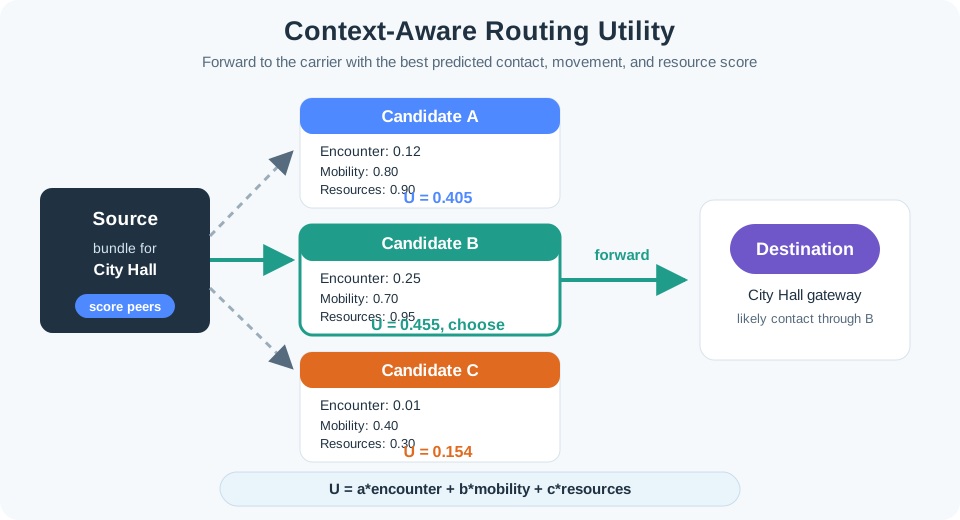
Q2In the CAR utility function U(X, D) = alpha * P_colocation + beta * Mobility + gamma * Resources, what does the colocation probability P_colocation(X, D) represent?

AThe physical distance between node X and destination D right now
BThe predicted likelihood that node X will encounter destination D
CThe number of hops between X and D in the current network topology
DThe battery level of node X relative to destination D
Show answer

Answer: B Colocation probability P_colocation(X, D) predicts how likely node X is to physically encounter destination D in the future, based on historical encounter patterns analyzed through Kalman filtering.

iotclass.org

Print reference

Answers

Answer key.

  1. A · Social-routing evidence can drift when mobility patterns change, so the scoring window and forwarding policy need review.
  2. B · Colocation probability P_colocation(X, D) predicts how likely node X is to physically encounter destination D in the future, based on historical encounter patterns analyzed through Kalman filtering.
iotclass.org