Emerging Paradigms · Study deck
Delay-Tolerant Networks: Disconnected Operations
This assumption fails in many IoT scenarios.
Blueprint Bina is your guide for this deck.

After studying this chapter
Learning objectives
You will be able to:
- Test disconnected ad hoc networks with a concrete scenario and pass criteria.
- Validate custody transfer is not delivery with a concrete scenario and pass criteria.
- test disconnected ad hoc networks with a concrete scenario and pass criteria
- validate custody transfer is not delivery with a concrete scenario and pass criteria
Major section
Disconnected Ad Hoc Networks
This assumption fails in many IoT scenarios.
- DSR: Route discovery fails if no connected path.
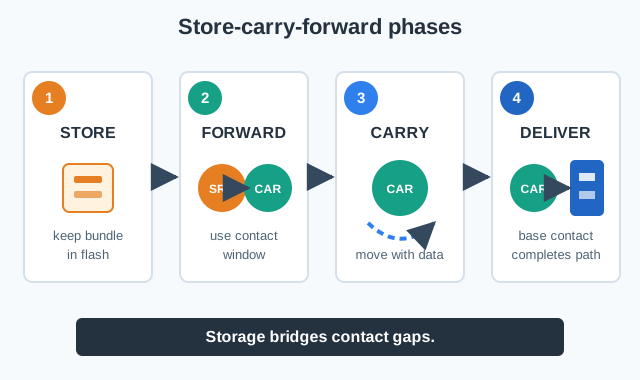
- The contact windows occur only at the first handoff and final delivery; between them, the carrier moves through a disconnected region while persistent storage protects the bundle.
Major section
Mobile Summary: Store-Carry-Forward
Deliver: The final carrier reaches a base station, gateway, or destination node.
- The Bundle Protocol packages application data into self-contained bundles that can survive long storage periods, custody transfer decisions, and multiple opportunistic contacts.
- Forward:: When encountering new nodes, forward buffered packets.
- The source records data and stores it as a bundle.
Major section
DTN Buffer Sizing for Tracking
Each collar collects GPS coordinates every 30 minutes and must deliver data to 3 base stations positioned at watering holes.
- The collar photo grounds the sizing assumptions in a constrained field device: the antenna, electronics enclosure, and battery must carry both sensing and opportunistic relay work.
- Each collar may carry copies for multiple other elephants.

Major section
DTN Buffer Sizing for Tracking (continued)
Each 32-byte record waits locally until another collar or one of the three base stations creates a usable contact window.
- Its buffer must survive the 4.2-day average base-station interval and the extra copies created by spray-and-wait, while its radio budget must cover brief exchanges without assuming a continuously reachable route.
- Step 2 -- Buffer sizing for spray-and-wait (L=6):: Each collar carries its own data PLUS replicas received from other elephants.
- With spray-and-wait, a source creates L=6 copies and distributes them to the first L/2 = 3 contacts.
Major section
Putting Numbers to It
For spray-and-wait routing with $L$ copies among $N$ nodes and $M$ base stations, delivery probability follows an exponential contact process.
- $$T_{wait} = \frac{1}{\frac{L}{2} \times \lambda_{eb}}$$.
- where $\lambda_{eb}$ is the elephant-to-base contact rate ($1/100.8$ hr$^{-1}$ in our case).
- With $L=6$ copies, this gives $T_{wait} = 33.6$ hours.
Deck summary
Key takeaways
This assumption fails in many IoT scenarios.
- Deliver: The final carrier reaches a base station, gateway, or destination node.
- Each collar collects GPS coordinates every 30 minutes and must deliver data to 3 base stations positioned at watering holes.
- Each 32-byte record waits locally until another collar or one of the three base stations creates a usable contact window.
- For spray-and-wait routing with $L$ copies among $N$ nodes and $M$ base stations, delivery probability follows an exponential contact process.
Retrieval practice
Recall check 1 of 4

Blueprint Bina says: answer from memory, then check your reasoning.
Q1A wildlife researcher wants to collect GPS data from collared zebras in a remote savanna with no cellular coverage. The collars have 100m radio range and zebras roam 5-20km apart. Which networking approach is appropriate?
Show answer
Answer: B DTN store-carry-forward is the only viable approach when no end-to-end path exists.
Retrieval practice
Recall check 2 of 4

Blueprint Bina says: answer from memory, then check your reasoning.
Q2A rural sensor kiosk only meets a data-collection bus twice per day. Why should it buffer readings locally instead of dropping them when the internet is unreachable?
Show answer
Answer: A The core DTN assumption is that no current end-to-end path may exist.
Retrieval practice
Recall check 3 of 4

Blueprint Bina says: answer from memory, then check your reasoning.
Q3Place each DTN role where it lives so you can follow a bundle through storage, movement without connectivity, and forwarding at contact.
Show answer
Answer: A Follow store, carry, and forward so you can distinguish delay tolerance from conventional routing that assumes a continuous path.
Q4What is the fundamental assumption that distinguishes DTN from traditional TCP/IP networking?
Show answer
Answer: B
Retrieval practice
Recall check 4 of 4

Blueprint Bina says: answer from memory, then check your reasoning.
Q5In the store-carry-forward paradigm, what does the "carry" phase involve?
Show answer
Answer: C
Q6Why would traditional routing protocols (DSDV, DSR, ZRP) fail in a wildlife tracking deployment where GPS-collared animals roam 5-20km apart?
Show answer
Answer: C
Print reference
Answers
Answer key.
- B · DTN store-carry-forward is the only viable approach when no end-to-end path exists.
- A · The core DTN assumption is that no current end-to-end path may exist.
- A · Follow store, carry, and forward so you can distinguish delay tolerance from conventional routing that assumes a continuous path.
- B
- C
- C