Emerging Paradigms · Study deck
Delay-Tolerant Networks: Design Principles
The ranger's boat may carry stored records to a base station hours later.
Blueprint Bina is your guide for this deck.

After studying this chapter
Learning objectives
You will be able to:
- Explain DTN Concepts: Describe Delay-Tolerant Networks and their fundamental assumptions about disconnection
- Analyze Disconnected Scenarios: Identify IoT applications where continuous connectivity is unavailable and justify DTN suitability
- Apply Store-Carry-Forward: Implement the core DTN paradigm for intermittent connectivity in real deployments
- Distinguish DTN from Traditional Routing: Compare DTN approaches with connected ad hoc protocols and evaluate when each is appropriate
Major section
Start Simple
A payload is the useful content inside a message.
- Latency means the time from making that message to the result that matters.
- The ranger's boat may carry stored records to a base station hours later.
- Eventual arrival is not enough if the record is too old or has lost meaning.
- The result should be easy to read.
Major section
Start Simple (continued)
The delayed path can carry history and planned work, but it cannot promise an immediate reply.
- This opening does not promise one delay or delivery chance.
- Under the Hood examines custody, buffer pressure, expiry, routing choices, energy, duplicates, and the limits of movement as a path.
- Storage use and power should remain visible.
Major section
Start Simple (continued)
Staff should see which record is new, which is late but useful, which expired, which was repeated, and which still waits.
- The final user should know the source time, not only the arrival time.
- If that person or rule is missing, the delayed service is not ready.
- A good result does not mean all data arrives at once.
Major section
Start With a Network That Is Usually Broken
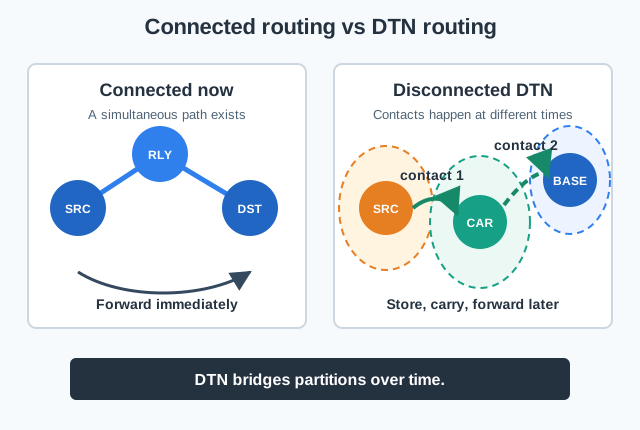
A delay-tolerant network assumes that end-to-end connectivity may not exist when a message is created.
- A node stores data, carries it through time and space, and forwards it when contact finally appears.
- That idea fits wildlife sensors, rural links, disaster response, ships, vehicles, and remote field work.
Major section
In 60 Seconds
DTN is not slow networking -- it is fundamentally different from TCP/IP because it assumes disconnection is normal, not a failure condition.
- Delay-Tolerant Networks use a store-carry-forward paradigm: a node stores a message locally, physically carries it while moving, and forwards opportunistically when encountering another node.
Major section
Minimum Viable Understanding
DTN is not "slow networking" -- it is fundamentally different from TCP/IP because it assumes disconnection is normal (not a failure), making it the only option for wildlife tracking, disaster zones, and rural areas without infrastructure.
- Delay-Tolerant Networks (DTN) enable communication where no continuous end-to-end path exists, using a store-carry-forward paradigm instead of traditional immediate forwarding.
Major section
The Traveling Mailbox
"Oh no!" cried Temperature Terry. "I need to send my temperature reading to the base station, but it's 10 kilometers away and my radio only reaches 100 meters!".
- Sammy could hand the message to the truck driver, the driver carries it across the desert, and drops it off at the base station!".
Major section
Key Concepts
Intermittent Connectivity: Characteristic of DTN environments; no end-to-end path exists simultaneously, contacts are opportunistic.
- Contact: Period when two DTN nodes can communicate; determined by proximity, mobility patterns, and communication range.
- Bundle Protocol: DTN's bundle layer (RFC 9171) stores and forwards bundles across intermittent links; BPv7 itself neither specifies custody transfer nor guarantees end-to-end delivery.
Major section
DTN and Social Routing Basics
Traditional networks assume you can call the post office anytime.
- Traditional routing fails completely.
- DTN: A network design that accepts disconnections and long delays as normal, closer to mail delivery than a phone call.
- Wildlife tracking, where animals rarely meet and infrastructure is unavailable.
- Rural connectivity, where a bus, drone, or vehicle can collect data periodically.
Major section
DTN and Social Routing Basics (continued)
Video streaming, because it requires continuous delivery.
- Real-time gaming or control loops, because they cannot tolerate minutes or hours of delay.
- DTN enables communication where traditional networking simply fails - you either use DTN or have no network at all!
- Understanding when to tolerate delays (hours) vs requiring real-time (milliseconds) is key to choosing the right IoT architecture.
Major section
Cross-Hub Connections
Simulations Hub: DTN simulators like The ONE Simulator for testing epidemic routing, spray-and-wait, and social-based protocols in realistic mobility scenarios.
- Knowledge Gaps Hub: Common DTN misconceptions including "DTN is just slow networking" and "epidemic routing wastes resources" clarifications.
Major section
DTN Is Not Just Slow Networking
The Misconception: Many students think DTN is simply traditional networking with high latency - like a slow internet connection.
- They assume DTN protocols are inefficient versions of TCP/IP that could be "fixed" with better routing algorithms.
- Assumption: End-to-end path exists when communication starts.
- Acceptance: Disconnection is normal, not a failure condition.
Major section
DTN Is Not Just Slow Networking (continued)
Infrastructure available (use Wi-Fi/cellular instead).
- Retransmission: Source resends if ACK not received (assumes path will reconnect).
- TCP gives up and reports "network unreachable.".
- Data reaches researchers after 3-7 day delay, which is acceptable for migration studies.
- Communication can tolerate hours/days delay.
Deck summary
Key takeaways
A payload is the useful content inside a message.
- The delayed path can carry history and planned work, but it cannot promise an immediate reply.
- Staff should see which record is new, which is late but useful, which expired, which was repeated, and which still waits.
- A delay-tolerant network assumes that end-to-end connectivity may not exist when a message is created.
- DTN is not slow networking -- it is fundamentally different from TCP/IP because it assumes disconnection is normal, not a failure condition.
Retrieval practice
Recall check

Blueprint Bina says: answer from memory, then check your reasoning.
Q1A wildlife collar stores hourly GPS bundles, meets other collars only every few days, and has limited flash storage. Which DTN record should be checked before field release?
Show answer
Answer: B DTN reliability depends on storage, contact, custody, expiry, and priority evidence, not just radio reachability.
Print reference
Answers
Answer key.
- B · DTN reliability depends on storage, contact, custody, expiry, and priority evidence, not just radio reachability.