Transport Protocols · Study deck
DTLS: Authentication Boundaries
A protected packet can still ask the wrong device to unlock a gate.
Packet Pete is your guide for this deck.

After studying this chapter
Learning objectives
You will be able to:
- bound confidentiality, integrity, identity, and permission claims
- choose PSK or certificate evidence for a device
- Explain: A protocol is an agreed set of exchange rules.
- Explain: A protected transport record may show that the message came through an approved peer path and was not changed in transit.
Major section
Start With the Identity Check
A protocol is an agreed set of exchange rules.
- Transport layer security is a way to protect a transport exchange.
- Datagram transport layer security (DTLS) protects messages carried by user datagram protocol (UDP).
- UDP sends separate packets without building a lasting connection first.
- These tests cover the stated threat, policy, keys, and software version.
Major section
Start With the Identity Check (continued)
A protected transport record may show that the message came through an approved peer path and was not changed in transit.
- They do not prove the whole system secure.
- The deeper sections explain handshakes, replay windows, identity choices, downgrade resistance, and the evidence needed to renew the claim after a change.
- Attack review then becomes a search for ways those records can be missing, stale, spoofed, or overclaimed.
Major section
Overview: DTLS Security Claims Need Boundaries
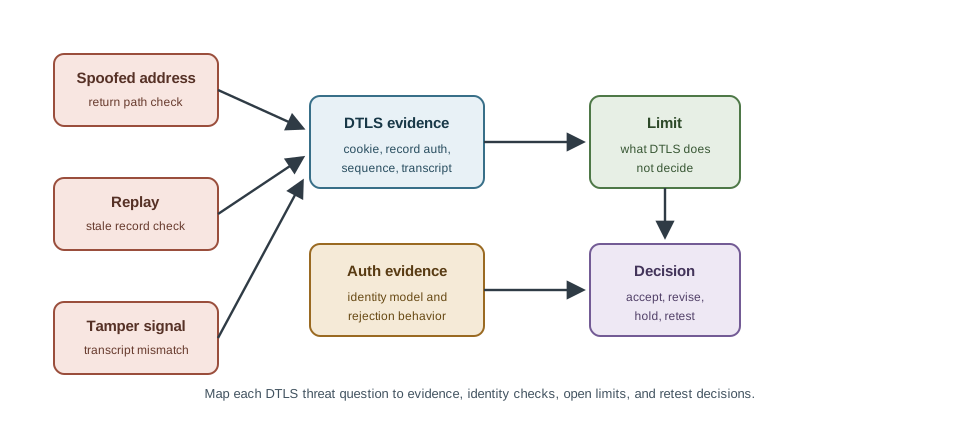
DTLS protects UDP traffic by adding handshake negotiation, record protection, replay checks, and peer authentication.
- A useful DTLS check names the exact threat or identity claim and keeps the conclusion inside the evidence the transport layer can actually provide.
- DTLS can help prove a protected transport path and a peer-identity decision.
Major section
Overview: DTLS Security Claims Need Boundaries (continued)
For IoT deployments, the common mistake is to write "DTLS is enabled" as if it proves device authorization, event validity, or safe actuation.
- Authorization, provisioning ownership, sensor validity, and application event handling remain separate checks.
- It still cannot say the command was safe to execute.
- Safe Scope This chapter is defensive.
Major section
Overview: DTLS Security Claims Need Boundaries (continued)
The three security claims above need a common route from question to bounded conclusion.
- For a replay claim, the record should show a normal protected record accepted and a duplicate protected record rejected or quarantined before the application treats it as a new event.
- For a peer-identity claim, the record should name the expected device or gateway role, the accepted PSK identity, certificate chain, raw public key, or pin, and the behavior when stale or wrong material appears.
- It describes how to verify bounded DTLS protection and authentication records.
Major section
Practitioner: Build the Check From Evidence, Not From Mode Names
A completed handshake is useful, but it is not the same thing as proving the intended identity was accepted and stale material was rejected.
- Without the rejection records, the check only proves the happy path.
- Challenge was required, incomplete attempts were bounded, accepted handshakes passed the challenge.
- Expected version, cipher policy, identity requirements, and failure behavior are visible.
- Accepted material, rejected material, trust source, owner, and retest trigger are named.
Major section
Under the Hood: Authentication Is a Repeatable Identity Decision
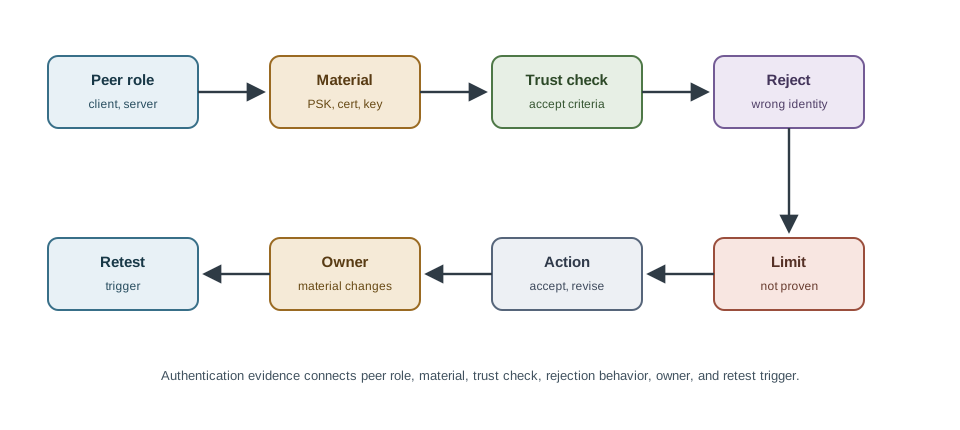
DTLS authentication is not one universal mechanism.
- Constrained IoT systems commonly use pre-shared keys, certificate-based authentication, raw public keys, or locally pinned identities.
- With certificates, the record should name the trust anchor, expected subject or SAN policy, validity window, chain result, and what happens to expired, revoked, or wrong-role certificates.
Major section
Under the Hood: Authentication Is a Repeatable Identity Decision (continued)
That result shows some identity was accepted, but not that the intended operational identity was accepted.
- The important audit question is whether the chosen model binds the expected peer role to the material that was accepted and to the behavior when material is wrong, stale, missing, or unexpected.
- A useful identity record therefore has two halves.
- Material Change Walkthrough A device moves from a lab identity to an operational identity store.
Major section
Under the Hood: Authentication Is a Repeatable Identity Decision (continued)
Authentication is repeatable only when another reviewer can reconstruct what identity was expected and what material was actually accepted.
- With PSK, the identity string and secret are the material under test: a completed handshake should be tied to the expected PSK identity, the provisioning source, the rotation owner, and a rejected old secret.
- With raw public keys or pinned keys, the record should explain how the bare key maps to the peer role and how replacement is governed.
- The check must compare expected peer role, material reference, trust source, rejection behavior for retired material, and the retest trigger.
Deck summary
Key takeaways
A protocol is an agreed set of exchange rules.
- A protected transport record may show that the message came through an approved peer path and was not changed in transit.
- DTLS protects UDP traffic by adding handshake negotiation, record protection, replay checks, and peer authentication.
- For IoT deployments, the common mistake is to write "DTLS is enabled" as if it proves device authorization, event validity, or safe actuation.
- The three security claims above need a common route from question to bounded conclusion.
Retrieval practice
Recall check 1 of 3

Packet Pete says: answer from memory, then check your reasoning.
Q1A deployment note says "DTLS is enabled, so the device commands are secure." What is the strongest first response?
Show answer
Answer: B DTLS checks should distinguish transport protection, peer identity, and application-layer decisions.
Retrieval practice
Recall check 2 of 3

Packet Pete says: answer from memory, then check your reasoning.
Q2A DTLS record shows one normal protected message accepted by a gateway. Which replay-handling evidence is still missing?
Show answer
Answer: C Replay checks need evidence for both accepted normal traffic and rejected duplicate or stale protected records.
Retrieval practice
Recall check 3 of 3

Packet Pete says: answer from memory, then check your reasoning.
Q3A device handshake completes after moving from lab credentials to an operational identity store, but the record does not name the accepted material. What conclusion is justified?
Show answer
Answer: D Authentication records must connect the completed handshake to the expected identity material and to rejection behavior for wrong or stale material.
Print reference
Answers
Answer key.
- B · DTLS checks should distinguish transport protection, peer identity, and application-layer decisions.
- C · Replay checks need evidence for both accepted normal traffic and rejected duplicate or stale protected records.
- D · Authentication records must connect the completed handshake to the expected identity material and to rejection behavior for wrong or stale material.