Emerging Paradigms · Study deck
Digital Twin Worked Examples
Picture a remote pump whose screen still shows "running" after the site loses contact.
Blueprint Bina is your guide for this deck.

After studying this chapter
Learning objectives
You will be able to:
- Explain: In Digital Twin Worked Examples, the practical question is what state must be synchronized, who acts on it, and what evidence proves the twin is still fit to use.
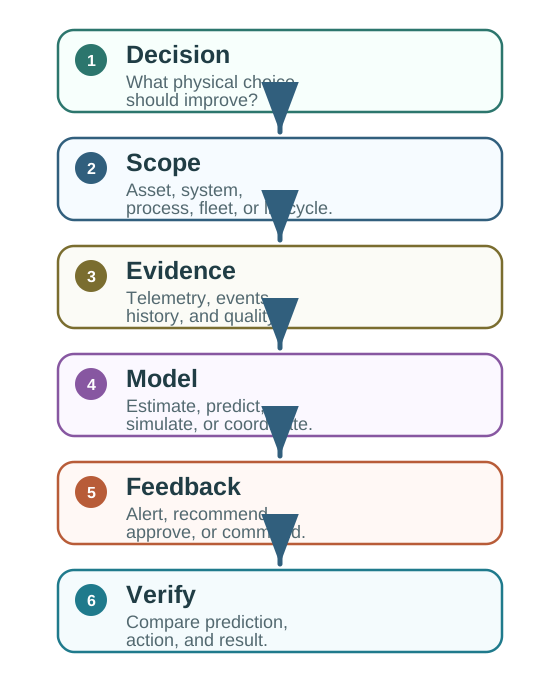
- Explain: For digital twins, that means naming the decision, bounding the model, choosing evidence, selecting a feedback path, planning failure behavior, and verifying the result.
- Explain: The team wants the twin to recommend whether to keep the current recipe, adjust a parameter, or hold the batch for review.
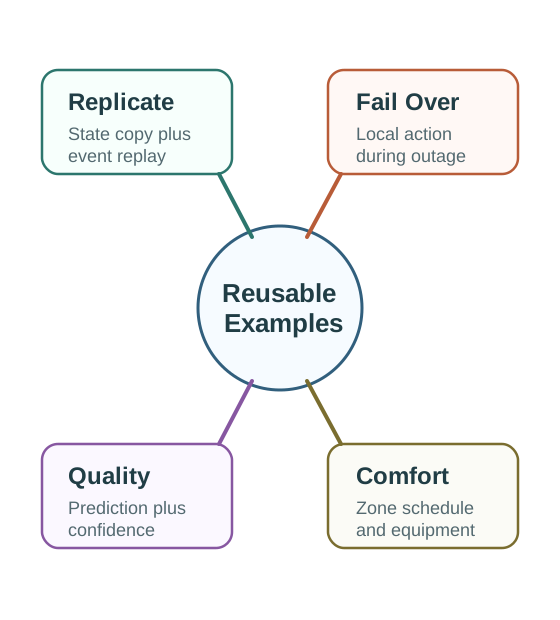
- Explain: The deeper cases show how selective copies, local failover, prediction checks, feedback, and retest rules support different physical decisions.
Major section
Start Simple
The model may hold the last known state, but an operator could mistake that old state for a live one.
- The first design task is to separate what is known, what is predicted, and what must remain safe at the pump.
- Telemetry means readings and status sent by a remote device.
Major section
Start Simple (continued)
Break the link, delay an event, repeat an update, restart the model, and change the pump locally.
- This example does not prove every model or control system.
- The deeper cases show how selective copies, local failover, prediction checks, feedback, and retest rules support different physical decisions.
- In Digital Twin Worked Examples, the practical question is what state must be synchronized, who acts on it, and what evidence proves the twin is still fit to use.
Major section
In 60 Seconds
Worked examples are useful only when the reasoning transfers to a new system.
- For digital twins, that means naming the decision, bounding the model, choosing evidence, selecting a feedback path, planning failure behavior, and verifying the result.
Major section
Minimum Viable Understanding
Worked examples are decision templates.: Copy the reasoning, not the numbers.
- The physical action controls the architecture.: Safety actions stay local; advisory actions can involve slower review paths.
- Replication is selective.: Critical current state, historical records, and raw telemetry do not need the same storage or synchronization treatment.
Major section
Remote Asset State Replicas
A remote asset fleet has local controllers, a site gateway, and a cloud service.
- Operators need current asset state for decisions, but the network can be intermittent.
- The twin must preserve important events, answer recent-state queries, and continue local protection when the wide-area link is unavailable.
Major section
Safety Action Failover
A safety-relevant event occurs while the site gateway is degraded.
- The local controller must act according to approved rules, and the wider twin must reconstruct the timeline after connectivity returns.
- Act within guardrails: The controller applies only actions that are pre-approved for the degraded state.
Major section
Example 3: Process Quality Twin
A production cell has repeated operations with measurable inputs, process settings, equipment state, and quality outcomes.
- The team wants the twin to recommend whether to keep the current recipe, adjust a parameter, or hold the batch for review.
- One process cell, recipe settings, machine state, material batch, environmental context, and quality check results.
Major section
Comfort and Scheduling Twin
A teaching building has rooms, schedules, HVAC zones, occupancy evidence, air quality readings, and comfort complaints.
- The twin should recommend whether to pre-condition rooms before occupancy and identify which zone may need inspection.
- Rooms connect to zones, zones connect to equipment, equipment connects to maintenance records, and schedules connect to occupancy expectations.
Major section
Practice Checks
A remote site has intermittent connectivity.
- A safety-relevant command was issued locally during an outage.
- A process model recommends changing a setting but reports low confidence.
- A building comfort twin predicts a room will be ready, but complaints arrive after occupancy.
Deck summary
Key takeaways
The model may hold the last known state, but an operator could mistake that old state for a live one.
- Break the link, delay an event, repeat an update, restart the model, and change the pump locally.
- Worked examples are useful only when the reasoning transfers to a new system.
- Worked examples are decision templates.: Copy the reasoning, not the numbers.
- A remote asset fleet has local controllers, a site gateway, and a cloud service.
Retrieval practice
Recall check 1 of 2

Blueprint Bina says: answer from memory, then check your reasoning.
Q1A remote asset twin loses its cloud link but the local controller still has current alarm state, command status, and protection rules. Which design principle does this demonstrate?
Show answer
Answer: B Edge or site-local state supports continuity during network loss, while delayed history can be replayed later.
Retrieval practice
Recall check 2 of 2

Blueprint Bina says: answer from memory, then check your reasoning.
Q2Place each worked-example element where it lives so you can reuse the reasoning without copying unsupported numbers.
Show answer
Answer: A Separate decision evidence, bounded computation, and action verification so you can transfer the method while recalculating local assumptions.
Print reference
Answers
Answer key.
- B · Edge or site-local state supports continuity during network loss, while delayed history can be replayed later.
- A · Separate decision evidence, bounded computation, and action verification so you can transfer the method while recalculating local assumptions.