Emerging Paradigms · Study deck

Digital Twin Fit and Use Cases

The same patterns appear across many domains.

Blueprint Bina is your guide for this deck.

digitaltwinscases
Blueprint Bina, the module guide, in a scene from this chapter.
iotclass.org

After studying this chapter

Learning objectives

You will be able to:

  • Classify digital twin use cases by decision pattern rather than industry label.
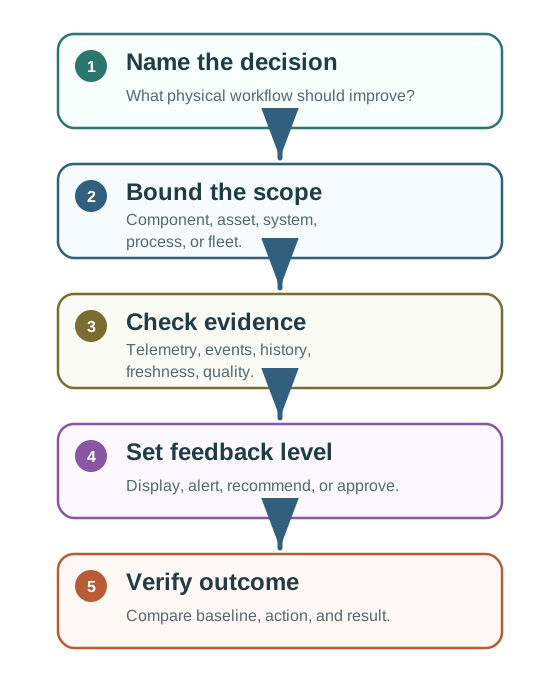
  • Choose an appropriate twin scope: component, asset, system, process, fleet, or lifecycle.
  • Identify the records and feedback path required for a candidate use case.
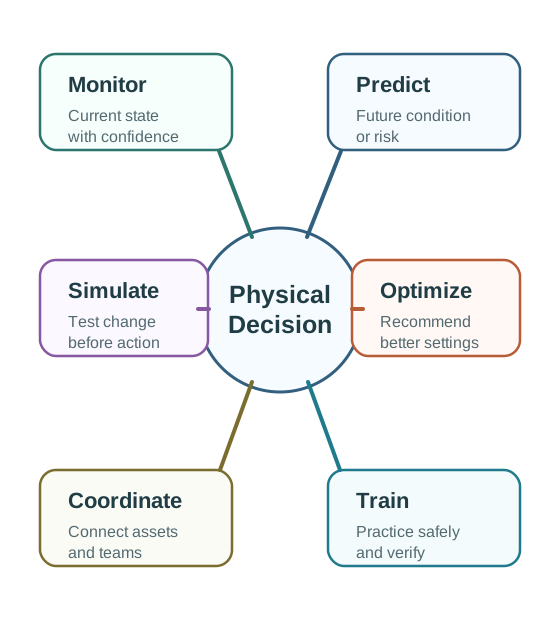
  • Distinguish monitoring, prediction, simulation, optimization, coordination, and training use cases.
iotclass.org

Major section

In 60 Seconds

A digital twin use case is not a sector story or a dashboard feature list.

  • Good use cases start small enough to verify and important enough to change a real workflow.
Digital twin use case pattern map.
iotclass.org

Major section

Minimum Viable Understanding

Sector labels are secondary.: Manufacturing, buildings, healthcare, cities, energy, and logistics reuse the same few patterns.

  • Proof matters more than slogans.: A useful case record includes baseline state, model assumptions, synchronization quality, action record, and outcome checks.
  • Feedback level must match risk.: Some use cases only advise; others automate.
  • The allowed feedback path should be explicit.
Digital twin use case pattern map.
iotclass.org

Major section

Common Use Case Families

Recommend inspection, change maintenance priority, create a work order, or adjust operating conditions inside approved limits.

  • Process parameters, batch records, product quality checks, equipment state, environment, operator events, and material inputs.
  • Recommend parameter changes, flag at-risk batches, compare what-if settings, or hold a process for approval.
Digital twin use case pattern map.
iotclass.org

Major section

Scope Levels

Scope should match the decision.

  • A broader scope is justified only when the decision needs broader relationships.
  • Many similar assets that share models, record patterns, operating policies, or exception workflows.
  • Design, commissioning, operation, maintenance, change, and retirement records tied to a physical entity.
Digital twin use case pattern map.
iotclass.org

Major section

Red Flags

The use case has a sector name but no decision owner.

  • The model displays data but cannot explain, predict, simulate, or recommend.
  • The feedback path is automatic even though the risk calls for approval.
  • The team cannot say what proof would show the use case failed.
Digital twin use case pattern map.
iotclass.org

Deck summary

Key takeaways

A digital twin use case is not a sector story or a dashboard feature list.

  • Sector labels are secondary.: Manufacturing, buildings, healthcare, cities, energy, and logistics reuse the same few patterns.
  • Recommend inspection, change maintenance priority, create a work order, or adjust operating conditions inside approved limits.
  • Scope should match the decision.
  • The use case has a sector name but no decision owner.
iotclass.org

Retrieval practice

Recall check 1 of 3

Blueprint Bina says: answer from memory, then check your reasoning.

Q1A team says its use case is 'smart factory digital twin' with many dashboards but no decision owner, model behavior, or feedback path. What should they do next?

AWrite a use-case record for one concrete decision, such as inspection priority or recipe adjustment
BAdd more live dashboards for every remaining machine on the factory floor first
CBuy a physically larger server so it can store far more sensor history data
DRename the whole project so that it simply sounds more specific to reviewers
Show answer

Answer: A A digital-twin use case begins with one concrete decision, its records, model behavior, and feedback path, not a dashboard list.

iotclass.org

Retrieval practice

Recall check 2 of 3

Blueprint Bina says: answer from memory, then check your reasoning.

Q2Place each use-case element where it lives so you can decide whether a proposed twin has an accountable outcome loop.

APhysical decision
BDecorative icon
CUnrelated headline
DRaw file path
Show answer

Answer: A Separate the decision record, bounded model, and governed outcome loop so you can reject twin proposals that lack authority, scope, or verification.

iotclass.org

Retrieval practice

Recall check 3 of 3

Blueprint Bina says: answer from memory, then check your reasoning.

Q3A team says their use case is 'smart factory digital twin.' They have sensor dashboards for many machines, but no defined decision owner, model behavior, or feedback path. What should they do next?

AProceed straight to rollout, because broad sensor coverage already proves this is a digital twin use case
BWrite a use case record for one concrete decision, such as inspection priority or recipe adjustment
CCommission a detailed 3D model of the whole factory floor before choosing any decision
DPostpone all verification work until every machine in the whole factory has been modeled
Show answer

Answer: B A focused use case record turns a vague smart-factory label into a verifiable twin decision.

iotclass.org

Print reference

Answers

Answer key.

  1. A · A digital-twin use case begins with one concrete decision, its records, model behavior, and feedback path, not a dashboard list.
  2. A · Separate the decision record, bounded model, and governed outcome loop so you can reject twin proposals that lack authority, scope, or verification.
  3. B · A focused use case record turns a vague smart-factory label into a verifiable twin decision.
iotclass.org