Emerging Paradigms · Study deck
Digital Twin Sync and Modeling
Picture a screen model of a warehouse door.
Blueprint Bina is your guide for this deck.

After studying this chapter
Learning objectives
You will be able to:
- Explain: In this twin model, an event rule that sends when change exceeds 0.2 °C can shorten that gap, but only if the edge device continues measuring and the threshold itself is valid near the fault.
- Explain: If edge and cloud clocks disagree, a new twin update can appear older than the state it should replace.
- Explain: The model says the door is closed, but a delayed field update is still travelling through the system.
- Explain: Conflict rules should identify the authoritative source for each field and the degraded behavior when evidence is missing.
Major section
Start Simple
The model says the door is closed, but a delayed field update is still travelling through the system.
- An operator acts on the neat picture and sends a worker into an unsafe area.
- A model without time can look certain while being wrong.
- A digital twin is a useful model linked to a real thing or process.
Major section
Start Simple (continued)
Telemetry means the readings and status sent from that real system.
- Message Queuing Telemetry Transport (MQTT) is one common way to carry those updates.
- For each model value, keep the source, event time, arrival time, unit, quality, and model version.
- The display should reveal stale or conflicting state instead of quietly showing an old value as current.
Major section
Set a Twin Cadence for a Cooling Tank
In this twin model, an event rule that sends when change exceeds 0.2 °C can shorten that gap, but only if the edge device continues measuring and the threshold itself is valid near the fault.
- Sync quality also depends on a common time base.
- Model updates need their own version.
Major section
Set a Twin Cadence for a Cooling Tank (continued)
If edge and cloud clocks disagree, a new twin update can appear older than the state it should replace.
- A new heat-transfer coefficient can change predicted tank temperature even when no new sensor value arrives.
- The digital twin should record which model version made each forecast.
- Measured temperature, estimated temperature, and commanded setpoint also need separate names.
- The digital twin must show the value and its nine-minute age as separate facts.
Major section
Summary
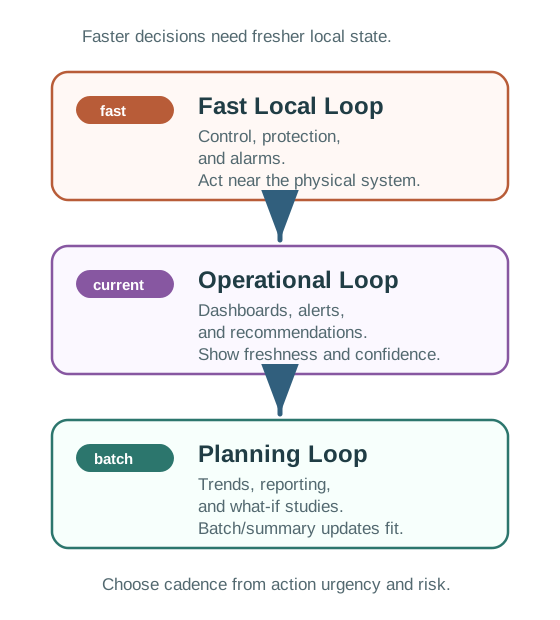
Synchronization cadence should be selected from decision speed, physical dynamics, and stale-data risk.
- Conflict rules should identify the authoritative source for each field and the degraded behavior when evidence is missing.
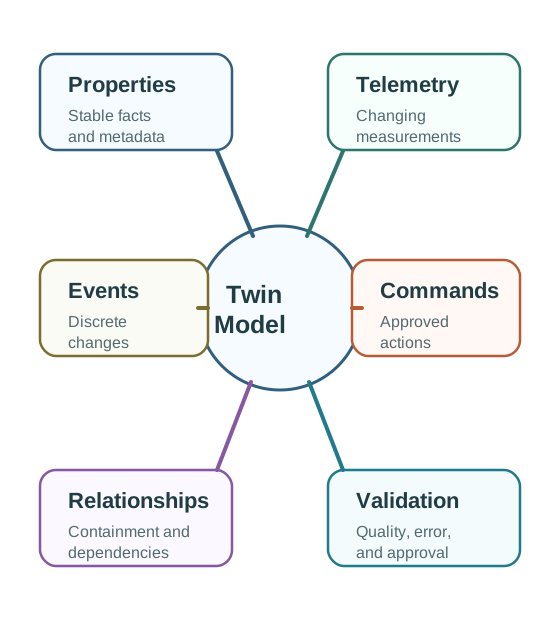
- Twin models need properties, telemetry, events, commands, relationships, and validation records.
- Relationship graphs support dependency queries that isolated sensor streams cannot answer.
Deck summary
Key takeaways
The model says the door is closed, but a delayed field update is still travelling through the system.
- Telemetry means the readings and status sent from that real system.
- In this twin model, an event rule that sends when change exceeds 0.2 °C can shorten that gap, but only if the edge device continues measuring and the threshold itself is valid near the fault.
- If edge and cloud clocks disagree, a new twin update can appear older than the state it should replace.
- Synchronization cadence should be selected from decision speed, physical dynamics, and stale-data risk.
Retrieval practice
Recall check 1 of 3

Blueprint Bina says: answer from memory, then check your reasoning.
Q1A team wants every sensor to stream to the digital twin once per second because faster sounds more accurate. What is the better design rule?
Show answer
Answer: A A synchronization cadence should be justified by the decision the twin supports and the risk created by stale or missing state.
Retrieval practice
Recall check 2 of 3

Blueprint Bina says: answer from memory, then check your reasoning.
Q2A pump twin shows outlet pressure as normal, but that value was last observed 38 minutes ago. The twin is used to recommend whether an operator should restart the pump after a trip. What should the system do?
Show answer
Answer: A Freshness and degraded-mode behavior must be explicit before a twin influences physical action.
Retrieval practice
Recall check 3 of 3

Blueprint Bina says: answer from memory, then check your reasoning.
Q3A room twin knows the current temperature but not which air handler serves the room. Which modeling weakness is most likely to limit useful decisions?
Show answer
Answer: A A twin becomes operationally useful when telemetry is connected to relationships, commands, assumptions, and validation records.
Print reference
Answers
Answer key.
- A · A synchronization cadence should be justified by the decision the twin supports and the risk created by stale or missing state.
- A · Freshness and degraded-mode behavior must be explicit before a twin influences physical action.
- A · A twin becomes operationally useful when telemetry is connected to relationships, commands, assumptions, and validation records.