Emerging Paradigms · Study deck
Digital Twins Across Industries
Imagine a cold store that has a digital model of each room.
Blueprint Bina is your guide for this deck.

After studying this chapter
Learning objectives
You will be able to:
- Map common digital twin patterns to manufacturing, buildings, healthcare, cities, energy, and logistics.
- Distinguish monitoring twins, simulation twins, optimization twins, and lifecycle twins.
- Explain why sector examples should be evaluated with proof rather than copied as fixed value stories.
- Build an industry application record with decision owner, model scope, data sources, feedback loop, and verification method.
Major section
Start Simple · In 60 Seconds · Minimum Viable Understanding
The model can show temperature, door state, and cooling demand.
- Leave out detail that cannot change this choice.
- Latency means the time from a physical event to the result that needs it: Set a limit for each fact.
- A monthly energy study can wait.
- A warming alarm cannot.
Major section
Application Patterns · Most Valuable Understanding
Industry examples are easiest to compare when they are grouped by what the twin is asked to do.
- Represent current asset, process, or environment state so operators can see what is happening now and whether the model is synchronized.
- Recommend better settings, maintenance windows, dispatch plans, energy schedules, or process parameters based on model records.
- Preserve the digital thread from design, commissioning, operation, maintenance, change, and retirement.
Major section
Sector Patterns
Vibration, temperature, current, quality, cycle state, and maintenance records.
- Their value often comes from hierarchy: room, floor, building, site, and portfolio views can use the same operating records differently.
- Without that relationship model, the twin becomes a collection of sensor charts rather than a building decision system.
- Healthcare twins can represent equipment, clinical workflows, facilities, or patient-specific models.
Major section
Sector Patterns (continued)
Imaging, device telemetry, clinician annotations, lab results, and workflow events.
- Privacy and consent controls.
- Clear separation between decision support and automated clinical action.
- A patient-specific simulation is not the same thing as a hospital operations twin, and neither should be used beyond its validated purpose.
- They support both real-time awareness and longer-horizon investment decisions.
Major section
Sector Patterns (continued)
They often need multiple levels of detail because modeling everything at maximum fidelity is not practical.
- This order connects the model to an accountable public-service decision instead of treating simulation as an end in itself.
- Operating limits and safety constraints.
- Finish by naming which local control remains authoritative when upstream coordination is unavailable.
Major section
Sector Patterns (continued)
Patient-centered twins require stronger governance because the model may influence care decisions.
- That sequence keeps simulation, maintenance, and degraded operation tied to the same current topology and operating-state evidence.
- A planning twin can be slower and richer; a control twin must be bounded and validated.
- Logistics twins often depend on event freshness and exception handling more than geometric detail.
Major section
Combining Patterns · Industry Application Record
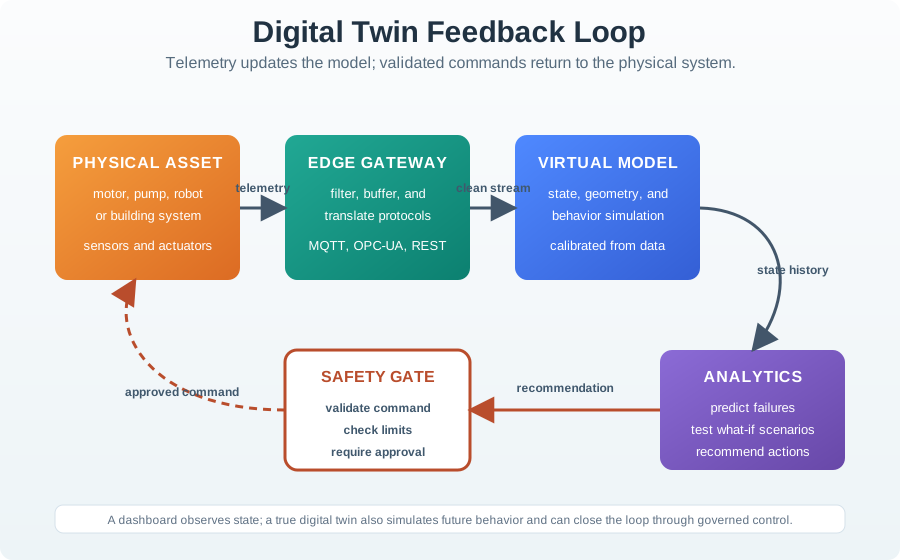
A warehouse twin may use edge filtering for conveyor telemetry, a hierarchical site model for equipment and zones, simulation for layout changes, and a lifecycle record for maintenance history.
- The point is to choose the combination deliberately rather than collecting technology features.
- The operational or planning decision the twin is expected to improve.
- How current the twin must be, how stale data is detected, and how conflicts are resolved.
Major section
Comfort and Energy Twin · Scenario
A campus team wants one twin to support occupant comfort, HVAC maintenance, and energy planning.
- The team has room sensors, equipment alarms, space schedules, and work-order history.
Major section
Common Mistakes · Practice Checks · Match Application Patterns
An aircraft, city, hospital, or factory example does not transfer automatically.
- A polished 3D scene can help communication, but it does not prove synchronization, prediction, simulation, or action quality.
- A stale twin can make confident wrong recommendations.
- Every application needs a freshness rule and a visible stale-state behavior.
Major section
Summary · Key Takeaway
Digital twin industry applications are best understood as reusable decision patterns.
- Across all sectors, a useful twin is judged by model scope, record quality, synchronization, action path, and verified outcome.
- An industry digital twin is valuable when synchronized state changes an operational decision.
- The twin must connect asset data, model assumptions, update cadence, and accountable actions in the specific domain.
Deck summary
Key takeaways
The model can show temperature, door state, and cooling demand.
- Industry examples are easiest to compare when they are grouped by what the twin is asked to do.
- Vibration, temperature, current, quality, cycle state, and maintenance records.
- Imaging, device telemetry, clinician annotations, lab results, and workflow events.
- They often need multiple levels of detail because modeling everything at maximum fidelity is not practical.
Retrieval practice
Recall check 1 of 6

Blueprint Bina says: answer from memory, then check your reasoning.
Q1A factory twin compares possible machine settings before anyone changes the line. Which twin use is being tested?
Show answer
Answer: C Simulation of alternatives before intervention.
Retrieval practice
Recall check 2 of 6
Blueprint Bina says: answer from memory, then check your reasoning.
Q2A factory digital twin shows live machine status but never changes maintenance planning, settings, alarms, or operator actions. What is its main weakness?
Show answer
Answer: A A twin that only displays data is a dashboard; a useful twin supports a monitored, simulated, or closed-loop decision.
Retrieval practice
Recall check 3 of 6
Blueprint Bina says: answer from memory, then check your reasoning.
Q3A factory twin displays live machine status but never changes maintenance planning, process settings, alarms, or operator actions. What is the main weakness?
Show answer
Answer: B A useful application must connect model records to a decision, recommendation, simulation, or controlled action.
Retrieval practice
Recall check 4 of 6
Blueprint Bina says: answer from memory, then check your reasoning.
Q4What represents only the scoped behaviour and state supported by a digital twin's records?
Show answer
Answer: D It represents only the scoped behaviour and state supported by those records.
Retrieval practice
Recall check 5 of 6
Blueprint Bina says: answer from memory, then check your reasoning.
Q5A city team wants to model an entire district, but only one transit corridor is under active redesign. Which modeling approach is most appropriate?
Show answer
Answer: C This is a multi-fidelity approach: detailed where the active decision needs it, lighter elsewhere for context.
Retrieval practice
Recall check 6 of 6
Blueprint Bina says: answer from memory, then check your reasoning.
Q6A campus team wants to copy a published smart-building twin case study across every building. Which record best proves the first deployment is ready?
Show answer
Answer: B Industry examples transfer only when the local decision, records, model scope, feedback path, and verification baseline are proven.
Print reference
Answers 1 of 2
Answer key.
- C · Simulation of alternatives before intervention.
- A · A twin that only displays data is a dashboard; a useful twin supports a monitored, simulated, or closed-loop decision.
- B · A useful application must connect model records to a decision, recommendation, simulation, or controlled action.
- D · It represents only the scoped behaviour and state supported by those records.
- C · This is a multi-fidelity approach: detailed where the active decision needs it, lighter elsewhere for context.
Print reference
Answers 2 of 2
Answer key.
- B · Industry examples transfer only when the local decision, records, model scope, feedback path, and verification baseline are proven.