Emerging Paradigms · Study deck
Digital Twin Concepts and Scenario Assessment
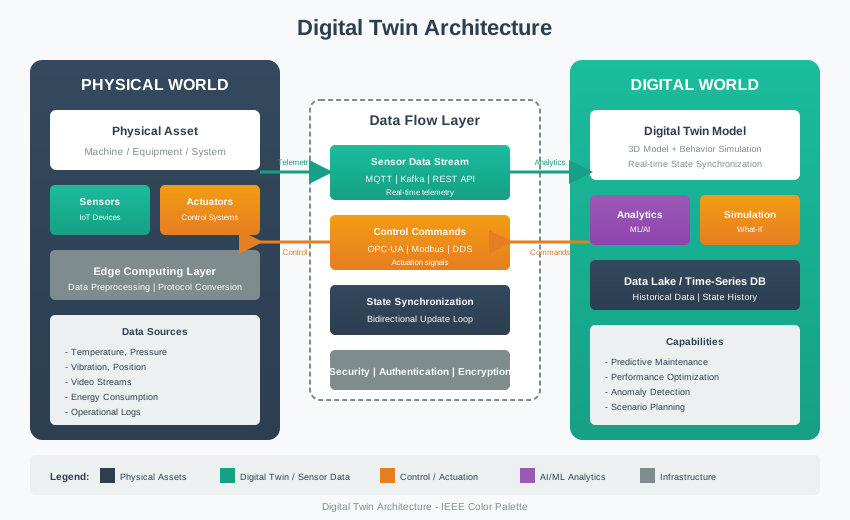
This part tests conceptual understanding of digital twin architecture through scenario-based questions: synchronization cadence, DTDL properties versus telemetry, conflict resolution, and graph-based relationship modeling.
Blueprint Bina is your guide for this deck.

After studying this chapter
Learning objectives
You will be able to:
- Explain: Commissioning establishes the initial identity and baseline; operation accumulates observations; evolution changes the asset or model under version control; and retirement closes control authority while preserving required records.
- Explain: The gallery therefore completes the chapter's narrative: architecture defines the loop, synchronization establishes current truth, and lifecycle governance keeps that truth interpretable over time.
- Explain: If the mirror figures out the robot is about to bump into a wall, it can send a message saying 'Hey, turn right!'".
- Explain: Under the Hood examines sync order, conflict, history, prediction, and the tests that reopen trust after change.
Major section
Start Simple
A valve is changed by hand during an outage, but the copy misses the update and still shows the old path.
- The maintainer must decide whether the model is fit to guide the next action.
- A moving display is not proof that both sides agree.
- If any answer is no, mark the twin unfit for that choice.
Major section
Start Simple (continued)
A remote model can advise and compare, but it must not hide the local stop, limit, or manual state.
- This opening does not prove that every model is a twin or that control is safe.
- Under the Hood examines sync order, conflict, history, prediction, and the tests that reopen trust after change.
- If they split, stop use, keep the machine safe, and name who will join them again.
Major section
Digital Twin Maturity Levels
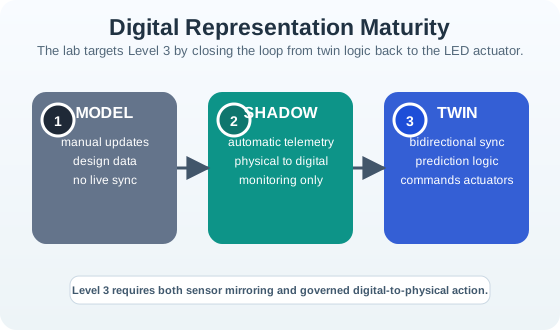
Key distinction: The jump from Level 2 (Shadow) to Level 3 (Twin) requires not just sensors but also actuators and decision logic.
- The lab in this chapter implements a Level 3 system where the digital twin autonomously controls an LED based on temperature thresholds.
Major section
Scenario: Wind Farm Digital Twin
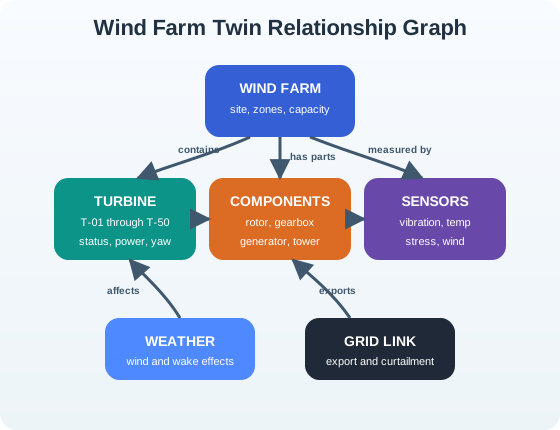
Each turbine has 100 sensors monitoring blade vibration, temperature, wind speed, power output, and mechanical stress.
- Blade Damage Prediction (highest value): Vibration pattern analysis detects micro-cracks 4-6 weeks before failure.
Major section
For Beginners: Why So Many Sensors?
You might wonder why a wind turbine needs 100 sensors.
- A blade breaking off could destroy the turbine and endanger workers.
- Efficiency: Tiny adjustments to blade angle based on wind sensors can boost power output by 5%.
- Replacing a bearing costs $50K and takes a day.

Major section
Digital Twins for Monitoring and Control
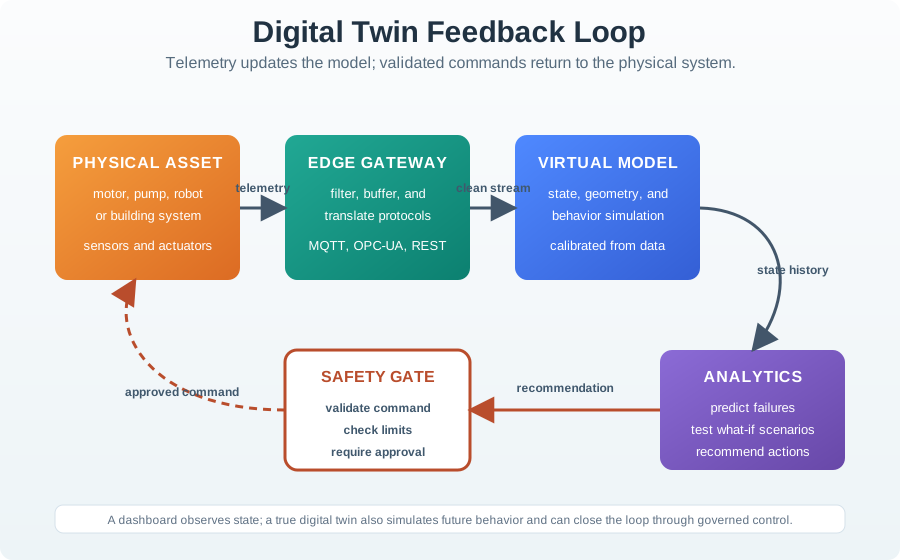
Temperature Terry says: "Imagine you have a toy robot that moves around your room.
- Light Lucy adds: "That mirror is a digital twin!
- But here's the cool part -- the mirror can also talk back to the real robot.
- If the mirror figures out the robot is about to bump into a wall, it can send a message saying 'Hey, turn right!'".
Major section
Twin Synchronization
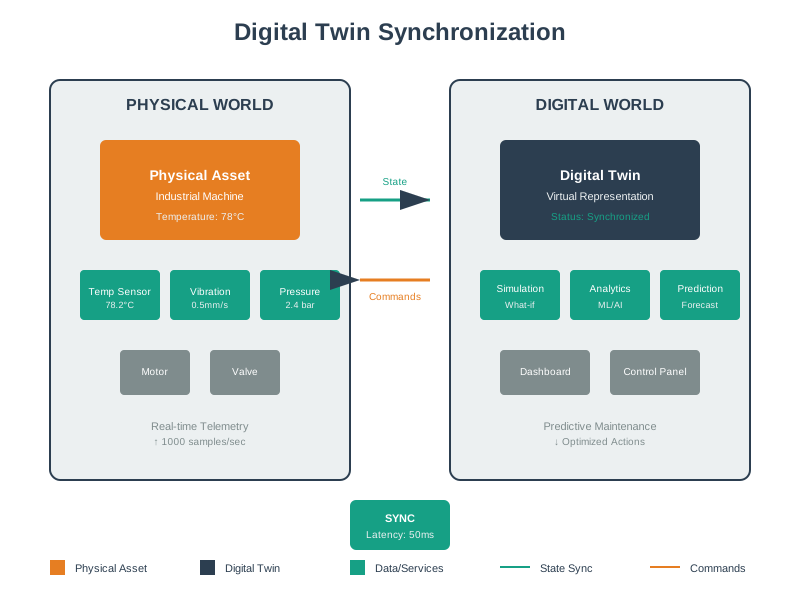
Architecture alone does not say whether the model is current enough to trust.
- Timestamps, ordering, conflict rules, and acknowledgement determine whether the virtual state still represents the asset when a decision is made.
Major section
Twin Lifecycle Management
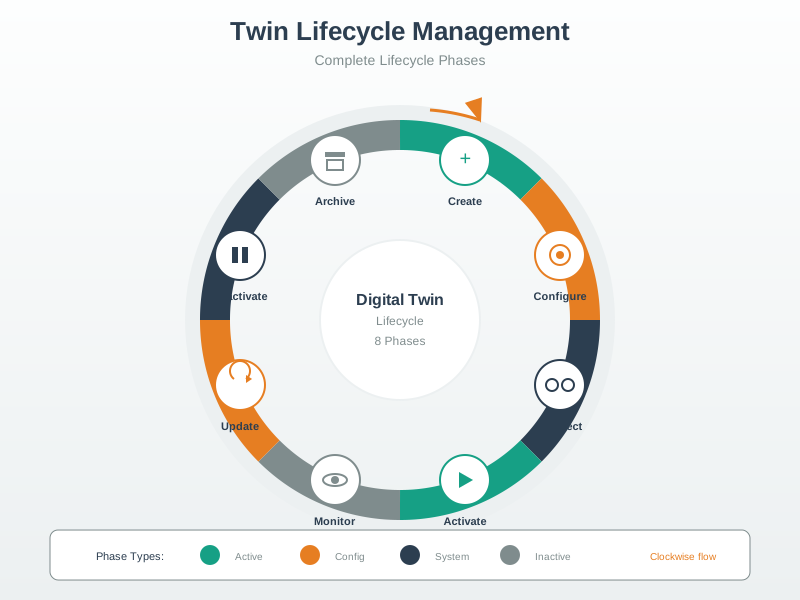
Commissioning establishes the initial identity and baseline; operation accumulates observations; evolution changes the asset or model under version control; and retirement closes control authority while preserving required records.
- The gallery therefore completes the chapter's narrative: architecture defines the loop, synchronization establishes current truth, and lifecycle governance keeps that truth interpretable over time.
Deck summary
Key takeaways
A valve is changed by hand during an outage, but the copy misses the update and still shows the old path.
- A remote model can advise and compare, but it must not hide the local stop, limit, or manual state.
- Key distinction: The jump from Level 2 (Shadow) to Level 3 (Twin) requires not just sensors but also actuators and decision logic.
- Each turbine has 100 sensors monitoring blade vibration, temperature, wind speed, power output, and mechanical stress.
- You might wonder why a wind turbine needs 100 sensors.
Retrieval practice
Recall check 1 of 6

Blueprint Bina says: answer from memory, then check your reasoning.
Q1What is the KEY difference between a digital shadow and a digital twin?
Show answer
Answer: C The fundamental distinction is data flow direction.
Retrieval practice
Recall check 2 of 6

Blueprint Bina says: answer from memory, then check your reasoning.
Q2A manufacturing plant is implementing digital twins for 500 CNC machines. Each machine generates 50 sensor readings per second. What is the most appropriate synchronization architecture?
Show answer
Answer: B At 25,000 readings/second (500 machines x 50 sensors), sending raw data directly to cloud is impractical due to bandwidth costs (~5 MB/second = 432 GB/day) and latency requirements.
Retrieval practice
Recall check 3 of 6

Blueprint Bina says: answer from memory, then check your reasoning.
Q3In DTDL (Digital Twin Definition Language), what is the distinction between a "Property" and "Telemetry"?
Show answer
Answer: A DTDL distinguishes data by change frequency and purpose: - Properties represent static or slowly-changing characteristics that describe the twin: roomNumber, floorArea, manufacturer, installationDate.
Retrieval practice
Recall check 4 of 6

Blueprint Bina says: answer from memory, then check your reasoning.
Q4A building operator notices their digital twin shows Room 305's temperature as 22.0C, but a handheld thermometer reads 24.5C. The discrepancy has persisted for 3 days. Using the "Physical-Wins" conflict resolution strategy, what should happen?
Show answer
Answer: D "Physical-Wins" means the physical world is the source of truth.
Retrieval practice
Recall check 5 of 6

Blueprint Bina says: answer from memory, then check your reasoning.
Q5A smart city is deploying digital twins for traffic management. They need to model 50,000 intersections, 10,000 traffic lights, and relationships like "intersection A is upstream of intersection B." Which platform characteristic is MOST critical for this use case?
Show answer
Answer: C Traffic management fundamentally depends on relationships between entities: upstream/downstream intersections, connected traffic lights, adjacent roads, and dependency chains.
Retrieval practice
Recall check 6 of 6

Blueprint Bina says: answer from memory, then check your reasoning.
Q6A wind farm operator is designing their digital twin system. They have 50 turbines, each generating 5,000 sensor readings per second. During network outages to the cloud, what should happen to ensure no data is lost?
Show answer
Answer: C Correct!
Print reference
Answers 1 of 2
Answer key.
- C · The fundamental distinction is data flow direction.
- B · At 25,000 readings/second (500 machines x 50 sensors), sending raw data directly to cloud is impractical due to bandwidth costs (~5 MB/second = 432 GB/day) and latency requirements.
- A · DTDL distinguishes data by change frequency and purpose: - Properties represent static or slowly-changing characteristics that describe the twin: roomNumber, floorArea, manufacturer, installationDate.
- D · "Physical-Wins" means the physical world is the source of truth.
Print reference
Answers 2 of 2
Answer key.
- C · Traffic management fundamentally depends on relationships between entities: upstream/downstream intersections, connected traffic lights, adjacent roads, and dependency chains.
- C · Correct!