Emerging Paradigms · Study deck
Digital Twin Architecture
Picture a wind turbine shown as a live model on an engineer's screen.
Blueprint Bina is your guide for this deck.

After studying this chapter
Learning objectives
You will be able to:
- Define the physical and virtual boundaries of a digital twin architecture
- Build an architecture record for scope, synchronization, model fidelity, and decision authority
- Explain how telemetry freshness, model drift, and control authority change twin risk
- Identify evidence needed before scaling a twin from monitoring to recommendation or control
Major section
Start Simple
The model says a bearing is healthy, but the last field reading arrived two hours ago.
- A detailed picture is dangerous if people mistake old data for current truth.
- A digital twin is a managed digital view of a real object or process.
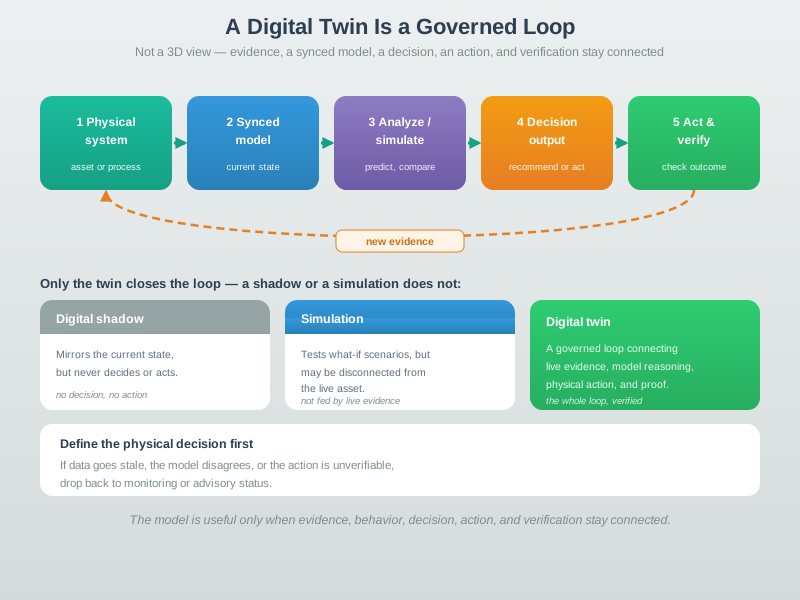
- The architect should begin with the decision it supports.
- The digital view is always incomplete.
Major section
What Is a Digital Twin?
The model is useful only while it matches the real building.
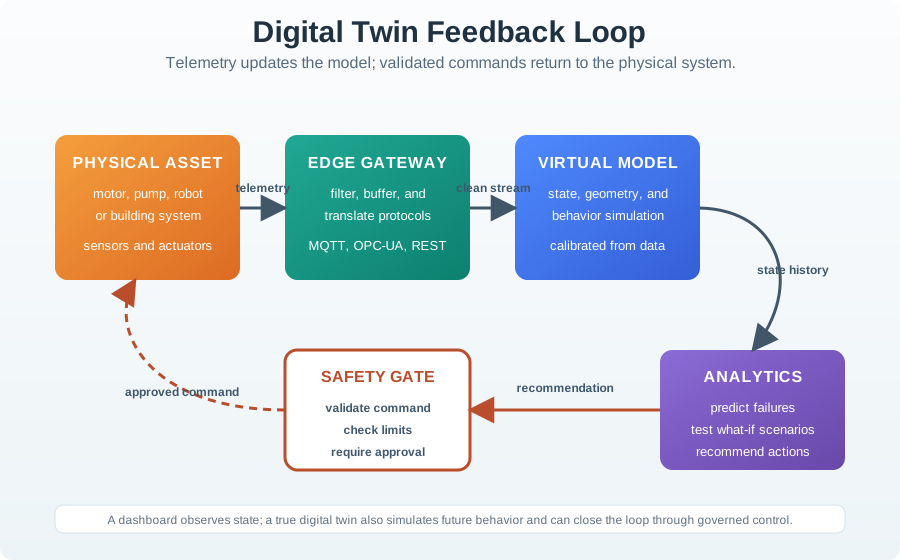
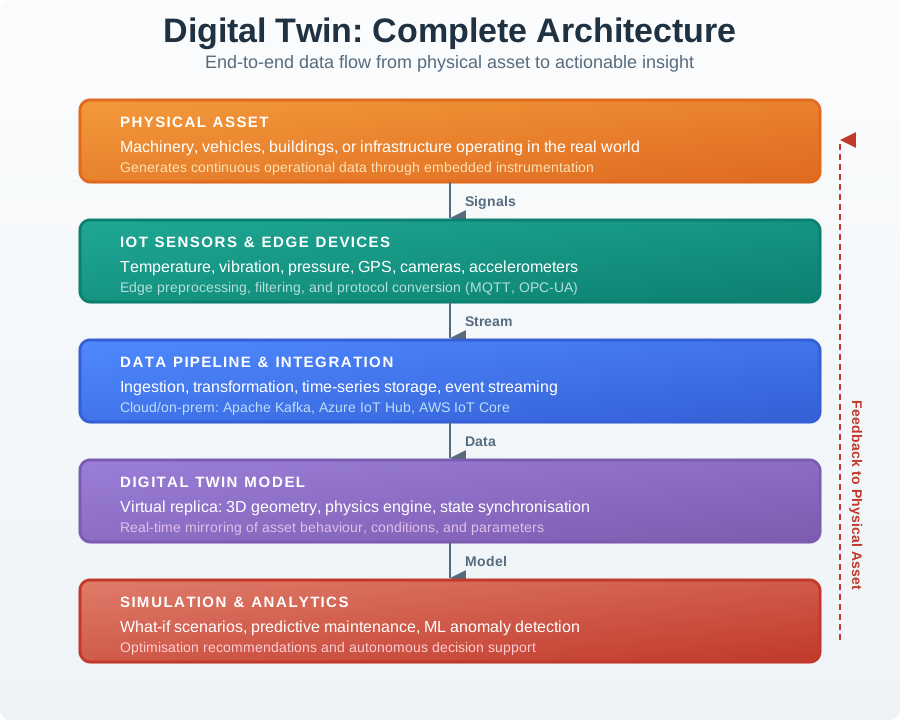
- In Figure: Trust loop, PHYSICAL ASSET sends telemetry through the: EDGE GATEWAY, where filtering, buffering, and protocol translation shape the clean stream used by the: VIRTUAL MODEL.
- The: SAFETY GATE across the top is therefore the chapter's governing boundary.
- The governance problem becomes clearer when the return path is visible. the Trust loop: synchronization, model behavior, and action governance must be reviewed together diagram distinguishes evidence moving into the twin from actions moving back into the asset, so use it to decide where synchronization ends and controlled intervention begins.
- A digital twin is a model kept in step with a real system.
Major section
What Is a Digital Twin? (continued)
It supports a decision and later checks the result.
- The model's state and history then feed: ANALYTICS, but a recommendation is not yet permission to act: VALIDATION checks safety limits and policy before: APPROVAL releases a command.
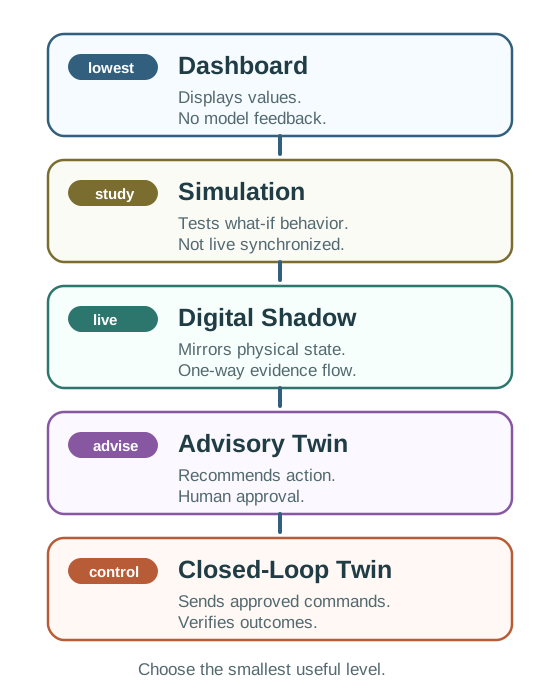
- A dashboard may stop at observed state, whereas a closed-loop twin must justify every step from evidence age and model validity to authorised actuation.
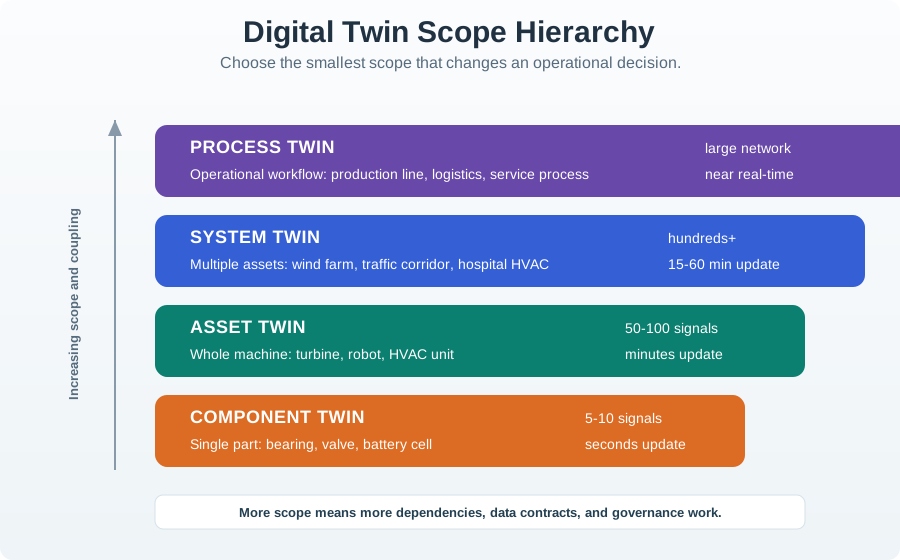
- The safest first twin is small and reviewable.
Major section
What Is a Digital Twin? (continued)
For each evidence stream, state update cadence, timestamp policy, missing-data handling, and the age at which data becomes stale.
- If the twin can recommend or command, add operating limits, approval rules, audit evidence, and recovery behaviour.
- The loop closes only when later observations are compared with the prediction, recommendation, and physical outcome.
- The lower authority rail is the governing rule: observation, recommendation, and command are different claims with different proof burdens.
Major section
Bound a Digital Twin for One Pump
A real pump vibrates, heats, and moves water while its digital twin receives only selected measurements.
- If vibration arrives every 2 s and temperature every 30 s, a one-minute twin view contains up to 60/2=30 vibration updates but only 60/30=2 temperature updates.
- The richer vibration cadence does not make temperature equally fresh.
- The digital twin architecture must carry timestamps and model assumptions so analytics can distinguish those two ages before proposing a pump action.
- A controlled twin architecture includes approval and rejection, not automatic actuation at any cost.
Deck summary
Key takeaways
The model says a bearing is healthy, but the last field reading arrived two hours ago.
- The model is useful only while it matches the real building.
- It supports a decision and later checks the result.
- For each evidence stream, state update cadence, timestamp policy, missing-data handling, and the age at which data becomes stale.
- A real pump vibrates, heats, and moves water while its digital twin receives only selected measurements.
Retrieval practice
Recall check 1 of 6

Blueprint Bina says: answer from memory, then check your reasoning.
Q1Which statement best separates a digital twin from a normal monitoring dashboard?
Show answer
Answer: A A digital twin must connect a physical boundary, synchronized model state, and a bounded decision purpose.
Retrieval practice
Recall check 2 of 6

Blueprint Bina says: answer from memory, then check your reasoning.
Q2A team wants a digital twin to recommend maintenance windows. What belongs in the architecture record before the pilot is approved?
Show answer
Answer: C A pilot-ready twin architecture record should connect scope, data path, model validation, action authority, and retest rules.
Retrieval practice
Recall check 3 of 6

Blueprint Bina says: answer from memory, then check your reasoning.
Q3Why should a digital twin expose stale or missing telemetry instead of silently reusing the last known state?
Show answer
Answer: D Digital twin decisions depend on state freshness, model validity, and explicit fallback behavior.
Retrieval practice
Recall check 4 of 6

Blueprint Bina says: answer from memory, then check your reasoning.
Q4A factory dashboard shows live motor temperature, vibration, and current draw. It does not predict behavior, recommend actions, or record whether a physical decision improved. What is the best classification?
Show answer
Answer: C Live data can be useful, but a twin also needs model behavior, a decision path, and verification.
Retrieval practice
Recall check 5 of 6

Blueprint Bina says: answer from memory, then check your reasoning.
Q5How should the building-twin workflow be classified from these actions?
Show answer
Answer: B The system has the evidence, model, feedback, and verification loop expected of an advisory twin.
Retrieval practice
Recall check 6 of 6

Blueprint Bina says: answer from memory, then check your reasoning.
Q6A team wants to let a digital twin send automatic setpoint changes because the advisory pilot looked useful. What evidence must be reviewed before changing the feedback level?
Show answer
Answer: B Moving from advisory to automatic control changes risk, so synchronization, model validity, governance, and recovery evidence must be reviewed together.
Print reference
Answers 1 of 2
Answer key.
- A · A digital twin must connect a physical boundary, synchronized model state, and a bounded decision purpose.
- C · A pilot-ready twin architecture record should connect scope, data path, model validation, action authority, and retest rules.
- D · Digital twin decisions depend on state freshness, model validity, and explicit fallback behavior.
- C · Live data can be useful, but a twin also needs model behavior, a decision path, and verification.
Print reference
Answers 2 of 2
Answer key.
- B · The system has the evidence, model, feedback, and verification loop expected of an advisory twin.
- B · Moving from advisory to automatic control changes risk, so synchronization, model validity, governance, and recovery evidence must be reviewed together.