Connected Product and Service Design · Study deck
Device Power: Energy Budgets
Start with the service promise.
UX Uma is your guide for this deck.
After studying this chapter
Learning objectives
You will be able to:
- review a connected-device power budget from measured states rather than assumptions
- explain how duty cycle, sleep current, radio use, sensing, actuation, and displays affect service interval
- identify checks needed for battery, mains, charging, harvesting, and backup power decisions
- connect power behavior to user experience, maintenance, OTA updates, and lifecycle risk
Major section
Start Simple
A duty cycle is the share of time spent doing a task instead of resting.
- It helps turn a list of power states into a daily energy budget.
- That promise includes sensing, screen use, wireless work, updates, charging, cold weather, and the time a person has to react.
- An average can hide a short peak that resets the device.
Major section
Start Simple (continued)
A large battery rating does not prove useful life if voltage falls too soon.
- More sleep can save energy while making controls or alerts feel late.
- Under the Hood explains the failures hidden by one average-current number.
- A battery goal with no user promise is hard to test.
- A board value may miss loss in the power path.
Major section
Start Simple (continued)
The hard day may include poor signal, many alerts, or long screen use.
- A source can hold enough energy yet fail to supply one sharp peak.
- Wake it from each cause and prove it can return to rest.
- Weak coverage can add scans, joins, waits, and retries.
- A downlink need can hold the radio awake.
Major section
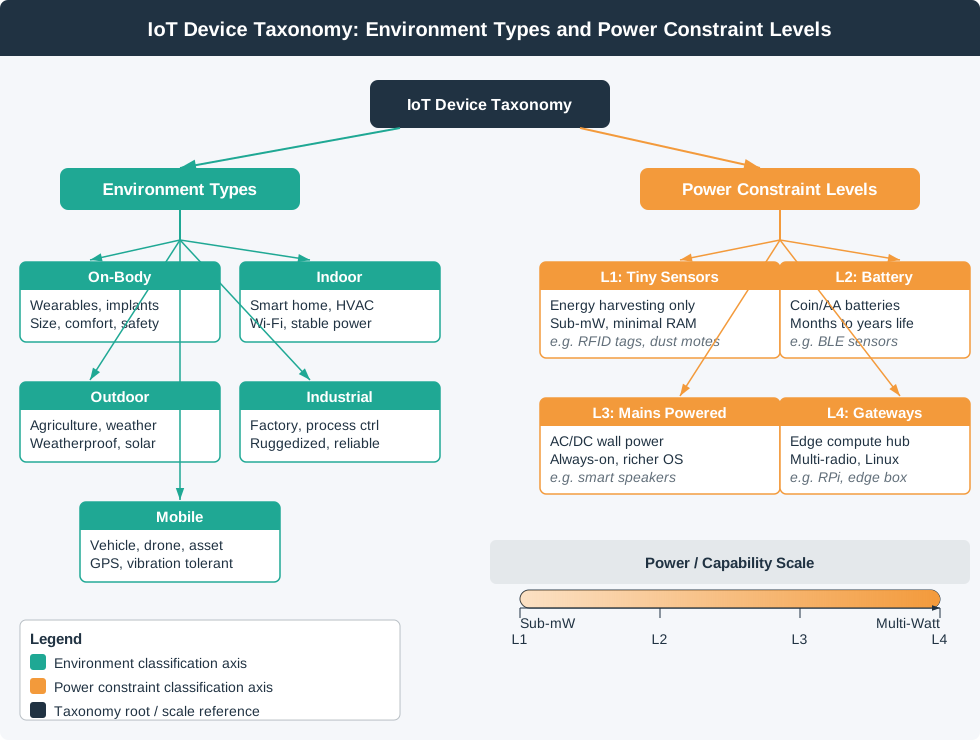
Overview: Power Is a Service Promise
The same nominal battery capacity can support very different products.
- Connected-device power design is not just choosing a larger cell.
- The power class then says what source or interval the design is trying to support.
- A CR2032 beacon that advertises every few seconds may be limited by pulse current and radio schedule.
Major section
Overview: Power Is a Service Promise (continued)
For a battery sensor, the promise depends on sleep current, wake interval, sensor warm-up, radio join or transmit time, acknowledgement policy, retry behavior, battery chemistry, temperature derating, regulator quiescent current, and the physical service path.
- For an interface or actuator, it also depends on displays, LEDs, haptics, motors, relays, locks, valves, and whether low-power mode changes the user-visible behavior.
- A Li-SOCl2 field sensor may be limited by cold-temperature voltage sag and passivation after storage.
- A Li-ion handheld reader may be limited by display brightness, user charging habits, and charger access.
Major section
Overview: Power Is a Service Promise (continued)
A mains-powered gateway may still need backup power long enough to flush buffers, preserve endpoint state, and report the outage cleanly.
- The record should show the energy source, measured states, expected event rate, installed radio behavior, derating assumption, low-power threshold, warning path, service owner, and change condition.
- If the device saves energy by reducing sampling, turning off live status, delaying uploads, or disabling actuation, that tradeoff belongs in the product record because it changes what users and support staff experience.
- Design degradation: warn early, preserve core function, defer noncritical work, and explain low-power behavior to support staff.
Major section
Budget from Workload
Gate risky operations: Require enough energy and storage for firmware download, signature verification, flash write, reboot, boot confirmation, rollback, and post-update health before OTA starts.
- For solar or harvested designs, include the worst charging window, load-shedding rule, storage reserve, and what support sees after several low-energy days.
- For rechargeable devices, include charging time, connector wear, cable availability, heat, and whether the user can recover without losing pairing or configuration.
- The decision should include derating.
Major section
Average Current Hides Failures
Average current is useful, but it can hide the state that breaks the product.
- The firmware state machine should make energy decisions explicit.
- It should know when it is manufactured, provisioned, commissioned, normal, degraded, low-battery, charging, updating, rollback, factory-reset, or retired.
- Hardware details can also invalidate a clean average-current spreadsheet.
Major section
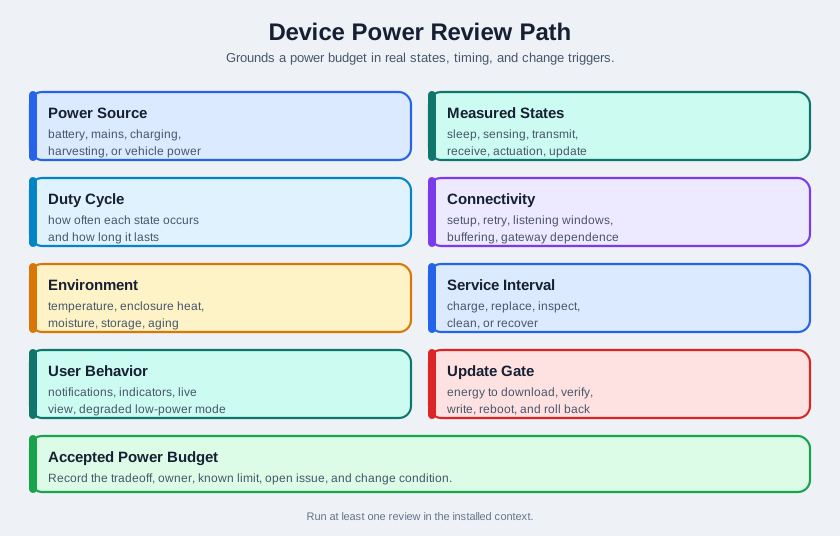
Power Review Path
Duty cycle records how often those states occur and for how long.
- Connectivity adds retries, listening, and buffering that a simple transmit estimate can miss.
- Environment and user behavior can change the load again.
- Service interval: charge, replace, inspect, clean, or recover before user trust is lost.
Deck summary
Key takeaways
A duty cycle is the share of time spent doing a task instead of resting.
- A large battery rating does not prove useful life if voltage falls too soon.
- The hard day may include poor signal, many alerts, or long screen use.
- The same nominal battery capacity can support very different products.
- For a battery sensor, the promise depends on sleep current, wake interval, sensor warm-up, radio join or transmit time, acknowledgement policy, retry behavior, battery chemistry, temperature derating, regulator quiescent current, and the physical service path.
Retrieval practice
Recall check 1 of 2

UX Uma says: answer from memory, then check your reasoning.
Q1A device draws 20 mA for 1 h each day and 1 mA for the other 23 h. With 430 mAh usable capacity, what is its ideal service interval before retries and aging?
Show answer
Answer: B 10 days.
Retrieval practice
Recall check 2 of 2
UX Uma says: answer from memory, then check your reasoning.
Q2A team is reviewing a battery sensor that claims a two-year service interval before a firmware update policy is approved. Which power record makes the service interval credible?
Show answer
Answer: A A reviewable power decision ties the power source, measured states, duty cycle, installed connectivity, service interval, low-power UX, update gate, performed checks, owner, and change condition together before the battery-life claim is trusted.
Print reference
Answers
Answer key.
- B · 10 days.
- A · A reviewable power decision ties the power source, measured states, duty cycle, installed connectivity, service interval, low-power UX, update gate, performed checks, owner, and change condition together before the battery-life claim is trusted.