Connected Product and Service Design · Study deck
Device Form Factors: Physical Constraints and Enclosures
Inspect the real wearable iot tag (body-worn device) below.
UX Uma is your guide for this deck.
After studying this chapter
Learning objectives
You will be able to:
- connect form factor choices to deployment, maintenance, and user-interaction constraints
- review component, battery, antenna, sensor, and thermal constraints before accepting an enclosure shape
- compare enclosure material choices against RF, durability, service, and environmental requirements
- identify mounting and interaction decisions that can make installation fail even when electronics work
Major section
Begin With the Hand, Wall, or Pocket
The first choice is not the shell shape.
- A smaller case may look neat, but it can hurt battery size, heat, reach, access, or touch.
- A tough case may resist rain, but its material may block radio or make repair slow.
- One mock-up does not prove field life, comfort, or safe use.
Major section
Begin With the Hand, Wall, or Pocket (continued)
The key part can be reached.
- For an enclosure choice, build the form record and test the deployment; check material, ingress, heat, radio, human limits, and service trade-offs before accepting the result.
- One shape may not fit every person or place.
- The mark can be read.
- The seal can be restored.
Major section
Begin With the Hand, Wall, or Pocket (continued)
It may lead to two mounts, a larger label, a new grip, or a remote service path.
- The final case should make the key task clear and the common wrong act hard.
- The radio still works.
- If one item fails, change the claim or the form.
Major section
Form Factor Makes IoT Physical
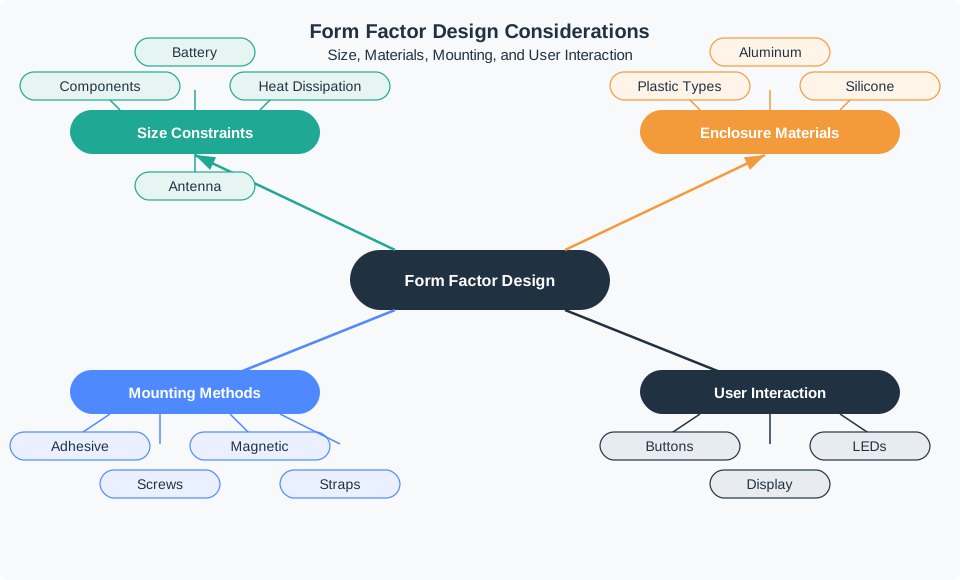
A connected-device form factor is the physical contract between the system and its installation context.
- Size must leave room for components, battery, heat, and antenna clearance.
- Material choice changes both the outer surface and the radio boundary, while mounting fixes the device to a real wall, machine, or person.
- Buttons, displays, and LEDs add user access needs that the enclosure must support.
- The same electronics can need different form factors in different contexts.
Major section
Form Factor Makes IoT Physical (continued)
The branches are not independent design options: a smaller case can make battery service harder, and a metal shell can change antenna placement.
- For an outdoor soil sensor, the form factor includes the sensor window, burial depth or mounting stake, gasket, drain path, UV-stable plastic, battery access, antenna clearance, label, and service sequence.
- For a wearable tag, it includes strap geometry, skin contact, cleaning, charging, pressure points, accelerometer orientation, BLE or UWB antenna placement, and status feedback that can be understood without opening a phone app.
- That framing keeps physical design from becoming a late styling decision.
Major section
Choose Shape from Failure Mode
Last, the closed case is checked in its installed position for signal, sensing, water entry, and service access.
- A LoRaWAN sensor in a metal cabinet may need an external SMA antenna or a plastic RF window.
- A BLE asset tag on a wet pallet may need antenna clearance from liquid and metal.
- Ratings and prototypes need context.
Major section
Choose Shape from Failure Mode (continued)
If the installer needs to scan a QR code, the code must remain visible after mounting.
- If the device uses a reset pinhole, the tool must be available in the service context.
- If the sensor needs airflow, the mounting bracket cannot block the vents.
- The review should end with an accepted tradeoff, not a vague approval.
Major section
Choose Shape from Failure Mode (continued)
For sensing, record response tests with the real membrane, lens, acoustic port, probe length, or airflow path.
- For ingress, record which opening, gasket, cable gland, button, or battery door is the weak point.
- For service, record how long the maintenance action takes, what tool it requires, and what error is easy to make under realistic conditions.
- Those tradeoffs are design decisions; they should have an owner and a condition for another review.
Major section
Choose Shape from Failure Mode (continued)
IP54, IP65, IP67, IK impact ratings, UL enclosure materials, and 3D-printed prototype checks are useful only when they match the real exposure, maintenance interval, and installation orientation.
- A sealed sensor might reject field battery replacement to improve washdown reliability, but then the product needs a replacement plan and low-battery warning.
- A metal enclosure might be justified for impact and heat, but only with an antenna plan that has been tested after assembly.
- A wearable might accept a smaller cell to reduce pressure points, but then the charging habit must fit the user's day.

Major section
Enclosures Change Measurements
Sensors are just as sensitive to form factor.
- The enclosure is part of the measurement system.
- Plastic thickness, dielectric constant, metal nearby, ground-plane shape, cable routing, and battery position can detune PCB, chip, FPC, ceramic, and external antennas.
- A BME280, SHT31, or other humidity sensor can lag or self-heat if airflow is blocked.
Major section
Enclosures Change Measurements (continued)
A small change in the housing can move a Wi-Fi, BLE, Thread, Zigbee, LoRaWAN, LTE-M, NB-IoT, GPS/GNSS, or UWB design from reliable to marginal.
- A MEMS microphone needs an acoustic path that does not trap water.
- An accelerometer needs a known axis orientation.
- A PIR sensor needs a lens and field of view.
Major section
Enclosures Change Measurements (continued)
A gas sensor needs exposure and sometimes a burn-in or calibration path.
- The housing either preserves those assumptions or invalidates the data.
- The hidden coupling is often mechanical.
- Moving from a hand-built prototype to an injection-moulded enclosure changes wall thickness, rib placement, boss locations, snap fits, gasket compression, and assembly tolerances.
Major section
Enclosures Change Measurements (continued)
Each change can shift antenna tuning, thermal paths, sensor lag, button force, water drainage, or the way a user grips the device.
- Potting and conformal coating can improve environmental protection while making heat, repair, and sensor exposure worse.
- A vent membrane can equalise pressure while adding response delay or clogging risk.
- Good under-the-hood evidence is traceable.
Deck summary
Key takeaways
The first choice is not the shell shape.
- The key part can be reached.
- It may lead to two mounts, a larger label, a new grip, or a remote service path.
- A connected-device form factor is the physical contract between the system and its installation context.
- The branches are not independent design options: a smaller case can make battery service harder, and a metal shell can change antenna placement.
Retrieval practice
Recall check 1 of 2

UX Uma says: answer from memory, then check your reasoning.
Q1A team is choosing an enclosure for an outdoor soil sensor. Which review set is strong enough to accept the form factor?
Show answer
Answer: D A form factor decision needs installed-context checks for sensing, RF, ingress, mounting, interaction, service access, and the conditions that require another review.
Retrieval practice
Recall check 2 of 2
UX Uma says: answer from memory, then check your reasoning.
Q2A radio sensor works on a bench but loses packets inside its new metal housing. Which material decision is best?
Show answer
Answer: C Test an RF window or external antenna in the installed housing before accepting the enclosure.
Print reference
Answers
Answer key.
- D · A form factor decision needs installed-context checks for sensing, RF, ingress, mounting, interaction, service access, and the conditions that require another review.
- C · Test an RF window or external antenna in the installed housing before accepting the enclosure.