Prototyping · Study deck
Development Environments: Selection and Setup Evidence
A toolchain that works on one laptop is not yet a project environment.
Voltage Vera is your guide for this deck.
After studying this chapter
Learning objectives
You will be able to:
- Define what evidence a software development environment must leave for an IoT prototype.
- Match environment families to prototype stage, board risk, language risk, team workflow, and debugging need.
- Record board profiles, build inputs, dependency versions, configuration, and upload commands without exposing secrets.
- Decide when a simulator, REPL, vendor SDK, project-based toolchain, or CI build adds useful evidence.
Major section
In 60 Seconds
The source file is the same, but the environment has become hidden part of the design.
- Firmware is the code stored on a device.
- The failure should point to a recorded difference instead of guesswork.
- A repeated build does not prove the device is safe in the field.
- A development environment is not just an editor.
Major section
Start With the Story
Two learners can write the same sensor sketch and get different results because their board package, compiler, library version, upload tool, serial monitor, or simulator setup is different.
- The environment is part of the prototype, not a background detail.
- If it is invisible, the evidence cannot travel.
- This chapter starts from that practical problem.
Major section
Environment Choice Guides Proof
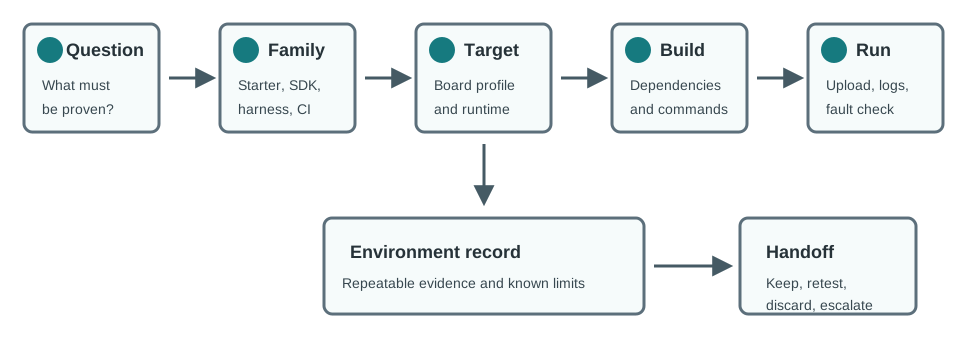
The environment decides what the team can rebuild, upload, observe, and hand off.
- A fast editor helps only if the build path and debugging evidence can be repeated by someone else.
- An environment choice should leave a path another builder can repeat.
- If the compiler, dependency, profile, or hardware changes, rerun the path before reusing the claim.
Major section
Environment Choice Guides Proof (continued)
A PlatformIO project can pin board profiles and libraries in the repository.
- The PlatformIO project and board profile define the target, while the build record keeps its configuration, command, and expected artifact beside source.
- For IoT prototypes, environment choice also decides how much board-specific behavior is visible: pin maps, clock setup, flash partitioning, RAM pressure, driver versions, simulator gaps, upload mode, and live logs.
- The best choice is therefore not the most advanced tool.
Major section
Environment Choice Guides Proof (continued)
As the prototype moves beyond first contact, the environment should expose more of the risk.
- ESP-IDF can make partition tables, sdkconfig options, FreeRTOS settings, and monitor output explicit.
- Zephyr with west can show board overlays, devicetree bindings, Kconfig choices, and a repeatable build command.
- A pump controller may need the upload method, watchdog reset log, and relay-disable observation before reviewers discuss architecture style.
Major section
Hidden Local State Misleads
The build record should name the git revision, build ID, binary size, warning state, partition map, and generated configuration.
- Many firmware failures are environment failures with a hardware symptom.
- A library cached on one laptop, a silent board-package update, a different compiler flag, or a missing upload setting can change behavior without changing the source file under review.
- The under-the-hood rule is to preserve the boundary between environment evidence and device evidence.
Major section
Environment Families
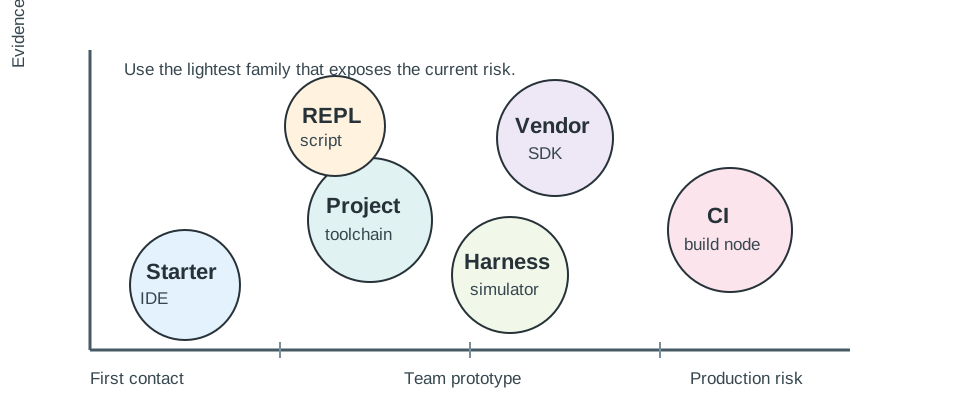
Specific products change, but the evidence role stays stable.
- A starter IDE is useful for first contact with a board and a serial reading.
- A project toolchain adds versioned dependencies, board profiles, and commands that a teammate can repeat.
- A scripting environment can speed gateway or data exploration, while a simulator or harness tests logic before hardware is available.
Major section
Environment Families (continued)
Starter IDE: Best when the risk is first contact with a board, sensor, serial output, or a simple loop.
- Project-based toolchain: Best when the prototype needs multiple files, versioned dependencies, several target boards, unit tests, or team review.
- Vendor SDK: Best when the evidence depends on low-power modes, secure boot, radio stack behavior, RTOS services, memory layout, or silicon-specific features.
- Scripting or REPL environment: Best when the prototype needs fast data exploration, MicroPython-style board interaction, gateway logic, or Linux-based device automation.
Deck summary
Key takeaways
The source file is the same, but the environment has become hidden part of the design.
- Two learners can write the same sensor sketch and get different results because their board package, compiler, library version, upload tool, serial monitor, or simulator setup is different.
- The environment decides what the team can rebuild, upload, observe, and hand off.
- A PlatformIO project can pin board profiles and libraries in the repository.
- As the prototype moves beyond first contact, the environment should expose more of the risk.
Retrieval practice
Recall check

Voltage Vera says: answer from memory, then check your reasoning.
Q1A teammate can open the source files, but cannot rebuild the firmware because the board profile and library versions are unknown. What evidence should the environment record add first?
Show answer
Answer: D A clean build record should let another reviewer recreate the firmware artifact and then compare upload and observation evidence.
Print reference
Answers
Answer key.
- D · A clean build record should let another reviewer recreate the firmware artifact and then compare upload and observation evidence.