Prototyping · Study deck
Development Environments: Reproducibility and Debugging
A named example helps only when another person can run it.
Voltage Vera is your guide for this deck.
After studying this chapter
Learning objectives
You will be able to:
- Explain: Arduino IDE or Thonny is acceptable if the record names the board package, selected port, library source, upload command, and one serial log line that shows the sensor read path.
- Explain: The repository now contains the target profile, dependency lock or version notes, build command, host-side parser tests, and a serial capture for one normal run and one fault case.
- Explain: CI builds the firmware artifact, the debugger or trace method is documented, and the handoff record separates host-test evidence from target-board evidence.
- Explain: A team is building firmware for a cold-room monitor.
Major section
Incremental Examples
Arduino IDE or Thonny is acceptable if the record names the board package, selected port, library source, upload command, and one serial log line that shows the sensor read path.
- The repository now contains the target profile, dependency lock or version notes, build command, host-side parser tests, and a serial capture for one normal run and one fault case.
- The result proves a repeatable multi-file build and reviewable logic, but hardware timing still needs board evidence.
- CI builds the firmware artifact, the debugger or trace method is documented, and the handoff record separates host-test evidence from target-board evidence.
Major section
Reproducible Toolchain Record
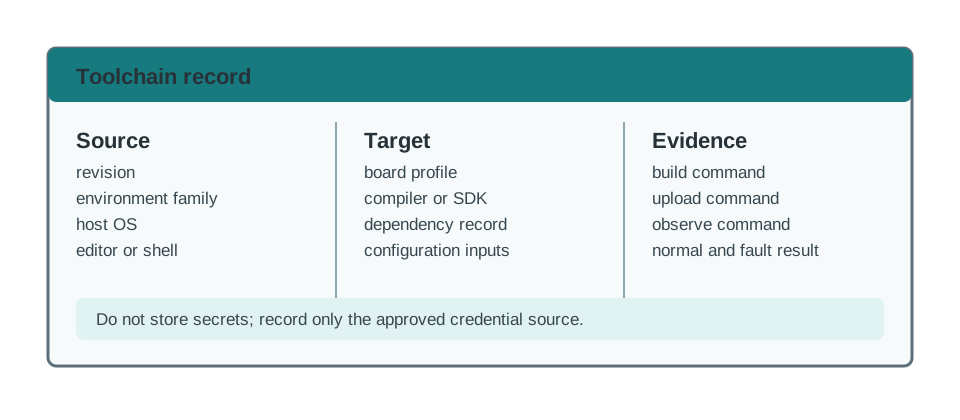
The most common environment failure is an unrepeatable build.
- The prototype may work on one laptop, but nobody can explain compiler version, board profile, library state, or configuration inputs.
- The closeout separates a normal result from a fault result and records the limits of the environment.
- If a dependency or board profile changes, the old result no longer proves the new build behaves the same way.
- Recording a retest trigger and owner makes that boundary visible without putting credentials in the record.
Major section
Debug and Observation Loop
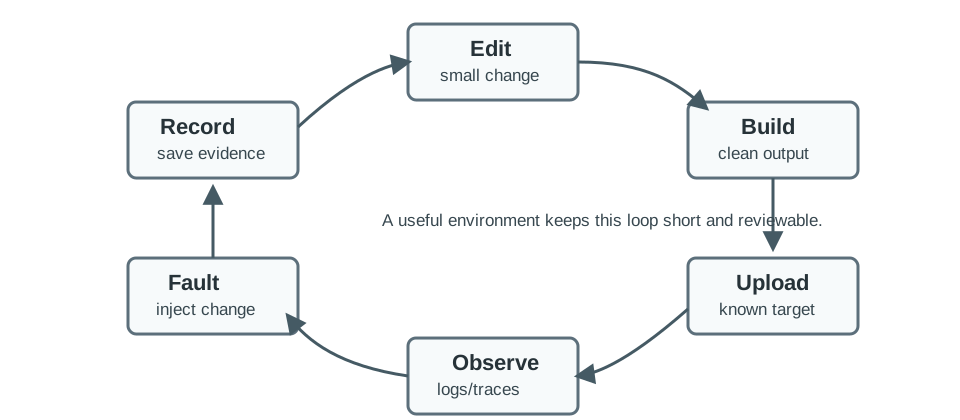
The environment should shorten the loop between a code change and an observed behavior.
- A faster editor does not help if the team cannot see why the device changed state or failed.
- A debugging loop needs an observed result for each code change.
- the Debug and observation loop diagram links each code change to an observed normal run and an injected fault.
Major section
Cold-Room Firmware Scenario
A team is building firmware for a cold-room monitor.
- The device reads temperature and door state, logs excursions, and reports status through a gateway.
- The first environment is a low-friction starter setup.
- It proves that the board can boot, read one temperature value, toggle a status output, and write a serial log.
Major section
Cold-Room Firmware Scenario (continued)
The team creates host tests for excursion logic and payload formatting.
- These tests do not prove sensor accuracy or power use, but they do prove the decision logic before every run reaches hardware.
- Low-power wake behavior and secure update layout depend on silicon features, so the team evaluates a vendor SDK or lower-level framework.
- The decision is based on evidence needs, not on tool prestige.
Major section
Handoff Decision
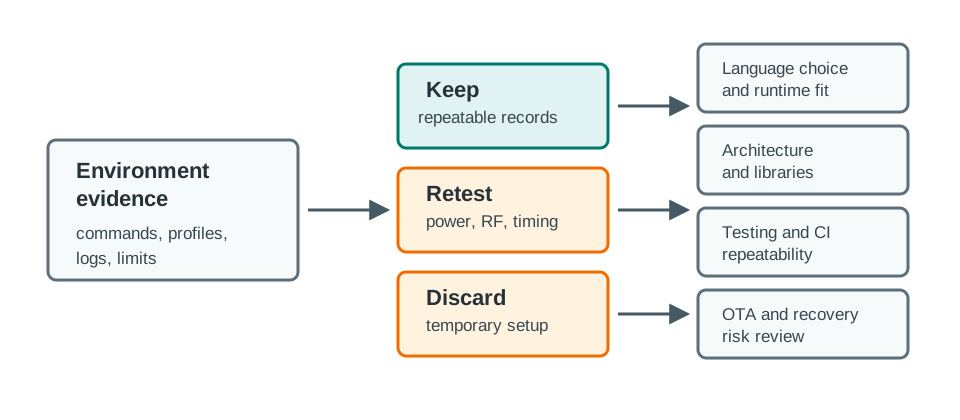
An environment choice should leave a decision trail.
- The next chapter may change language, the architecture chapter may split the firmware into tasks, and the testing chapter may formalize the harness.
- Those later decisions need to know what the current environment actually proved.
- the Environment handoff boundary diagram sorts repeatable environment evidence from assumptions that need another test.
- The handoff package carries a repeatable record, risk review, and next test into language, architecture, testing, and update decisions.
Major section
Common Failure Patterns
One-laptop build: The prototype works only where it was created.
- Board profile drift: Reviewers use a different board, clock, memory map, or package version.
- Simulator overreach: Logic checks are treated as proof of power, RF, sensor, or actuator behavior.
- Debug method mismatch: Serial logs are used for timing bugs that need a probe or debugger.
Deck summary
Key takeaways
Arduino IDE or Thonny is acceptable if the record names the board package, selected port, library source, upload command, and one serial log line that shows the sensor read path.
- The most common environment failure is an unrepeatable build.
- The environment should shorten the loop between a code change and an observed behavior.
- A team is building firmware for a cold-room monitor.
- The team creates host tests for excursion logic and payload formatting.
Retrieval practice
Recall check 1 of 4

Voltage Vera says: answer from memory, then check your reasoning.
Q1A team needs to prove that payload parsing and retry-state logic are correct before scarce hardware is available. Which environment family is the best first fit?
Show answer
Answer: C Choose the environment family that exposes the current evidence question.
Retrieval practice
Recall check 2 of 4
Voltage Vera says: answer from memory, then check your reasoning.
Q2A sensor read fails only when a probe is attached. What should the debugger check first?
Show answer
Answer: A The observation setup must not create the fault being studied.
Retrieval practice
Recall check 3 of 4
Voltage Vera says: answer from memory, then check your reasoning.
Q3What can the host-side harness establish about the untested device?
Show answer
Answer: D Good environment evidence separates what the current tool proved from what still needs hardware, field, or production-path validation.
Retrieval practice
Recall check 4 of 4
Voltage Vera says: answer from memory, then check your reasoning.
Q4What is needed to make this prototype build reproducible for another engineer?
Show answer
Answer: A A development environment supports prototype evidence only when another reviewer can rebuild, upload, observe, and challenge the result.
Print reference
Answers
Answer key.
- C · Choose the environment family that exposes the current evidence question.
- A · The observation setup must not create the fault being studied.
- D · Good environment evidence separates what the current tool proved from what still needs hardware, field, or production-path validation.
- A · A development environment supports prototype evidence only when another reviewer can rebuild, upload, observe, and challenge the result.