Design Methodology · Study deck
IoT Decision Validation
Picture a care team deciding whether to add connected room sensors.
Blueprint Bina is your guide for this deck.

After studying this chapter
Learning objectives
You will be able to:
- Decide whether an IoT solution is necessary, or whether a simpler alternative can satisfy the user need.
- Test connectivity, freshness, remote access, intelligence, lifecycle cost, security, and operational readiness as separate validation gates.
- Build a validation brief that turns user evidence, technical evidence, and cost evidence into a go/no-go decision.
- Record evidence gaps and decision outcomes so future teams can update the project without restarting the design process.
Major section
Start With the Go/No-Go Question · Key Concepts
The pilot dashboard looks polished, but staff still make the same manual checks and no one owns late alerts.
- A working device has not yet proved a useful service.
- A failed gate should change the plan rather than disappear inside an average score.
Major section
Validate Connected Behavior Need
Validation asks whether IoT is necessary for the user outcome.
- A connected sensor is justified when networked data, remote action, automation, or shared visibility changes a decision that matters.
- If the same outcome can be reached with a checklist, QR code, local display, periodic inspection, or batch upload, the simpler path may be the better design.
Major section
Validate Connected Behavior Need (continued)
The validation decision should be explicit.
- Proceed when connectivity, freshness, remote access, and lifecycle ownership are all needed and testable.
- Narrow when only part of the connected system is justified.
- The decision is strongest when the team can point to evidence for each gate instead of relying on enthusiasm for connected devices.
Major section
Validate Connected Behavior Need (continued)
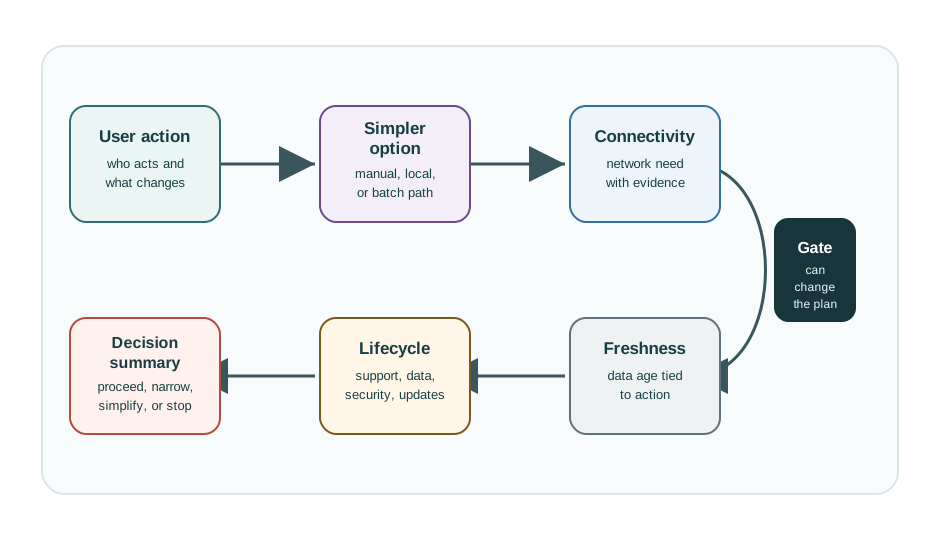
Its: Simpler and: Connectivity labels show why Each validation gate should be able to change the project.
- The transition to connectivity asks whether the outcome requires a network.
- Freshness, remote access, and lifecycle checks can then narrow, simplify, or stop the project.
- Validation does not start by selecting sensors.
Major section
Validate Connected Behavior Need (continued)
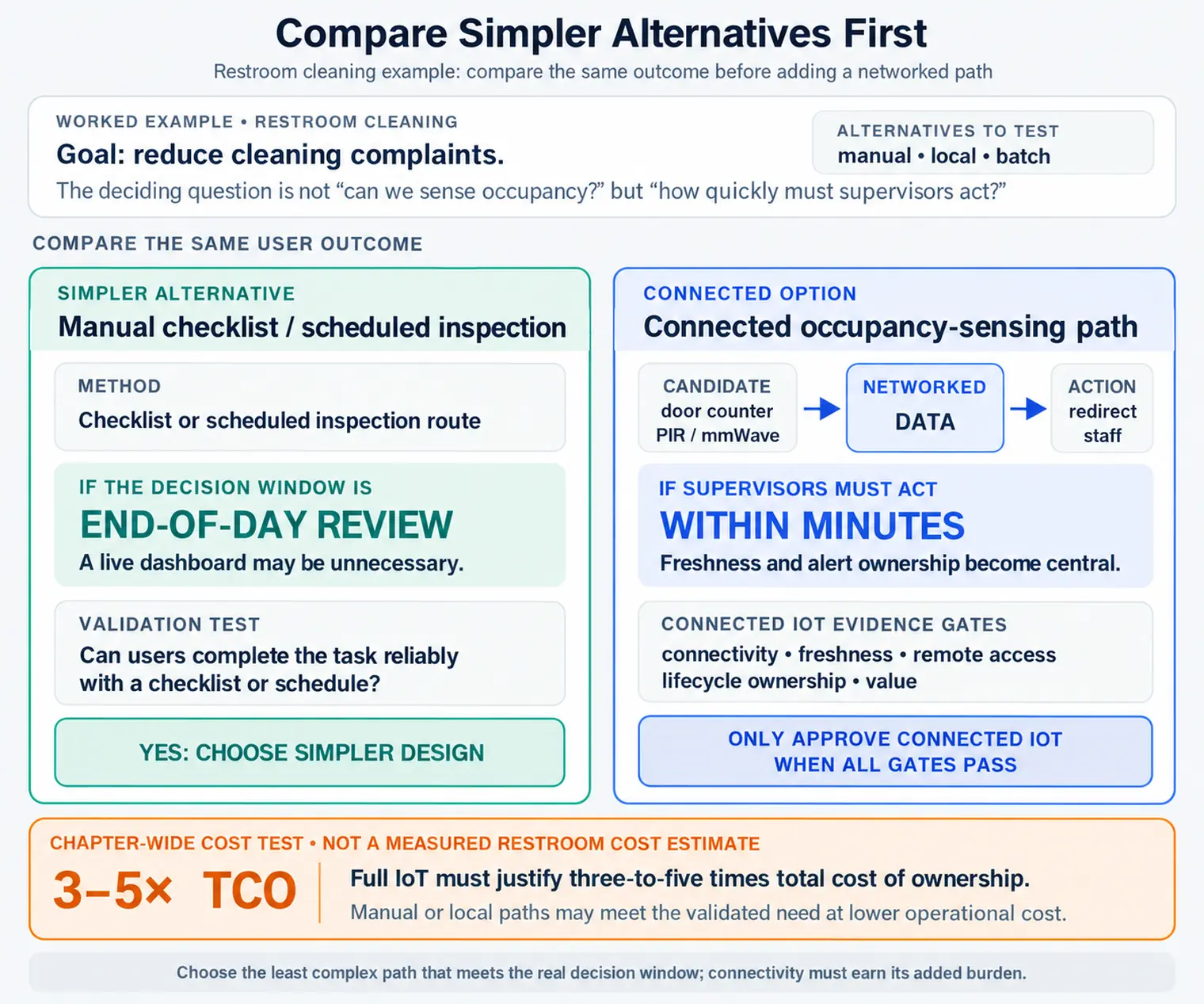
It asks whether complaints depend on real-time occupancy, delayed service records, vandalism detection, supply levels, or staffing handoff.
- A door counter, PIR sensor, mmWave presence sensor, QR complaint form, or scheduled inspection route each changes a different decision.
- If custodial staff only review reports at the end of the day, a live dashboard may be unnecessary.
- If supervisors must redirect staff within minutes, freshness and alert ownership become central.
Major section
Validate Connected Behavior Need (continued)
A validation brief should also state the burden that comes with connectivity.
- That includes device installation, calibration, battery replacement, Wi-Fi or LoRaWAN coverage, cloud storage, access control, privacy signage, maintenance tickets, and retirement.
- The question is not "can we connect it?" The question is "does the connected path create enough decision value to justify the operational system around it?".
- Freshness:: The data age required by the user action is known, not guessed.
Major section
Gate IoT Decisions One by One
A connected option might require MQTT retained-message behavior, certificate rotation rehearsal, dashboard stale-state display, SMS or email escalation, and acknowledgement records.
- A cold-room project might compare manual thermometer logs, a BLE data logger, a Wi-Fi ESP32 node with an SHT31 sensor, and a LoRaWAN node with a DS18B20 probe.
- Practitioners should write gate evidence in comparable units.
- The go/no-go meeting should end with a record that another team can review.
Major section
Gate IoT Decisions One by One (continued)
Each option should be judged against the same user action: who notices a temperature excursion, how quickly they act, and what proof they need later.
- A manual-log option might require two weeks of completed temperature sheets, exception handling notes, and audit acceptance.
- A BLE logger option might require download interval, staff time, missing-record rate, and export format.
- Price the lifecycle.: Include connectivity fees, hosting, certificates, OTA updates, support time, replacement stock, retention, and retirement.
- Using the same decision window across all options prevents the connected prototype from being judged by richer evidence than the simpler alternatives.
Major section
Go/No-Go as Systems Contract
A validation decision is not only a product choice.
- If any layer lacks an owner or acceptance condition, the decision is not ready for pilot.
- Under the hood, validation fails when the acceptance record cannot be traced to runtime evidence.
- A payload schema should identify units, timestamp source, device identifier, firmware version, and fault fields.
Major section
Go/No-Go as Systems Contract (continued)
Those distinctions matter because each failure has a different owner.
- A cloud ingestion path in AWS IoT Core, Azure IoT Hub, ThingsBoard, or a self-hosted broker should preserve rejection logs and versioned rules.
- The validation contract should also test reversal.
- Narrow:: One connected behavior is justified, but analytics, automation, or fleet expansion should wait.
Major section
Go/No-Go as Systems Contract (continued)
A dashboard should show stale data differently from normal data, and an alerting path should distinguish sensor fault, network outage, rule misconfiguration, and operator non-response.
- If the team chooses to stop, narrow, or simplify, the evidence should say which assumption failed and what will be retired or deferred.
- If the team proceeds, the same record should name pilot limits, data retention, certificate lifecycle, update responsibility, privacy review, support queue, and the trigger for retest.
- A connected product that cannot be safely narrowed or retired is already carrying technical debt before launch.
Major section
In 60 Seconds · How It Works: Validate the IoT Decision
The IoT validation framework asks whether the project truly needs connectivity, fresh data, remote access, automation, and long-term operations.
- A good validation result is not a score.
- IoT validation is a controlled challenge to the proposed solution.
- The team starts with the user outcome, compares simpler alternatives, tests whether connected behavior is necessary, and records the evidence behind the decision.
Major section
Validation Reshapes Solutions · The Validation Gates
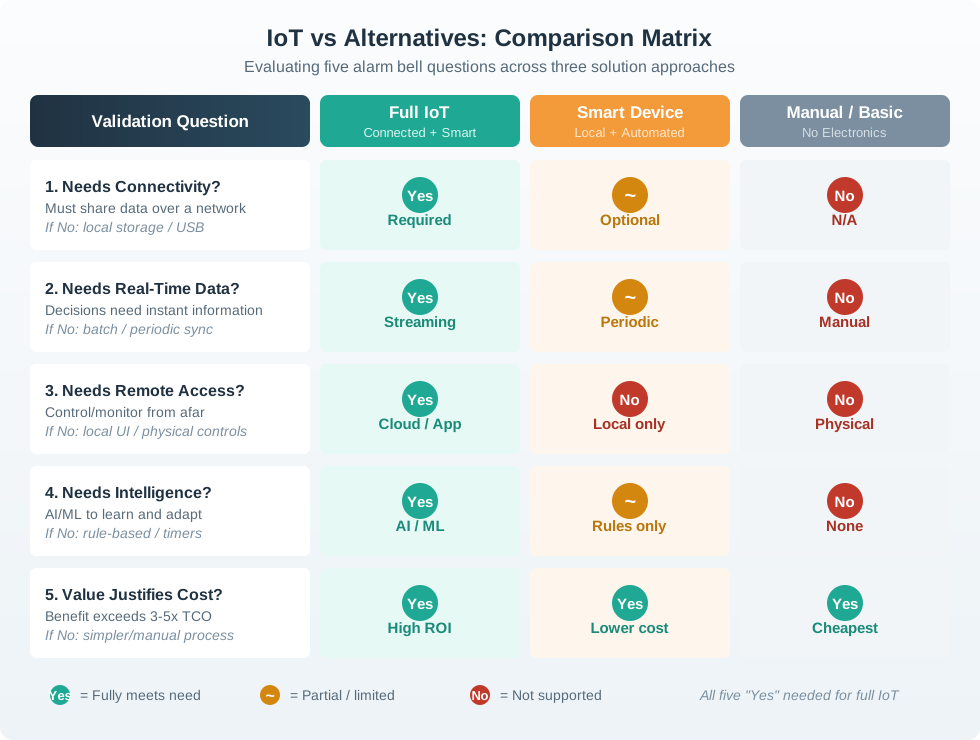
A project can pass user validation but fail IoT validation.
- It may mean the right answer is a simpler device, a local workflow, a batch report, or a service change rather than a fully connected system.
- Observation, interview, task test, support logs, or field walkthrough.
- The team can name a feature, but not a user action.
Major section
Compare Simpler Alternatives First
Validation should not compare one IoT design against nothing.
- Those hand-offs make Compare manual, local, and batch alternatives first; approve connected IoT only when connectivity, freshness, remote access, lifecycle ownership, and value evidence all pass actionable within: Compare Simpler Alternatives First.
- No shared data, remote support, or analytics.
- Periodic reporting, audit records, or delayed analysis.
Major section
A Useful Challenge Question · Incremental Examples
If the non-connected version solves most of the user problem, the connected version needs strong evidence for the remaining value.
- A single storage room may only need a local display and a manual log if the operator is always on site and the decision window is slow.
- Validation should compare a DS18B20 or SHT31 probe with a local display against a connected ESP32 or Raspberry Pi Pico W node.
- If the user action is "check before loading stock" and delayed review is acceptable, full cloud connectivity may not be justified.
Major section
Build the Validation Brief · Lifecycle Cost Without False Precision
The validation brief is the handoff artifact that makes the decision reviewable.
- It should fit into the project planning decision log and be easy for a later maintainer to update.
- User observations, interview notes, support logs, or field facts that show the problem matters.
- The chosen solution is not the only option listed.
Deck summary
Key takeaways
The pilot dashboard looks polished, but staff still make the same manual checks and no one owns late alerts.
- Validation asks whether IoT is necessary for the user outcome.
- The validation decision should be explicit.
- Its: Simpler and: Connectivity labels show why Each validation gate should be able to change the project.
- It asks whether complaints depend on real-time occupancy, delayed service records, vandalism detection, supply levels, or staffing handoff.
Retrieval practice
Recall check 1 of 3

Blueprint Bina says: answer from memory, then check your reasoning.
Q1A team proposes a connected device, but users only need to read the state while standing beside it. What should the validation review do first?
Show answer
Answer: B IoT validation compares connected behavior against simpler alternatives.
Retrieval practice
Recall check 2 of 3

Blueprint Bina says: answer from memory, then check your reasoning.
Q2The team says data must be real time, but cannot name the decision that fails when data is delayed. What is the best next action?
Show answer
Answer: B Freshness validation asks how old data can be when someone acts.
Retrieval practice
Recall check 3 of 3

Blueprint Bina says: answer from memory, then check your reasoning.
Q3Place each control where it lives so you can decide whether an IoT concept earns its connectivity and lifecycle cost.
Show answer
Answer: A These regions connect the decision from evidence to action so you can decide whether an IoT concept earns its connectivity and lifecycle cost.
Q4Complete the Python function so it returns True only when an IoT validation record has the required evidence and lifecycle ownership.
Show answer
Answer: A A validation record is ready only when core fields are present and lifecycle ownership is visible.
Print reference
Answers
Answer key.
- B · IoT validation compares connected behavior against simpler alternatives.
- B · Freshness validation asks how old data can be when someone acts.
- A · These regions connect the decision from evidence to action so you can decide whether an IoT concept earns its connectivity and lifecycle cost.
- A · A validation record is ready only when core fields are present and lifecycle ownership is visible.