Design Methodology · Study deck
Human-Centred Design for IoT
Imagine a technician ignoring a "smart" alert because it arrives during the wrong task, names the wrong equipment, or asks for action they cannot take.
Blueprint Bina is your guide for this deck.
After studying this chapter
Learning objectives
Connect each technical choice to a user need and a testable assumption.
- A connected feature needs a person, setting, task, and consequence.The technician can ignore an alert that arrives at the wrong moment, names the wrong equipment, or requests an impossible action.
- A problem statement needs a specific user, outcome, and supporting insight.Kitchen supervisors need to recognise actionable cold-room alerts because repeated non-actionable warnings reduce trust and delay responses.
- The seven phases connect research with implementation and field learning.The team can return to an earlier problem frame, prototype, release plan, or operating model when evidence challenges the current decision.
- Early validation must challenge risky assumptions before expensive implementation.A sketch, clickable flow, or bench test can answer a bounded question before the team commits to hardware, services, and apps.
Major section
Worked Example: One Person in One Place · In 60 Seconds
An alert becomes useful only when its recipient can understand and act on its message.
- A technician may ignore an alert during the wrong task.The message can fail despite working technology if its timing, equipment label, or requested action does not fit the recipient’s situation.
- The setting needs a named person and an achievable action.The first design question is whose decision improves because of the message, rather than which sensor or dashboard can deliver the feature.
- The first build slice needs evidence that justifies continuing.A small test must show whether the proposed intervention changes the user’s outcome before the team expands implementation.
- Evidence can reopen an earlier design phase.A challenged problem frame or unreliable prototype needs revision instead of automatically moving through the seven phases as a rigid sequence.
Major section
Design Thinking Controls Risk
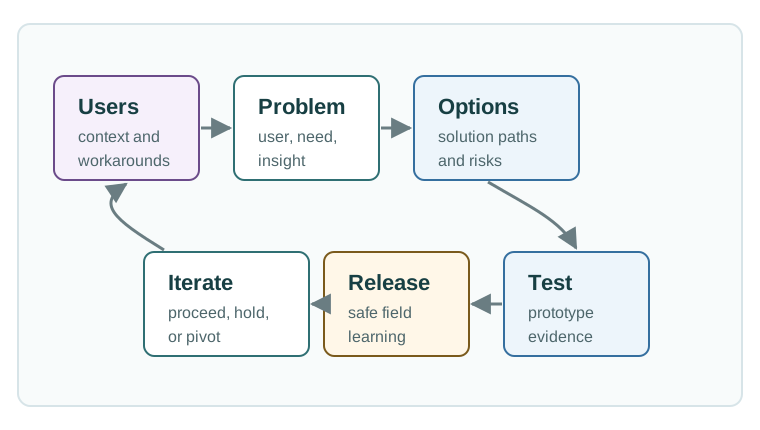
Start at Users, follow Problem and Options, then trace testing, release, and field learning.
- The Users stage identifies a person and decision the design serves.The cold-room monitor needs to establish who notices spoilage risk and who can respond during a shift handoff.
- The Problem and Options stages connect observed needs with possible interventions.A local alarm or inspection routine must remain a candidate until remote awareness demonstrates a useful change in action or accountability.
- Testing and release need both user and system evidence.The alert must be understandable, while placement, connectivity, support, and recovery also need to work in the real setting.
- The field-learning return path can change an earlier decision.A new observation can reopen the problem, prototype, or operating model rather than treating release as the end of design.
Major section
Desirability means an alert someone can act on
Desirability asks whether the proposed feature changes a real decision or action.
- The cold-room alert needs an owner during shift handoffs.Spoilage-risk awareness is useful only when someone has responsibility for the warning, including after-hours response.
- Trustworthy placement and clear warnings can support staff action.A probe affected by door openings or airflow can produce confusing changes that make staff distrust otherwise functional alerts.
- A school ventilation warning needs someone who can act.The design must consider the classroom context, threshold trust, and what the device does after a power cut.
- Connectivity needs to improve a real decision or outcome.Desirability requires a named user’s pain point or trust barrier rather than assuming a delivered message is inherently useful.
Major section
Simpler alternatives and technical feasibility
Compare simpler alternatives before assuming the user needs a connected device.
- A medication reminder may need a routine or service instead of sensing.A phone prompt, caregiver escalation, pharmacy workflow, or printed routine can address different barriers behind the same initial product idea.
- Alternatives need testing against the actual user problem.A restaurant freezer can also benefit from an inspection routine, sign-off sheet, mechanical thermometer, or local audible alarm.
- Feasibility includes the complete technical and support path.Hardware, firmware, radio, cloud service, app, updates, and support must fit the real installation context.
- An appealing feature still needs operational evidence in its setting.A BLE provisioning demo cannot establish LoRaWAN coverage, and a working dashboard cannot establish the device’s OTA update path.
Major section
Viability after the prototype demonstration
Viability extends the review beyond a successful prototype demonstration.
- The organisation must sustain installation, operations, maintenance, and incident response.Viability includes the cost and responsibility of operating the product after the prototype demonstration has ended.
- Desirability requires a named user decision that the feature improves.The cold-room supervisor needs an actionable warning rather than another connected measurement with unclear responsibility.
- Feasibility requires the whole path to fit the installation context.The device, software, connectivity, app, support, and update behaviour must work together in the intended field setting.
- The continuation decision needs desirability, feasibility, and viability together.A liked prototype can still fail if nobody can operate, recover, support, or maintain the product through its expected life.
Major section
Small prototypes for specific uncertainties
Choose a small test with a clear boundary and a decision it could change.
- A journey map can test whether the frame matches the workflow.Observed staff tasks can become alert-state requirements instead of leaving the team with a product idea detached from daily work.
- A clickable alarm flow can test understanding of the next action.A nurse, technician, or facilities manager needs to know what to do when the message appears, beyond recognising a measurement.
- A bench prototype can test placement, sampling, and power assumptions.The chapter’s sensor board can provide placement, calibration, battery, and packet evidence without proving the complete product.
- The test needs offline, failed, overridden, and recovered states.A polished dashboard cannot establish manual fallback, setup, weak-radio behaviour, or support recovery if those states were never exercised.
Activity 1 · Match
✎ Match the uncertainty to a test
I want you to choose the smallest test that could change your design.
On paper, match journey map, clickable flow, breadboard, service blueprint, and consent wording test to: installation ownership; stable sensor placement; user workflow; alert understanding; acceptance of data collection.
3 minutes · Pen and paper · Answer: Activity 1
Major section
User evidence before feature commitment
Begin with user context, then test whether the proposed technology improves the situation.
- A new capability can encourage implementation before the need is understood.A sensor or competitor feature can add complexity that users ignore, distrust, or struggle to support.
- User pull begins with a person, need, and contextual barrier.The cold-room statement needs kitchen supervisors, actionable alerts, and the loss of trust caused by repeated non-actionable warnings.
- A simpler process, service, or local tool may meet the need.The freezer example includes inspection routines, a thermometer with sign-off, and a local audible alarm as credible alternatives.
- Observed results can justify continuing, revising, holding, or changing direction.The next decision must follow what the test changed instead of protecting the team’s original connected-product idea.
Major section
The Seven Phases
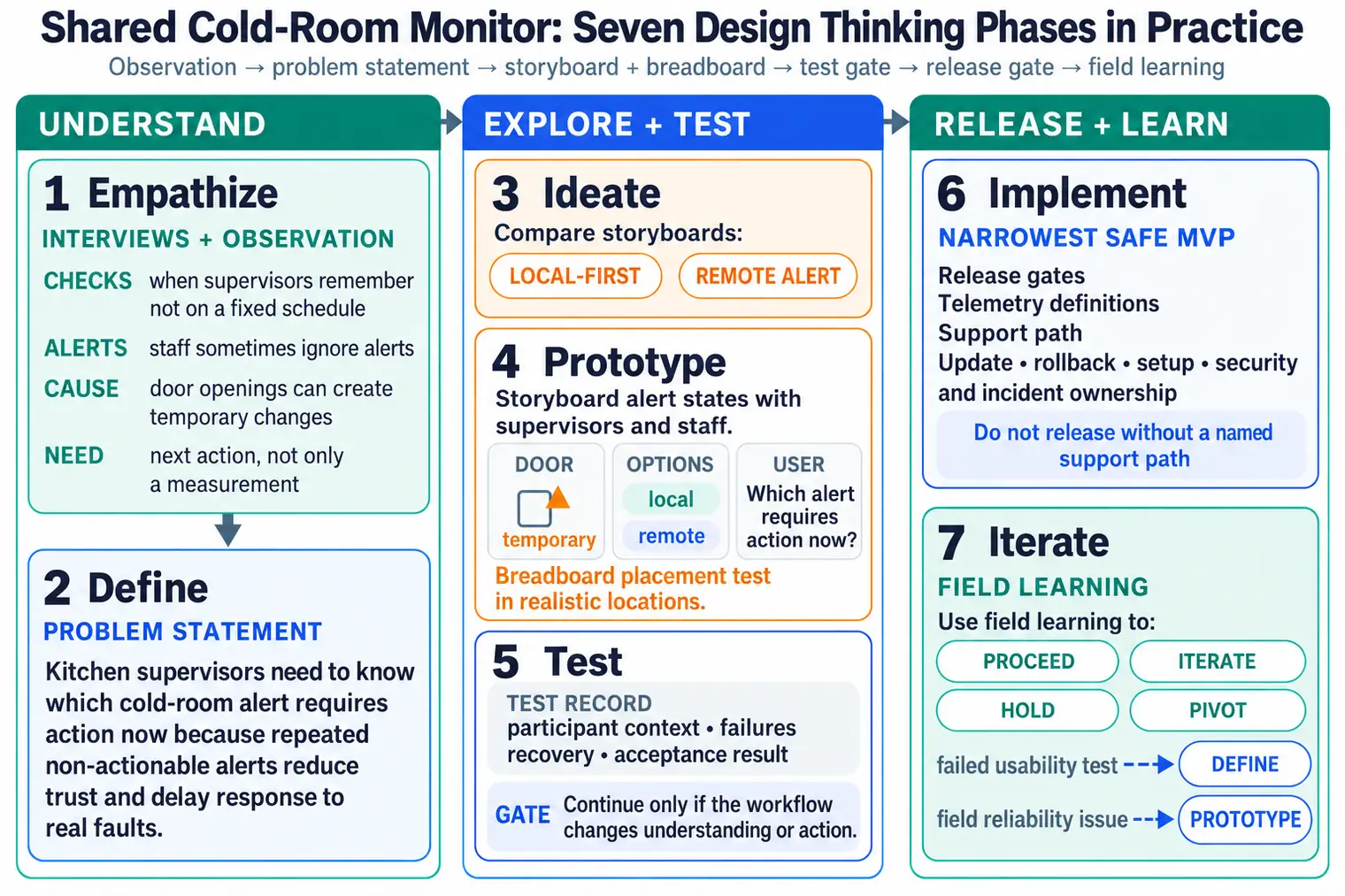
Follow the route from Empathize through testing to implementation and continued field learning.
- Empathize and Define connect observed work with a focused problem.Interviews, observation, and journey maps must lead to a user need and success measure without naming a device as the solution.
- Ideate compares alternatives before Prototype creates a bounded artifact.Non-connected, local, service, and low-tech options can remain candidates while the cheapest credible test addresses the current uncertainty.
- The Test phase brings real users and constraints together with the artifact.Offline, low-power, ambiguous-alert, privacy, and support conditions need observations alongside the normal workflow.
- Implement and Iterate connect release conditions with continuing field evidence.Setup, updates, rollback, security, and incident ownership need release gates, while telemetry and support trends can reopen earlier decisions.
Major section
Evidence can reopen the design
A failed test can send the team back to an earlier design decision.
- A usability finding may require another Define phase.The team needs to change the problem frame when the tested workflow fails to address the observed user barrier.
- A field reliability failure may require another bounded prototype.The seven phases allow a return to Prototype when new constraints challenge the earlier technical evidence.
- Architecture decisions need user evidence and a demonstrated reason for connectivity.The necessity gate compares the connected idea with a process, service, local tool, or non-connected product.
- The next disconfirming test and risk owners need explicit records.Privacy, installation, maintenance, support, and rollback must have ownership before the team broadens its implementation commitment.
Major section
The Problem Statement Pattern · Assumption Mapping
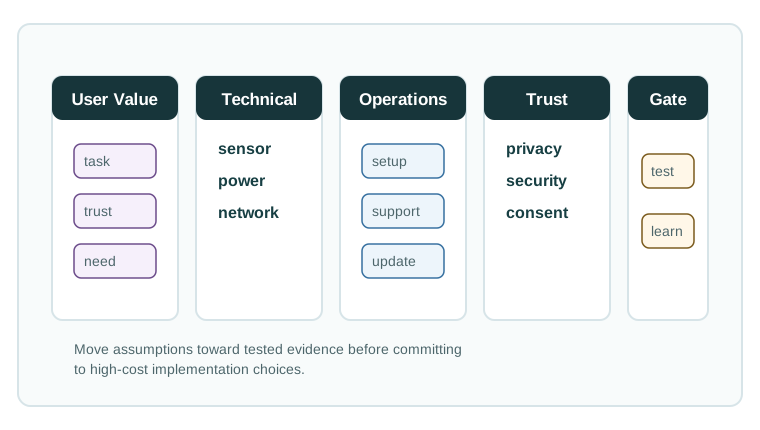
Read the evidence board from user value through technical, operations, and trust assumptions to the gate.
- The user-value notes identify the decision the product should improve.Kitchen supervisors need to recognise which cold-room warning requires action now because non-actionable alerts can reduce trust.
- Technical and operations assumptions have different evidence needs.A breadboard can test placement, while a service blueprint can establish who installs, maintains, updates, and responds to the system.
- Trust and privacy assumptions require acceptance evidence.Consent wording, permission walkthroughs, and data-minimisation review can challenge whether users understand and accept the proposed collection or automation.
- The gate needs tested evidence behind the user, need, and insight.An observed result must justify the next commitment rather than letting an untested assumption travel unchanged into costly implementation.
Activity 2 · Draw it
✎ Frame the cold-room decision
I want you to leave room for a better answer than a new device.
Draw three boxes on paper: user, need, and insight. Fill them for the shared cold-room example. Below them, sketch one storyboard test comparing a local alert with remote awareness, and name what result would justify connectivity.
4 minutes · Pen and paper · Answer: Activity 2
Major section
Early Validation Artifacts
Compare the time spent understanding users and framing the problem with later prototype and test work.
- For the cold-room monitor, the first 3.5 weeks should therefore produce named staff roles, observed handoffs, network and mounting constraints, a bounded spoilage-risk statement, and assumptions ranked by consequence.
- Ideate has 10% of the schedule, while Prototype has 25%.Those allocations support comparing options and creating iterative low-fidelity models instead of treating the first artifact as a finished product.
- The Test phase has the largest single allocation at 30%.The chapter’s ten-week plan deliberately reserves repeated feedback alongside prototype work rather than one final demonstration.
- The time budget requires evidence before prototype polish becomes the priority.Procurement, enclosure work, and dashboard polish cannot compensate for an unverified workflow or an alert with no responsible actor.

Major section
Phase records in the ten-week cold-room plan
Each phase needs a recorded result that justifies the next commitment.
- The first 3.5 weeks need roles, handoffs, constraints, and ranked assumptions.The cold-room plan must produce staff observations, network and mounting constraints, and a bounded spoilage-risk statement.
- The later 6.5 weeks can test small alarm and recovery slices.Alarm, acknowledgement, offline, and escalation tests must answer the earlier findings instead of becoming a single large build.
- Each phase needs evidence, unresolved assumptions, owners, and a decision.Product and operations owners must record the acceptance result and whether to continue, revise, or stop together.
- Delayed user access requires an exposed evidence gap and reduced commitment.Schedule drift must not replace missing research with implementation that cannot establish the unverified workflow.
Major section
The next credible cold-room test
Choose the simplest credible artifact for the cold-room question currently blocking progress.
- A sketch can test whether staff recognise an actionable alert.The storyboard must change understanding or action before the team assumes that unclear warnings require more sensing.
- A placement breadboard can reveal unstable readings near doors or airflow.The cold-room prototype needs realistic location evidence before sensor-placement guidance is treated as credible.
- Local and remote alert storyboards can test the need for connectivity.Remote awareness must change action or accountability to justify the connected path over a simpler local indicator or procedure.
- A service blueprint needs setup, response, escalation, and maintenance ownership.An alert can remain useless despite correct sensing if the product has no named support and response path.
Deck summary
Key takeaways
Human-centred IoT design keeps technical evidence attached to a real user decision.
- The workflow must be understood before the device or dashboard is defined.An alert can fail because of timing, equipment labels, or unavailable action even when the technology delivers its message.
- The problem frame needs a user, desired outcome, and explanatory insight.Kitchen supervisors need actionable cold-room warnings because repeated non-actionable alerts reduce trust and delay real-fault response.
- The highest-consequence assumption needs a bounded credible prototype.A sketch, clickable flow, breadboard, or service blueprint must answer its named question without being claimed as proof of the entire product.
- Field learning and support evidence must guide revisions.Usability, reliability, recovery, and operating observations can reopen the problem frame, prototype, release plan, or long-term service model.
Retrieval practice
Recall check 1 of 4
Blueprint Bina says: answer from memory, then check your reasoning.
Q1A team wants to build a connected device because a new low-power sensor is available. What should they do first in a design thinking process?
Show answer
Answer: D The first step is to learn from users and context.
Retrieval practice
Recall checks 2–3 of 4
Blueprint Bina says: answer from memory, then check your reasoning.
Q2Which statement is the strongest design thinking problem statement?
Show answer
Answer: B A strong problem statement names a specific user, need, and insight without prescribing the final technology.
Q3What user observations and constraints should precede a proposed product solution?
Show answer
Answer: C Observation, constraints, environment, and stakeholder goals precede any proposed solution.
Retrieval practice
Recall check 4 of 4
Blueprint Bina says: answer from memory, then check your reasoning.
Q4Complete the helper that checks whether a problem statement record has the minimum design thinking fields:
Show answer
Answer: A A ready problem statement includes user, need, and insight, and it should not lock the team into a predetermined solution too early.
Print reference
Answers
Answer key.
- D · The first step is to learn from users and context.
- B · A strong problem statement names a specific user, need, and insight without prescribing the final technology.
- C · Observation, constraints, environment, and stakeholder goals precede any proposed solution.
- A · A ready problem statement includes user, need, and insight, and it should not lock the team into a predetermined solution too early.
Print reference
Activity 1 answer
Model answer.
Match: Journey map: user workflow. Clickable flow: alert understanding. Breadboard: stable sensor placement. Service blueprint: installation ownership. Consent wording test: acceptance of data collection. Each test supports its named question without proving the whole product.
Print reference
Activity 2 answer
Model answer.
Draw it: User: kitchen supervisors. Need: recognize which cold-room alert needs action now. Insight: repeated non-actionable alerts reduce trust and delay response. A storyboard compares local and remote alert responses; connectivity is justified when remote awareness changes action or accountability.