Design Methodology · Study deck

Implement and Iterate

Picture a cold-room alert that works in a demo but cannot recover after its first lost message.

Blueprint Bina is your guide for this deck.

thinkingimplementiterate
Blueprint Bina, the module guide, in a scene from this chapter.
iotclass.org

After studying this chapter

Learning objectives

You will be able to:

  • Convert prototype evidence into a narrow MVP scope and release goal.
  • Define an IoT-ready Definition of Done that covers hardware, firmware, cloud, privacy, support, and rollback.
  • Organize implementation work into thin slices that produce evidence instead of disconnected component work.
  • Plan staged rollouts, telemetry, and field feedback loops for deployed connected products.
iotclass.org

Major section

Start With One Thin Slice · In 60 Seconds

The team needs one complete, supportable path before it adds more screens or sensors.

  • Firmware means the software stored on the device.
  • Telemetry means records a system sends about its readings, state, and health.
  • This runway does not prove that the whole product is ready.
  • Implementation is not the moment when design thinking ends.
iotclass.org

Major section

Implementation Is Operating Model
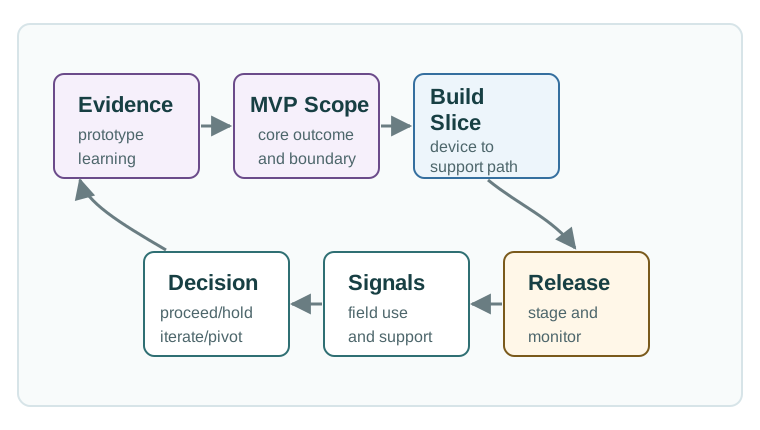
An IoT MVP is not just the first version of the app.

  • If any part of that loop has no owner, the product is not ready for real users.
  • The implementation stage should protect the validated value while shrinking everything else.
  • This gives: Implementation Is Operating Model evidence to revisit.
Implementation keeps moving through evidence, MVP scope, build slices, staged release, field signals, and the next proceed, hold, iterate, or pivot decision.
iotclass.org

Major section

Implementation Is Operating Model (continued)

When the evidence says the setup flow fails, the next iteration should improve setup rather than adding a second chart or a new integration.

  • A cold-room alert MVP may need one supported sensor node, a defined placement rule, a three-state alert, acknowledgement, device-health telemetry, setup guidance, and a support path.
  • A release-ready slice also includes the unglamorous paths that prototypes often skip.
  • The team should treat implementation evidence as a decision record.
iotclass.org

Major section

Implementation Is Operating Model (continued)

Scope boundary:: Include only what protects the user outcome, field operation, security, privacy, update path, and learning question.

  • This route carries: Implementation Is Operating Model from Implementation keeps moving through evidence, MVP scope, build slices, staged release, field signals, and the next proceed, hold, iterate, or pivot decision into the project record.
  • That record keeps iteration from becoming endless feature churn.
  • Learning boundary:: Collect telemetry and feedback only when the team knows what decision each signal supports.
iotclass.org

Major section

Build Field-Ready Vertical Slices · Release Safety Needs State

Hardware may need enclosure labeling, battery-life evidence, regulatory assumptions, and spare-unit handling.

  • For an alert product, one slice might include sensor sampling, firmware fault state, MQTT publish, cloud rule, app notification, acknowledgement, support runbook, and telemetry dashboard.
  • Staged rollout is part of product design.
  • The implementation layer needs versioned contracts.

Key terms

OTA safety
OTA safety is a state machine, not a button.
iotclass.org

Major section

MVP Red Flag · Definition of Done for IoT
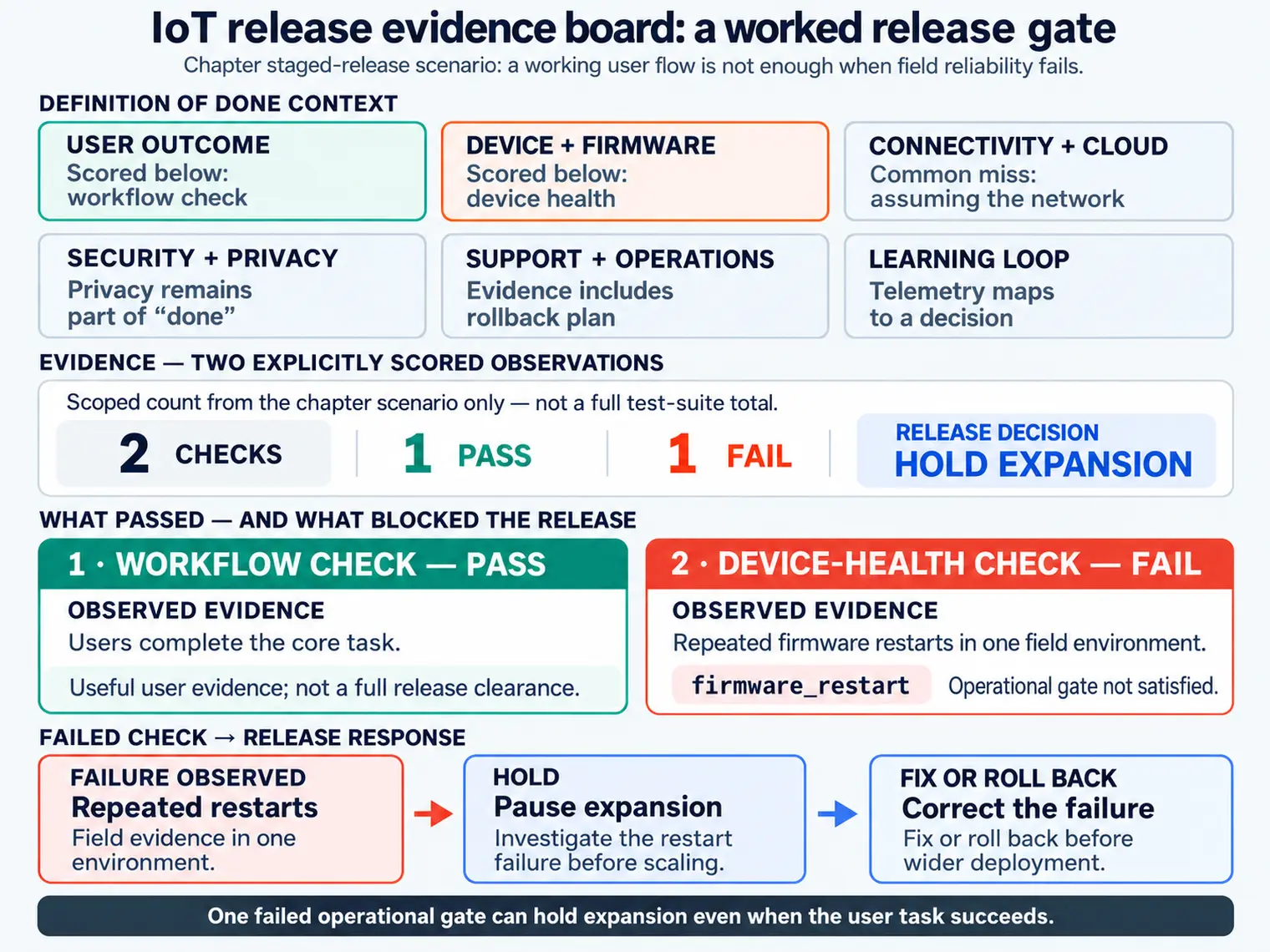
If the release plan includes every feature from the prototype wish list, the team has not defined an MVP.

  • The release scope should be narrow enough that each included feature can be defended by prototype evidence, operational need, security need, or a clear learning question.
  • Authentication, message handling, retry behavior, rate limits, and observability.

Key terms

Assuming the network
Assuming the network is always available.

Why it matters

IoT products need a broader version because the release crosses hardware, firmware, network, cloud, mobile interface, data governance, field support, and update operations.

An IoT release board makes readiness visible across product, engineering, support, and field learning.
iotclass.org

Major section

Staged Rollout and Update Safety

Connected products need a release plan that assumes some devices will be offline, misconfigured, low on power, behind weak networks, or running older firmware.

  • Staged rollout is not only for user-interface experiments; it is part of device safety and supportability.
  • Device reports compatible version, enough resources, and valid configuration.
  • Separates code deployment from feature exposure.
iotclass.org

Major section

Staged Rollout and Update Safety (continued)

Checks whether the update can run on the device, firmware, configuration, and data schema in the field.

  • Health signals stay within expected bounds and support volume does not spike.
  • Lets the team recover from a bad update without physical access where possible.
  • Previous version remains available, device can report status, and support can identify affected units.
iotclass.org

Major section

Decide: Proceed, Iterate, Hold, or Pivot · Worked Example: Cold-Room Alert MVP

Iteration is useful only if evidence changes the plan.

  • A release review should separate observed field signals from opinions, then choose a specific next action.
  • The release meets the user outcome, operational gate, and risk controls.
  • Moving forward while hidden field problems are still unresolved.

Why it matters

Kitchen supervisors need to know when a shared cold room is drifting out of a safe operating range because they cannot continuously watch the room and they need a clear next action when an alert occurs.

iotclass.org

Major section

Release Evidence Record

Each implementation cycle should leave an evidence record that future teams can understand.

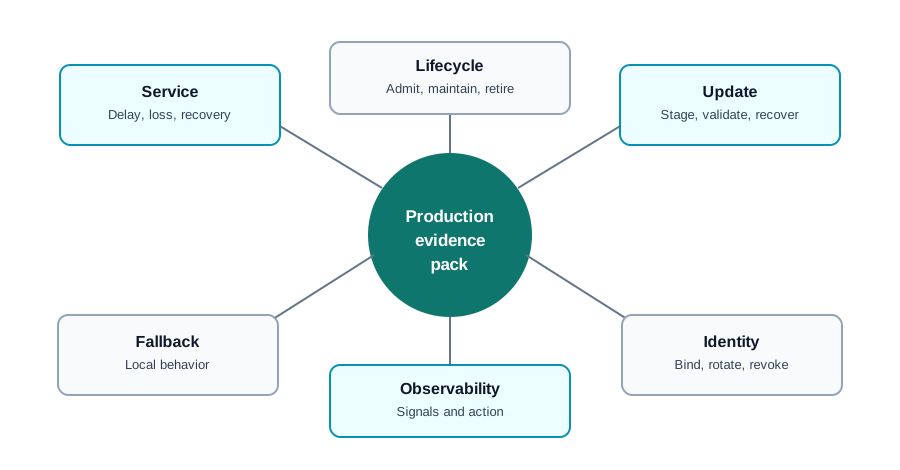
  • Its: Production and evidence markers reveal where A production evidence pack keeps service behavior, lifecycle ownership, update readiness, fallback behavior, identity, and observability visible before rollout expansion enters the running decision.
  • The learning or operational question this release is meant to answer.
A production evidence pack keeps service behavior, lifecycle ownership, update readiness, fallback behavior, identity, and observability visible before rollout expansion.
iotclass.org

Major section

Release Evidence Record (continued)

Those hand-offs make A production evidence pack keeps service behavior, lifecycle ownership, update readiness, fallback behavior, identity, and observability visible before rollout expansion actionable within: Release Evidence Record.

  • Links to tests, review notes, security checks, support runbooks, rollback notes, and telemetry definitions.
  • Task success, device health, connectivity, support, trust, and feedback observations.
  • Proceed, iterate, hold, or pivot, plus the reason.
iotclass.org

Deck summary

Key takeaways

The team needs one complete, supportable path before it adds more screens or sensors.

  • An IoT MVP is not just the first version of the app.
  • When the evidence says the setup flow fails, the next iteration should improve setup rather than adding a second chart or a new integration.
  • Scope boundary:: Include only what protects the user outcome, field operation, security, privacy, update path, and learning question.
  • Hardware may need enclosure labeling, battery-life evidence, regulatory assumptions, and spare-unit handling.
iotclass.org

Retrieval practice

Recall check 1 of 3

Blueprint Bina says: answer from memory, then check your reasoning.

Q1A team validated that users need a reliable cold-room alert with a clear next action. A stakeholder asks to add custom dashboards, voice commands, and broad third-party sensor support before launch. What is the strongest MVP response?

AAdd dashboards, voice commands, and third-party sensor support now so stakeholders see a broader launch package.
BShip the validated alert workflow with operations and telemetry; defer extras to the next-learning backlog.
CDrop telemetry and support signals from the first release so engineering can finish the alert screen and claim the MVP is smaller.
DShip a demo-only alert because support, recovery, placement guidance, and failure handling can wait until adoption grows.
Show answer

Answer: B The MVP should deliver the validated core outcome and the minimum operational requirements.

iotclass.org

Retrieval practice

Recall check 2 of 3

Blueprint Bina says: answer from memory, then check your reasoning.

Q2A staged rollout shows that users complete the core task, but device health events show repeated firmware restarts in one field environment. What should the team do next?

AExpand anyway because task completion shows users value the release and device restarts can be handled after scale-up.
BHold expansion, investigate restarts, and fix or roll back before wider deployment.
CAdd roadmap features first so release notes look stronger while the reliability concern stays in monitoring.
DHide the restart telemetry until the next scheduled operations review so rollout momentum is not interrupted.
Show answer

Answer: B A release can be held even when users like the workflow.

iotclass.org

Retrieval practice

Recall check 3 of 3

Blueprint Bina says: answer from memory, then check your reasoning.

Q3Place each implementation activity where it lives so you can bound the release, expose it safely, and turn field evidence into the next decision.

AMVP Scope
BDefinition of Done
CStaged Release
DField Learning
Show answer

Answer: A Separate release definition, controlled delivery, and field learning so you can distinguish planned completion from evidence that the implementation works in context.

Q4Complete the helper that decides whether a staged IoT release can expand:

Afor field in required:
Bfor field in record:
Cwhile record:
Dif field in required:
Show answer

Answer: A A rollout can expand only when the release record has the required evidence, the decision is proceed, and no release gate is blocked.

iotclass.org

Print reference

Answers

Answer key.

  1. B · The MVP should deliver the validated core outcome and the minimum operational requirements.
  2. B · A release can be held even when users like the workflow.
  3. A · Separate release definition, controlled delivery, and field learning so you can distinguish planned completion from evidence that the implementation works in context.
  4. A · A rollout can expand only when the release record has the required evidence, the decision is proceed, and no release gate is blocked.
iotclass.org