Design Methodology · Study deck
Agile and Risk Management
Picture a team building a cold-room alarm.
Blueprint Bina is your guide for this deck.
After studying this chapter
Learning objectives
You will be able to:
- Build an IoT risk register that records cause, effect, owner, trigger, mitigation, evidence, and decision date.
- Use qualitative probability and impact ratings without pretending weak estimates are precise forecasts.
- Use Kanban flow and work-in-progress limits for lab queues, supplier qualification, certification, and integration work.
- Decide when a design sprint is appropriate for user or product uncertainty and when engineering validation is required.
Major section
Start With the Risk That Can Break the Sprint
By Friday, the screen is polished and every task is closed, but nobody has tested the weak radio path behind the freezer door.
- The work looks complete while the largest release risk remains open.
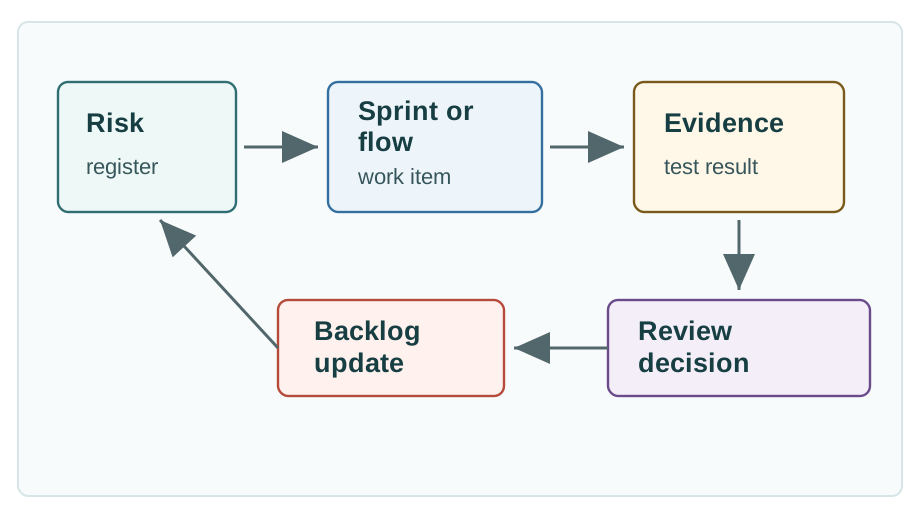
- Delay the service, repeat an alert, change the phone user, and record the result.
- At review, choose one outcome: accept the claim, narrow it, change the design, or stop the release until new evidence exists.
Major section
In 60 Seconds
Agile is useful for IoT only when it creates evidence faster than the project creates risk.
- A sprint that produces only status updates is not agile.
- A sprint that proves battery draw, radio range, cloud ingestion, enclosure fit, supply alternatives, security assumptions, and user workflow risk is useful.
- Agile cadence is the discipline that makes that testing repeatable.
Major section
Agile Retires Risk
Agile practice helps IoT teams when each cycle closes a named uncertainty.
- A sprint should not merely move tickets.
- It should prove whether a sensor, radio, enclosure, firmware path, cloud path, security control, or field workflow can meet the next project decision.
- The risk register gives the work its order.
Major section
Agile Retires Risk (continued)
Each increment needs a named owner and a measurement that can change the next decision.
- The Definition of Done prevents the team from accepting work that has code but no measurement, no trace, no review, or no recovery plan.
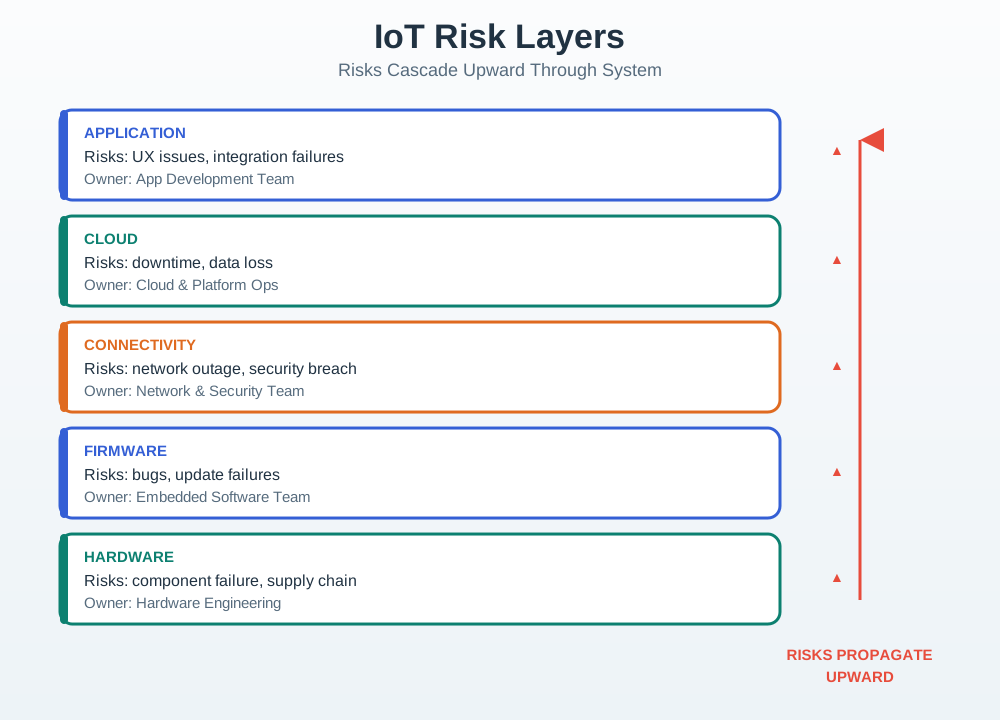
- That evidence reduces hardware, firmware, network, and cloud risk at once.
- A different cycle might discover that the enclosure blocks airflow or that the dashboard freshness rule hides stale readings.
Major section
Agile Retires Risk (continued)
Product risk: The user workflow, installation sequence, dashboard interpretation, support model, or business promise may be wrong.
- Engineering risk: Battery life, RF range, memory use, thermal behavior, enclosure fit, firmware update, or gateway reliability may fail under real conditions.
- The cloud/service row shows the boundary state and evidence that helps locate the source instead of blaming only the final symptom.
- The final dashboard symptom is useful, but it is not enough to identify the source.
Major section
Retire One Assumption per Sprint
A battery sprint might require a Joulescope or Nordic Power Profiler trace, sleep-current measurement, sensor warm-up profile, and projected duty cycle.
- A radio sprint might require RSSI/SNR samples, packet-loss counts, antenna placement notes, Wireshark or broker logs, and a repeatable test route.
- A security sprint might require device identity, certificate rotation, OTA rollback, audit events, and a recovery procedure.
- A LoRaWAN range risk might use one node, one gateway, a fixed spreading-factor plan, a mapped walk route, and a table of RSSI, SNR, frame count, and missed uplinks.
Major section
IoT Agile Fails at Boundaries
The hidden cost in IoT planning is boundary mismatch.
- Firmware may pass a unit test but miss an MQTT retransmission edge case.
- A BLE GATT workflow may work in a demo but fail when connection intervals, phone background limits, or pairing recovery are included.
- Agile controls must therefore expose state across layers.
Major section
IoT Agile Fails at Boundaries (continued)
A LoRaWAN prototype may pass uplink tests but run into ADR behavior, downlink scarcity, regional duty-cycle limits, or gateway backhaul outages.
- Firmware state includes watchdog resets, brownout handling, heap use, flash wear, and OTA slot health.
- Network state includes join success, retry counts, queue depth, RSSI/SNR, TLS session failures, and broker acknowledgements.
- Service state includes schema version, alert latency, retention rule, dashboard freshness, permission model, and incident handoff.
Major section
IoT Agile Fails at Boundaries (continued)
The reason boundary evidence matters is that IoT defects cascade.
- A marginal sensor connection can create firmware retries, which drain the battery, which causes missed network joins, which makes a dashboard look stale, which triggers a support incident.
- If the sprint evidence records only the final dashboard symptom, the team fixes the wrong layer.
- Without that evidence, "done" is just a workflow label.
Major section
IoT Agile Fails at Boundaries (continued)
If it records source samples, firmware counters, broker acknowledgements, cloud validation failures, and the operations alert, the team can decide which layer owns the risk and which backlog item should change next.
- A ticket closes only when the related trace, log, capture, test report, or operator runbook is attached, and when the owner has named the next risk state.
- Network boundary: MQTT QoS semantics, CoAP confirmable messages, BLE reconnect behavior, Thread route changes, LoRaWAN airtime, and Wi-Fi roaming.
- Operations boundary: Grafana dashboards, Prometheus alerts, AWS IoT Core or Azure IoT Hub policies, certificate expiry, log retention, and field-support runbooks.
Major section
Incremental Examples
Beginner Example: A classroom sensor prototype uses an ESP32 board and a BME280 over I2C.
- The first risk is not market fit; it is whether the board, sensor, wiring, and firmware path can produce stable readings.
- Intermediate Example: A gateway prototype publishes telemetry with MQTT over TLS to AWS IoT Core, Azure IoT Hub, Mosquitto, or EMQX.
- The agile method is useful only if each layer leaves reviewable evidence.
Major section
Scrum Adaptation for IoT
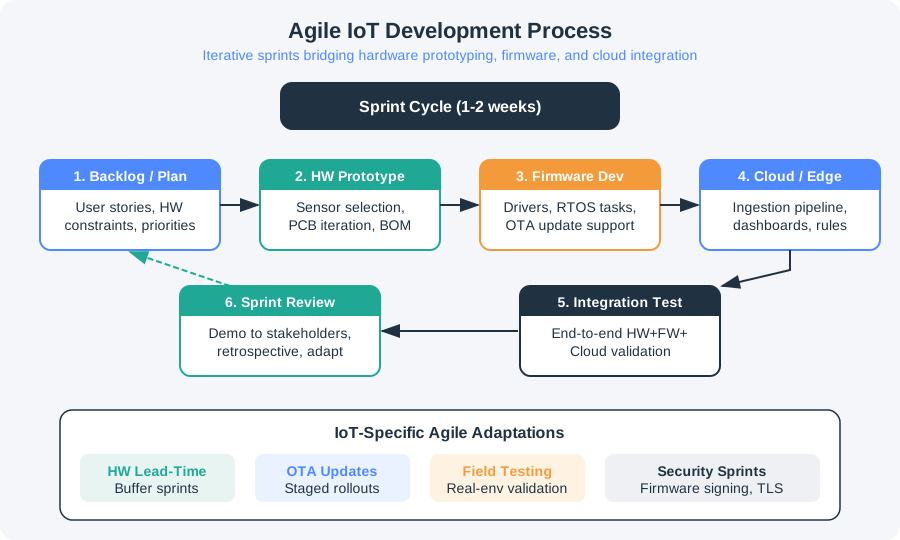
Scrum is a lightweight framework for adaptive work.
- For IoT, those ideas help only when the increment includes cross-layer evidence.
- Hardware lead-time needs buffer sprints, while OTA updates need staged rollouts.
- Field testing and security sprints add checks that keep the cycle tied to deployment conditions.
- For an IoT increment, Done often needs additional proof.
Major section
Kanban Flow for Hardware Constraints
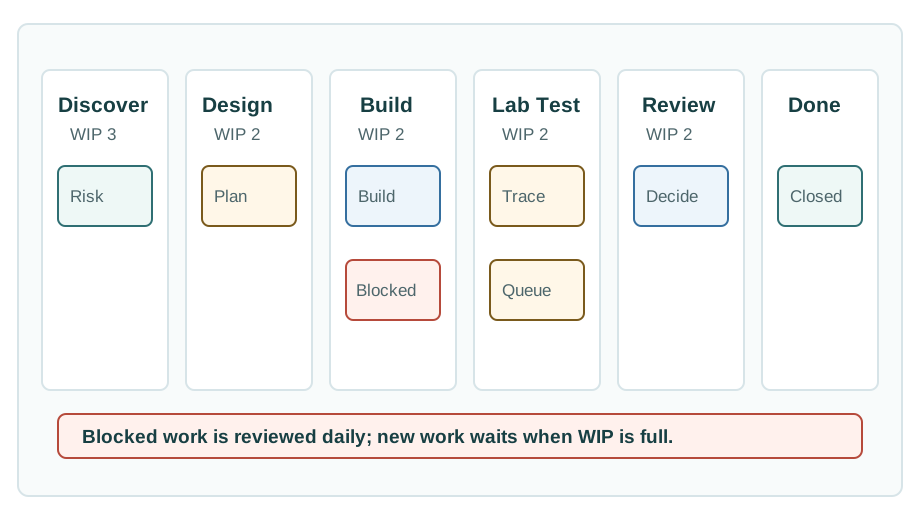
Kanban is useful when work waits in queues: lab test slots, procurement, PCB review, firmware integration, certification evidence, enclosure changes, or customer installation feedback.
- The key is to visualize the workflow, limit work in progress, and actively manage blocked items.
- The lab stage adds conditions, traces, sample size, and a pass or fail outcome, while review decides what happens to the risk.
- Work-in-progress limits keep scarce engineering and lab capacity from being overcommitted.
Major section
Common Pitfalls
The cadence matters only if it changes what the team learns, builds, tests, or stops doing.
- PCB fabrication, supplier quotes, lab slots, fixtures, and certification feedback should be visible.
- Done must match the product risk.
- A design sprint can validate a workflow or product assumption.
- Risk scores are decision aids.
Deck summary
Key takeaways
By Friday, the screen is polished and every task is closed, but nobody has tested the weak radio path behind the freezer door.
- Agile is useful for IoT only when it creates evidence faster than the project creates risk.
- Agile practice helps IoT teams when each cycle closes a named uncertainty.
- Each increment needs a named owner and a measurement that can change the next decision.
- Product risk: The user workflow, installation sequence, dashboard interpretation, support model, or business promise may be wrong.
Retrieval practice
Recall check 1 of 5

Blueprint Bina says: answer from memory, then check your reasoning.
Q1A supplier risk has little frequency data. How should the team rate it for planning?
Show answer
Answer: B Weak evidence supports triage, not a precise forecast.
Retrieval practice
Recall checks 2–3 of 5
Blueprint Bina says: answer from memory, then check your reasoning.
Q2Which risk-register entry is strongest for an IoT project?
Show answer
Answer: A A useful risk entry drives action and makes closure evidence visible.
Q3What exposes delivery queues and shortens feedback by limiting work in progress?
Show answer
Answer: B Flow limits belong in delivery control because limiting work in progress exposes queues and shortens the feedback path for risky changes.
Retrieval practice
Recall checks 4–5 of 5
Blueprint Bina says: answer from memory, then check your reasoning.
Q4Complete the sprint record so the team can prove the sprint retired or reduced real IoT risks.
Show answer
Answer: A
Q5Which statement best describes high-quality Agile risk management for IoT?
Show answer
Answer: A Agile is valuable when it creates inspectable evidence against the risks that matter.
Print reference
Answers
Answer key.
- B · Weak evidence supports triage, not a precise forecast.
- A · A useful risk entry drives action and makes closure evidence visible.
- B · Flow limits belong in delivery control because limiting work in progress exposes queues and shortens the feedback path for risky changes.
- A · risk_links: battery-budget-02, radio-range-01, install-flow-03
- A · Agile is valuable when it creates inspectable evidence against the risks that matter.