Network Topologies · Study deck
Network Design Readiness
A network design becomes real when cables, radios, power supplies, addresses, and maintenance access meet the site.
Packet Pete is your guide for this deck.

After studying this chapter
Learning objectives
You will be able to:
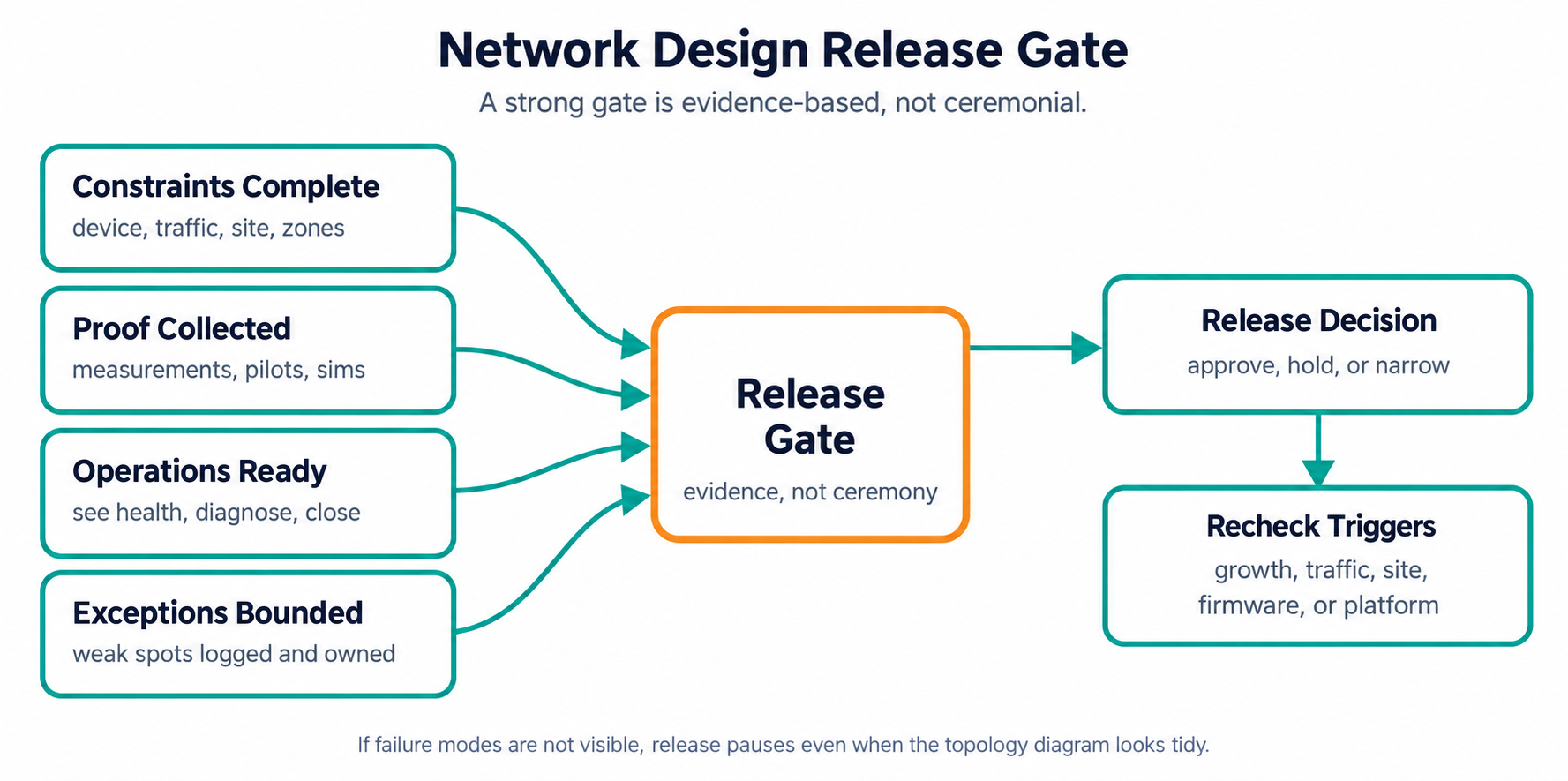
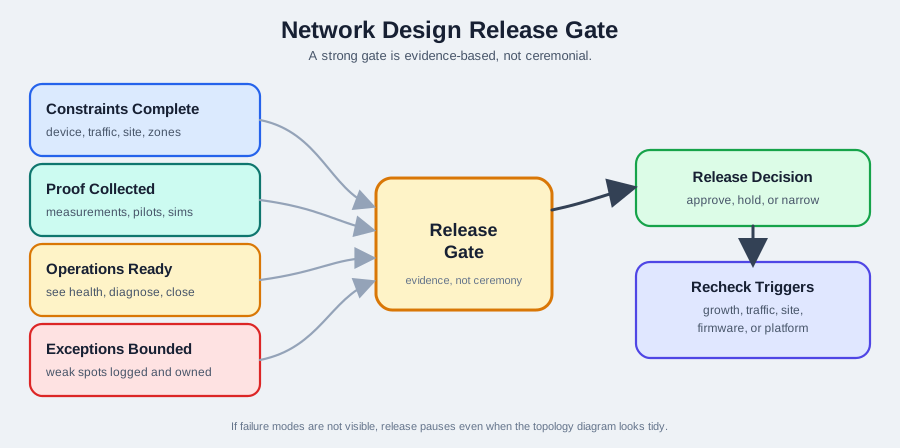
- Explain: With the three views assembled, the gate diagram Figure: The release gate asks whether constraints tests whether their evidence is sufficient to approve, hold, or narrow the design.
- Explain: Those inputs narrow: Protocol Fit and the: Gateway Boundary, where translation and buffering occur, before the: Release Decision asserts that topology and operations are ready.
- Explain: This closes the chapter's traceability narrative: release is a bounded evidence claim, and the trigger prevents that claim from surviving changed conditions by habit.
- Explain: Reliability testing removes the gateway, a shared switch or relay, and power to one zone.
Major section
Turn the Design Map Into a Readiness Decision
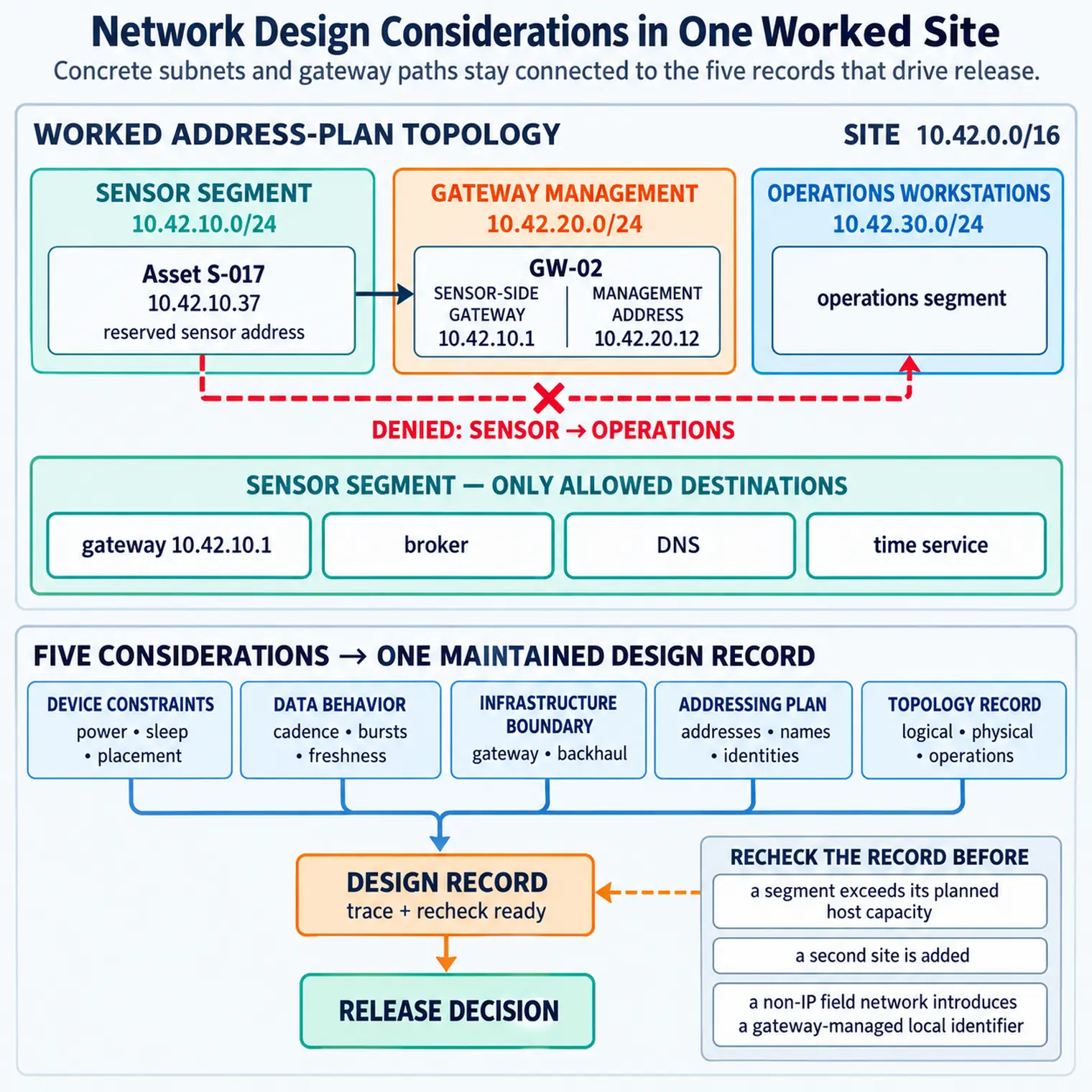
Coverage affects placement; capacity affects shared links; reliability exposes failure domains; security limits reachable paths; operations determine how faults and changes are handled.
- The gate should cite evidence, not confidence in the drawing.
- Application data entering the gateway is (30\times120=3{,}600) bytes per minute before protocol overhead and retries.
Major section
Turn the Design Map Into a Readiness Decision (continued)
Reliability testing removes the gateway, a shared switch or relay, and power to one zone.
- Security testing attempts a route that policy should deny.
- Operations testing asks whether staff can identify a missing sensor, replace it, and confirm its identity without weakening credentials.
- If a requirement has no test or a test has no limit, the design is not ready for release even when basic connectivity works.
Major section
Start With the Story
A line on a drawing does not show whether a battery can last, a message can arrive, or a broken device can be replaced.
- A protocol is a set of rules for exchanging messages.
- A gateway is a bridge between a local device network and a wider system.
- If the design record cannot show what must be checked again, it is not ready for release.
- This first review cannot predict every wall, radio, or maintenance event.
Major section
Practitioner: Build the Record Before the Diagram
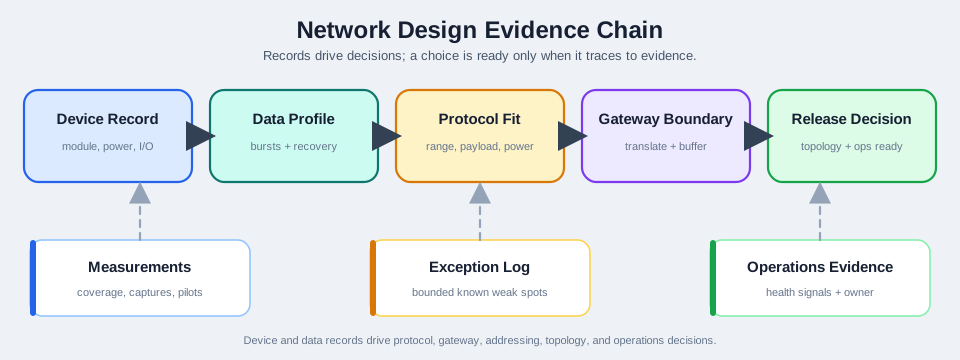
Those inputs narrow: Protocol Fit and the: Gateway Boundary, where translation and buffering occur, before the: Release Decision asserts that topology and operations are ready.
- The dashed supports matter too:: Measurements,: Exception Log, and: Operations Evidence supply coverage results, bounded weak spots, and named health owners.
Major section
Under the Hood: Release Gates Keep the Design Honest
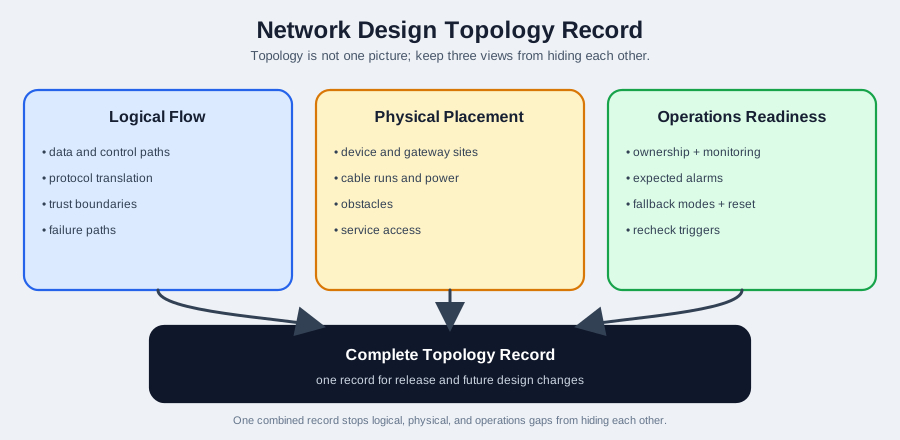
With the three views assembled, the gate diagram Figure: The release gate asks whether constraints tests whether their evidence is sufficient to approve, hold, or narrow the design.
- This closes the chapter's traceability narrative: release is a bounded evidence claim, and the trigger prevents that claim from surviving changed conditions by habit.
Deck summary
Key takeaways
Coverage affects placement; capacity affects shared links; reliability exposes failure domains; security limits reachable paths; operations determine how faults and changes are handled.
- Reliability testing removes the gateway, a shared switch or relay, and power to one zone.
- A line on a drawing does not show whether a battery can last, a message can arrive, or a broken device can be replaced.
- Those inputs narrow: Protocol Fit and the: Gateway Boundary, where translation and buffering occur, before the: Release Decision asserts that topology and operations are ready.
Retrieval practice
Recall check 1 of 2

Packet Pete says: answer from memory, then check your reasoning.
Q1A team selected a wireless protocol before documenting battery limits, message frequency, gateway placement, or addressing. What is the best design response?
Show answer
Answer: B Network design starts with traceable records.
Q2Which data-design habit is most likely to hide an IoT network failure mode?
Show answer
Answer: D Average-only design hides the traffic shapes that often break IoT networks: bursts, retries, stale readings, and recovery behavior.
Retrieval practice
Recall check 2 of 2

Packet Pete says: answer from memory, then check your reasoning.
Q3Which evidence gap should block release of an IoT network design?
Show answer
Answer: A A design is not ready if operations cannot detect, diagnose, and respond to the main failure modes after deployment.
Print reference
Answers
Answer key.
- B · Network design starts with traceable records.
- D · Average-only design hides the traffic shapes that often break IoT networks: bursts, retries, stale readings, and recovery behavior.
- A · A design is not ready if operations cannot detect, diagnose, and respond to the main failure modes after deployment.