Applications & Use Cases · Study deck

IoT Deployment Economics: Rollout and ROI Evidence

A partial rollout may carry most fixed costs but deliver little network value.

Blueprint Bina is your guide for this deck.

iotclass.org

After studying this chapter

Learning objectives

You will be able to:

  • Explain: Scenario: A regional water authority is deploying an IoT-based flood early warning system for a 200 km river basin that includes 15,000 hectares of farmland, 3 towns (combined population 45,000), and critical infrastructure.
  • Explain: Scenario: Beijing, China (population 21,540,000) deploys a hyperlocal air quality monitoring network to provide block-level PM2.5 alerts and enable pollution-responsive traffic routing.
  • Explain: A flood-warning network gains early warning from upstream rainfall rather than waiting for water to reach the protected town.
  • Explain: Key Insight: Urban air quality networks require a tiered sensor strategy.
iotclass.org

Major section

Beijing Air Quality Network
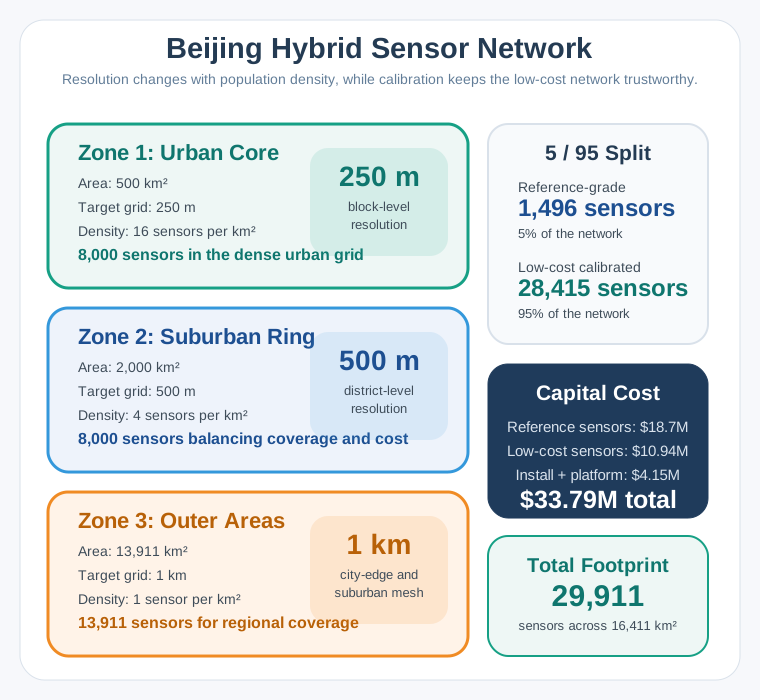
The Beijing network combines reference-grade sensors with a larger low-cost layer to support local air-quality decisions.

  • Reference sensors provide calibration evidence for the cheaper devices rather than replacing their spatial coverage.
  • The budget includes installation, connectivity, and platform costs as well as sensor purchases.

Numbers to remember

95%95% low-cost) reduces costs by 85% while maintaining data quality through calibration.
85%95% low-cost) reduces costs by 85% while maintaining data quality through calibration.

Why it matters

The benefit model discounts potential value by adoption because residents must use the routing service for its proposed benefit to occur.

Beijing hybrid air-quality network using dense urban sensing, wider suburban spacing, and a 5/95 reference-to-low-cost sensor split.
iotclass.org

Major section

Beijing Air Quality Network (continued)

Scenario: Beijing, China (population 21,540,000) deploys a hyperlocal air quality monitoring network to provide block-level PM2.5 alerts and enable pollution-responsive traffic routing.

  • The hybrid sensor approach (5% reference-grade, 95% low-cost) reduces costs by 85% while maintaining data quality through calibration.
  • The key is hyperlocal resolution; city-average readings miss pollution hotspots where interventions matter most.
  • The decision in hybrid sensor network architecture must preserve that labelled boundary.
iotclass.org

Major section

Tiered Sensor Economics

A tiered network uses reference sensors as calibration anchors for a larger set of inexpensive measurement points.

  • The reference layer corrects drift and bias so the coverage layer can support useful decisions.
  • The worked comparison separates sensor hardware savings from the data-quality condition that makes those savings credible.
  • This 89% cost reduction with <15% accuracy degradation explains widespread adoption of hybrid networks.

Why it matters

Removing the anchors would change the evidence behind the low-cost readings, not merely reduce the purchase bill.

iotclass.org

Major section

Urban Air Quality Network Design

Reference units support calibration, while mid-grade units cover critical locations and inexpensive units add spatial density.

  • The budget decision preserves those distinct roles rather than treating each sensor as an interchangeable cost.
  • Reducing the coverage tier changes spatial detail while retaining the calibration anchors and critical-location evidence described below.
  • Key Insight: Urban air quality networks require a tiered sensor strategy.
  • A few expensive reference-grade sensors provide accuracy anchors for calibrating many lower-cost sensors.
iotclass.org

Major section

Flood Early Warning Network

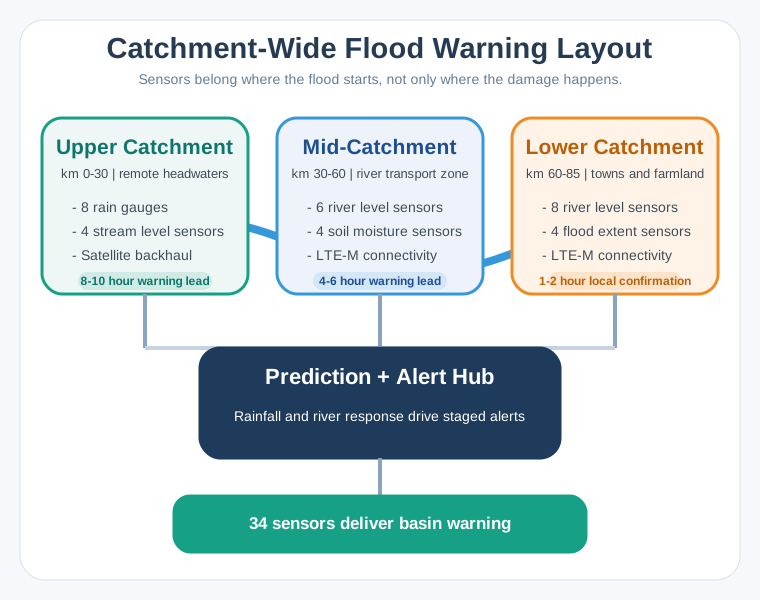
Scenario: A regional water authority is deploying an IoT-based flood early warning system for a 200 km river basin that includes 15,000 hectares of farmland, 3 towns (combined population 45,000), and critical infrastructure.

  • Key Insight: Flood early warning systems require sensors distributed across the ENTIRE catchment, not just at the point of interest.
Catchment-wide flood-warning design placing sensors upstream so alerts arrive hours before downstream impacts.
iotclass.org

Major section

Point-of-Impact Monitoring Pitfall

A flood-warning network gains early warning from upstream rainfall rather than waiting for water to reach the protected town.

  • Downstream level sensors confirm model predictions and support final-stage alerts after the upstream evidence has arrived.
  • A network concentrated at the valley floor can observe danger while leaving too little time for evacuation.
  • The instinct in flood warning is to place sensors near the towns and farms that need protection.
iotclass.org

Deck summary

Key takeaways

The Beijing network combines reference-grade sensors with a larger low-cost layer to support local air-quality decisions.

  • Scenario: Beijing, China (population 21,540,000) deploys a hyperlocal air quality monitoring network to provide block-level PM2.5 alerts and enable pollution-responsive traffic routing.
  • A tiered network uses reference sensors as calibration anchors for a larger set of inexpensive measurement points.
  • Reference units support calibration, while mid-grade units cover critical locations and inexpensive units add spatial density.
  • A flood-warning network gains early warning from upstream rainfall rather than waiting for water to reach the protected town.
iotclass.org

Retrieval practice

Recall check 1 of 5

Blueprint Bina says: answer from memory, then check your reasoning.

Q1An air-quality network uses inexpensive sensors for coverage. What role should its reference sensors retain?

AAnchor calibration of the low-cost layer
BReplace the need for spatial coverage
CEstimate adoption of the routing app
DSet the cellular subscription price
Show answer

Answer: A Reference sensors correct drift and bias so the inexpensive layer remains useful.

iotclass.org

Retrieval practice

Recall check 2 of 5

Blueprint Bina says: answer from memory, then check your reasoning.

Q2A city of 800,000 commuters has an average commute of 28 minutes. They plan to deploy smart traffic signals that reduce commute time by 10%. The average driver's hourly value is $25. What is the approximate annual value of time saved?

A$23 million
B$233 million
C$2.3 billion
D$23 billion
EYes, traffic ROI is always this fast
FNo, this ignores that benefits ramp up over deployment months, not day one
Show answer

Answer: B

iotclass.org

Retrieval practice

Recall check 3 of 5

Blueprint Bina says: answer from memory, then check your reasoning.

Q3Why does the worked example describe a payback period of "19.7 days" -- is this realistic?

AYes, traffic ROI is always this fast
BNo, this ignores that benefits ramp up over deployment months, not day one
CNo, the calculation is fundamentally wrong
DYes, but only for cities above 3 million population
Show answer

Answer: B

Q4Why does the Beijing example calculate an "achievable benefit" of $2.61 billion rather than the full $17.4 billion potential?

ABecause the sensors are only 15% accurate
BBecause only 15% of the population uses the dynamic routing feature
CBecause pollution routing only works 15% of the time
DBecause 85% of sensors are low-cost and less reliable
Show answer

Answer: B

iotclass.org

Retrieval practice

Recall check 4 of 5

Blueprint Bina says: answer from memory, then check your reasoning.

Q5The generic air quality example uses a 5:30:60 ratio of Tier 1 (reference), Tier 2 (mid-grade), and Tier 3 (low-cost) sensors. If the total budget were cut by 30%, which tier should be reduced FIRST?

ATier 1 (reference-grade) -- they are the most expensive per unit
BTier 2 (mid-grade) -- they are in the middle and easiest to cut
CTier 3 (low-cost) -- reducing spatial coverage has the smallest impact on data quality
DAll tiers equally -- maintain the same ratio
Show answer

Answer: C

iotclass.org

Retrieval practice

Recall check 5 of 5

Blueprint Bina says: answer from memory, then check your reasoning.

Q6The system prevents $1.1-1.7 million in annual flood damage. The CapEx is $350,000 and annual OpEx is $40,000. What is the approximate payback period?

AAbout 2 weeks
BAbout 4 months
CAbout 1 year
DAbout 3 years
Show answer

Answer: B

iotclass.org

Print reference

Answers

Answer key.

  1. A · Reference sensors correct drift and bias so the inexpensive layer remains useful.
  2. B
  3. B
  4. B
  5. C
  6. B
iotclass.org