Data Storage · Study deck
Data Quality Monitoring
Picture a cold-room chart that suddenly shows forty degrees instead of four.
Data Dora is your guide for this deck.
After studying this chapter
Learning objectives
You will be able to:
- define the main IoT data-quality dimensions and connect each one to a detectable failure mode;
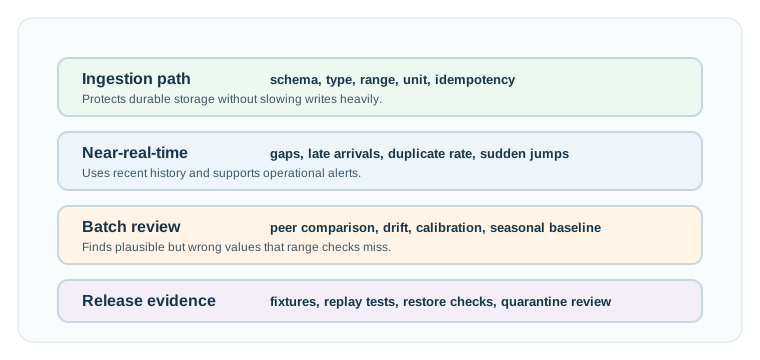
- place cheap validation checks on the ingestion path and expensive checks in near-real-time or batch jobs;
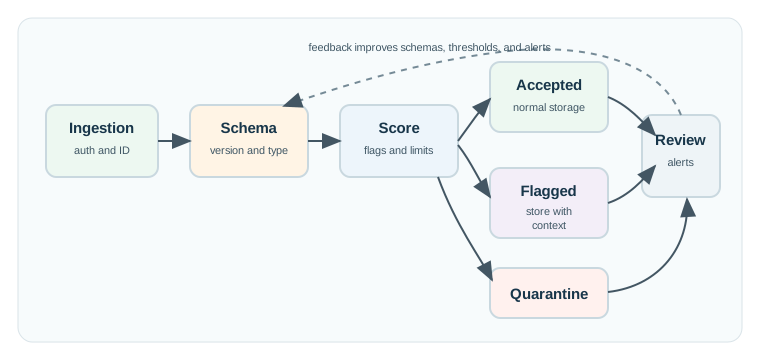
- design reject, quarantine, and flag routing for low-quality records;
- explain why range checks do not catch slow sensor drift;
Major section
Start With the Bad Reading
The store manager needs to know whether the room is unsafe, the unit changed, or the record was copied twice.
- Saving the value first and asking later can turn a data fault into a costly action.
- A gateway is a device that joins one network to another.
- Firmware is the code stored on a device.
Major section
Start With the Bad Reading (continued)
Machine learning means software that finds patterns from examples.
- None of these can rescue a record whose source, unit, time, and quality are missing.
- These checks cannot prove that every accepted reading is accurate.
- One bad reading is enough to make a dashboard lie if the storage path accepts it silently.
Major section
Quality Is a Storage Contract
A storage system can be fast and still store untrustworthy data.
- A sensor may send a value outside physical limits, a gateway may replay the same message, a firmware update may rename fields, or a device clock may be hours behind.
- If those records silently enter the durable path, later systems inherit the error.
- Suspect but usable records retain a visible quality state, quarantine preserves evidence for review, and rejection stops malformed input.
Major section
Monitoring the Quality Monitor
The quality system needs its own meta-metrics.
- These signals tell you whether the quality gate is healthy before a monthly report, machine-learning feature, or billing export discovers the damage.
- At scale, three mechanisms keep quality evidence honest.
- Second, a lateness watermark separates live data from backfill, so old buffered readings recompute affected quality scores and rollups instead of silently changing dashboards.
Major section
Concept Relationships
Data Storage and Databases explains how quality gates fit into broader storage contracts.
- Database Selection Framework helps choose storage roles that support validation, quarantine, and analytical filtering.
- Sharding Strategies covers how quality checks behave when writes are distributed across partitions.
- Stream Processing Fundamentals covers validation before records reach durable storage.
Deck summary
Key takeaways
The store manager needs to know whether the room is unsafe, the unit changed, or the record was copied twice.
- Machine learning means software that finds patterns from examples.
- A storage system can be fast and still store untrustworthy data.
- The quality system needs its own meta-metrics.
- Data Storage and Databases explains how quality gates fit into broader storage contracts.
Retrieval practice
Recall check 1 of 6

Data Dora says: answer from memory, then check your reasoning.
Q1A soil sensor reports no readings between 02:00 and 03:00, then resumes normally. Which quality dimension should trigger first?
Show answer
Answer: B The platform expected readings during that hour and did not receive them.
Retrieval practice
Recall check 2 of 6

Data Dora says: answer from memory, then check your reasoning.
Q2A temperature reading says -273.5 C. The payload is otherwise valid and may indicate sensor failure. What is usually the best response for a predictive-maintenance system?
Show answer
Answer: D The value should not drive analytics as a normal reading, but it is useful evidence of sensor or firmware failure.
Retrieval practice
Recall check 3 of 6

Data Dora says: answer from memory, then check your reasoning.
Q3A sensor slowly drifts 2 C high over six months but stays within the allowed -10 C to 50 C range. Which check is most likely to catch it?
Show answer
Answer: B Range checks catch impossible values; peer or reference checks catch plausible but wrong values.
Retrieval practice
Recall check 4 of 6

Data Dora says: answer from memory, then check your reasoning.
Q4A firmware rollout changes payloads from {'temp': 22.5} to {'temperature': 22.5, 'unit': 'C'}, but only half the fleet updates immediately. What should the ingestion layer do?
Show answer
Answer: C Version-aware parsing lets old and new firmware coexist while storage receives a stable canonical record.
Retrieval practice
Recall check 5 of 6

Data Dora says: answer from memory, then check your reasoning.
Q5Which evidence best proves that a quality gate handles device reconnects safely?
Show answer
Answer: B Reconnect behavior is about late data and replay, so the evidence must test event time, receive time, and downstream handling.
Retrieval practice
Recall check 6 of 6

Data Dora says: answer from memory, then check your reasoning.
Q6A reading is well formed and remains useful for trend review, but its calibration warning means automation must exclude it. How should it be routed?
Show answer
Answer: A Flagged storage preserves useful evidence while the quality state prevents it from silently driving automation.
Print reference
Answers 1 of 2
Answer key.
- B · The platform expected readings during that hour and did not receive them.
- D · The value should not drive analytics as a normal reading, but it is useful evidence of sensor or firmware failure.
- B · Range checks catch impossible values; peer or reference checks catch plausible but wrong values.
- C · Version-aware parsing lets old and new firmware coexist while storage receives a stable canonical record.
Print reference
Answers 2 of 2
Answer key.
- B · Reconnect behavior is about late data and replay, so the evidence must test event time, receive time, and downstream handling.
- A · Flagged storage preserves useful evidence while the quality state prevents it from silently driving automation.