Data Storage · Study deck
Database Selection for IoT Workloads
Picture a sensor record that is read now, joined next week, and removed at the end of a job.
Data Dora is your guide for this deck.

After studying this chapter
Learning objectives
You will be able to:
- Explain: The registry table's fixed device_id / zone / fw columns are what make it queryable by a stable schema — and what makes that schema hard to scale horizontally — so it *lands in: SQL row store*.
- Explain: A database choice feels abstract until the next firmware release adds a field, a dashboard needs a new query, or a support engineer asks for last month's raw readings.
- Explain: If the storage role, query path, owner, and restore story survive that change, the product name becomes a smaller part of the review.
- Define lifecycle and recovery proof for stored data
Major section
Start With the Next Data Change
One store can make the first build easy, but it may strain under a new query or fault.
- More stores fit each job, yet they add copies and repair work.
- The role and failure records later in the chapter supply the full test.
- Firmware is the code stored on a device.
Major section
Start With the Next Data Change (continued)
A database choice feels abstract until the next firmware release adds a field, a dashboard needs a new query, or a support engineer asks for last month's raw readings.
- If the storage role, query path, owner, and restore story survive that change, the product name becomes a smaller part of the review.
- “Every reading has a time and a cost — decide retention before you decide the database.”.
- Here Dora walks each storage role separately: what the record must prove, what stays with it, and what a wrong merge costs later.
Major section
Overview: Choose A Database From Evidence
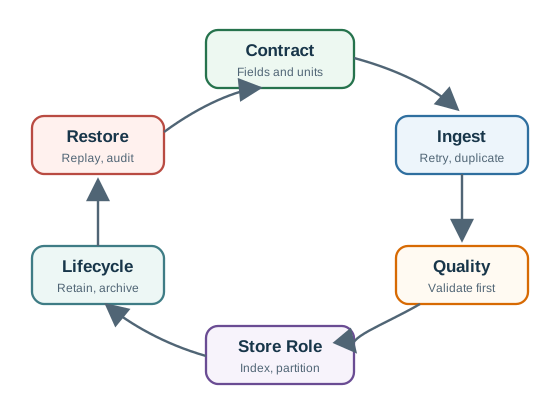
The samples in Figure: Structured do the arguing.
- The registry table's fixed device_id / zone / fw columns are what make it queryable by a stable schema — and what makes that schema hard to scale horizontally — so it *lands in: SQL row store*.
Major section
Place Meter Readings and Work Orders Deliberately
For 10,000 meters at one reading per minute, the store receives 10{,}000 × 1{,}440=14.4 million readings per day.
- A time-series path can optimise append and time-window queries, while relational work-order data needs joins and transaction rules.
Deck summary
Key takeaways
One store can make the first build easy, but it may strain under a new query or fault.
- A database choice feels abstract until the next firmware release adds a field, a dashboard needs a new query, or a support engineer asks for last month's raw readings.
- The samples in Figure: Structured do the arguing.
- For 10,000 meters at one reading per minute, the store receives 10{,}000 × 1{,}440=14.4 million readings per day.
Retrieval practice
Recall check 1 of 3

Data Dora says: answer from memory, then check your reasoning.
Q1What is the best first step when selecting storage for a new IoT telemetry and device-management system?
Show answer
Answer: A Database selection becomes reviewable when the workload and release evidence are visible before product choice.
Retrieval practice
Recall check 2 of 3

Data Dora says: answer from memory, then check your reasoning.
Q2A proposal adds separate stores for telemetry, registry, search, graph, cache, artifacts, and analytics before any representative query evidence exists. What should the review require first?
Show answer
Answer: B Additional stores can be justified, but every role needs workload evidence and operational ownership.
Retrieval practice
Recall check 3 of 3

Data Dora says: answer from memory, then check your reasoning.
Q3A latest-value cache makes a dashboard fast, but the durable telemetry store sometimes lags and the cache does not show freshness. What is the strongest review finding?
Show answer
Answer: C Latest values are useful, but users need evidence about freshness and rebuild behavior.
Print reference
Answers
Answer key.
- A · Database selection becomes reviewable when the workload and release evidence are visible before product choice.
- B · Additional stores can be justified, but every role needs workload evidence and operational ownership.
- C · Latest values are useful, but users need evidence about freshness and rebuild behavior.