IoT Fundamentals · Study deck
Text Encoding for IoT
Picture a sensor label that displays correctly on the bench but becomes damaged text after an update.
Physics Phoebe is your guide for this deck.

After studying this chapter
Learning objectives
You will be able to:
- Explain: An MQTT topic, a CoAP URI path segment, a JSON field name, and a device label shown in a dashboard may all begin as readable text, but the packet, broker, gateway, and database store encoded bytes.
- Explain: Reading: ASCII against letters, digits, punctuation clarifies the practical meaning of UTF-8 byte width grows with the code point: one byte for ASCII, up to four for supplemental code points.
- Explain: The ASCII characters are one byte each and the two non-ASCII characters are two bytes each, so the encoded length is 18 + (2 x 2) = 22 bytes.
Major section
In 60 Seconds
The team needs to know which boundary changed the bytes.
- Firmware means the program stored on a device to control its hardware.
- A payload means the part of a message that carries the application data.
- The deeper sections explain character sets, Unicode, UTF-8, byte limits, validation, and recovery.
Major section
Characters Are Not Bytes
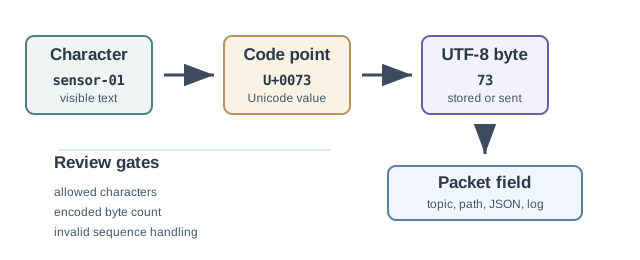
IoT payloads are often described as "text" or "binary," but the real boundary is sharper: text is characters, while transmission and storage are bytes.
- A device name, a topic path, a JSON key, or a status message must be encoded before it can be sent.
Major section
Characters Are Not Bytes (continued)
The design question is not only "can a person read it?" but also "how many bytes does it take, and how will both sides validate it?".
- ASCII is a small character set for English-oriented text.
- UTF-8 encodes those code points as one to four bytes, and it keeps every ASCII character at a single byte.
- ASCII characters stay one byte; many other characters need more.
Major section
Characters Are Not Bytes (continued)
If you only need the intuition, this layer is enough: a character is a symbol, a code point is its Unicode number, and UTF-8 turns that number into bytes.
- Every text field that crosses a device, gateway, or network boundary needs a character policy and a byte limit, not just a character count.
- The same word can occupy a different number of marks for each writer.
- In UTF-8, ASCII characters keep their one-byte values.
Major section
Characters Are Not Bytes (continued)
On the wire, the "marks" are bytes, and only an agreed encoding lets both ends count and read them the same way.
- The lower review boxes separate allowed characters from the byte limit.
- A name can satisfy the character policy yet still require more storage than its appearance suggests.
- UTF-8 A variable-width encoding for Unicode that stores each code point in one, two, three, or four bytes.
Major section
Characters Are Not Bytes (continued)
An MQTT topic, a CoAP URI path segment, a JSON field name, and a device label shown in a dashboard may all begin as readable text, but the packet, broker, gateway, and database store encoded bytes.
- Beginner Examples An ASCII topic such as lab/device/temp uses one byte per visible character in UTF-8.
- A device label with non-ASCII characters can look short while using more bytes than its visible length suggests.
- A gateway that accepts user-defined identifiers must validate UTF-8 and length limits before forwarding records.
Major section
Apply It: Size and Validate Text Fields
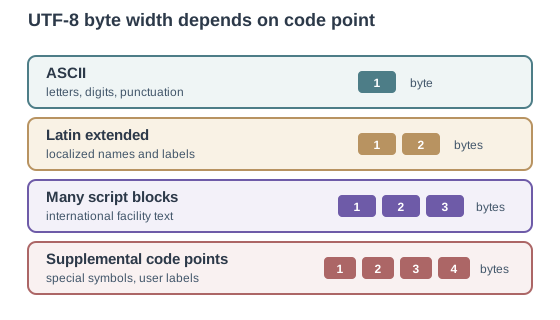
UTF-8 does not use one byte per visible character for every string.
- The encoded length depends on the code points present, so buffers and field limits must be written in encoded bytes.
- Keeping those two fields separate prevents a renamed room label from becoming a changed routing key.
Major section
Apply It: Size and Validate Text Fields (continued)
A topic with 18 ASCII characters plus 2 Latin-extended characters is not 20 bytes.
- Reading: ASCII against letters, digits, punctuation clarifies the practical meaning of UTF-8 byte width grows with the code point: one byte for ASCII, up to four for supplemental code points.
- Letters, digits, and punctuation in that first row fit in one byte; later groups need more space.
- A "20 character" limit would have been wrong.
Major section
Apply It: Size and Validate Text Fields (continued)
Structured payloads JSON keys and string values are UTF-8 text.
- Size the encoded field from its actual contents, since a visible symbol does not always occupy one byte.
- The ASCII characters are one byte each and the two non-ASCII characters are two bytes each, so the encoded length is 18 + (2 x 2) = 22 bytes.
- A field name can be larger than the sensor value it labels.
Major section
Apply It: Size and Validate Text Fields (continued)
Where Text Hides in Messages Identifiers Device IDs, asset names, room names, and user labels need a documented character policy and a byte limit.
- Topics and paths Topic strings and URI paths can repeat on every message, so descriptive names should be chosen deliberately.
- Diagnostics Text logs help review, but production messages still need size limits and escaping rules.
- Prefer a documented character subset for device-controlled identifiers, such as lowercase letters, digits, hyphen, underscore, and slash where hierarchy is needed.
Major section
Under the Hood: Payload Representation and Safe Decoding
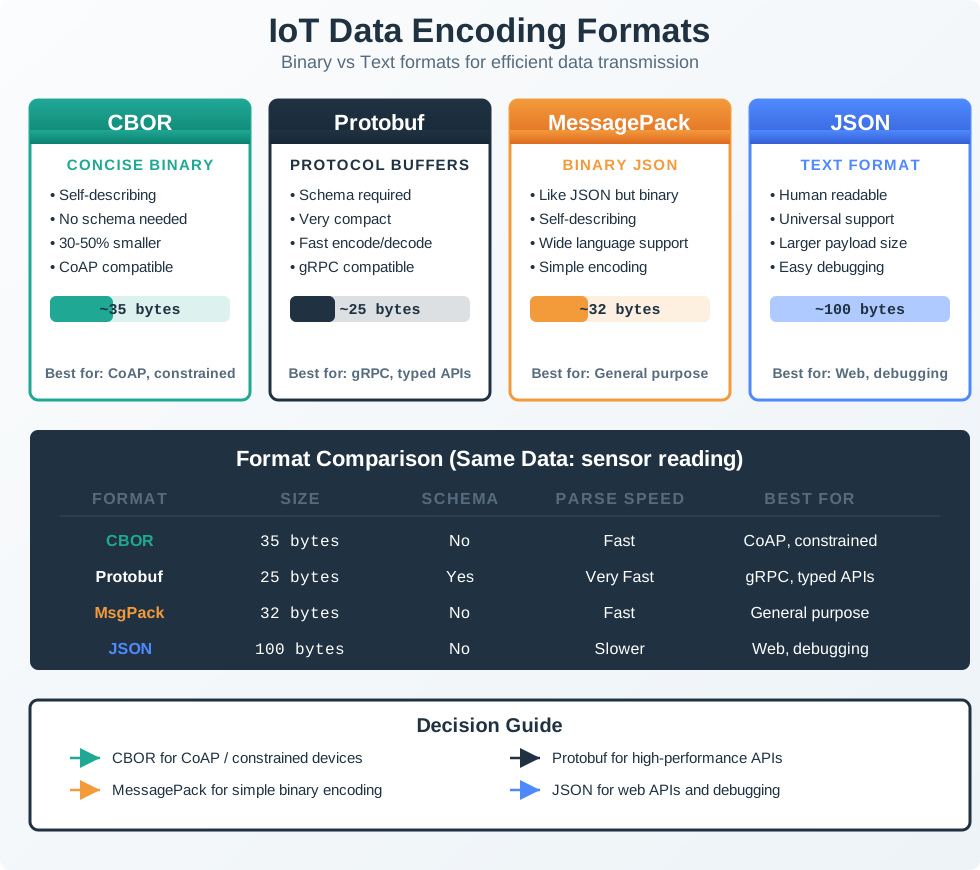
The right representation depends on who reads the payload, how constrained the link is, and whether both endpoints share a schema.
- Constrained systems that still need flexible field structure.
- Smallest when fields and units are fixed.
- Replacing invalid bytes with a placeholder can hide data corruption.
Major section
Under the Hood: Payload Representation and Safe Decoding (continued)
For protocol fields, it is usually safer to reject the field and record a validation error than to forward repaired text as if it were correct.
- Common Pitfalls Sizing by visible characters.: A "20 character" limit is ambiguous unless the allowed characters and the encoded byte limit are both defined.
- Treating display labels as stable IDs.: Human labels change; device identifiers and routing paths should be stable protocol fields.
- Sending binary without a schema.: Small byte arrays are not self-documenting.
- At this depth, text encoding is part of the data contract.
Major section
Summary
UTF-8 keeps ASCII at one byte but uses two to four bytes for many other code points.
- Buffer and field limits must be written in encoded bytes, not visible characters.
- Topic strings and JSON keys can be a meaningful part of small messages.
- Validate text at trust boundaries, and reject invalid sequences instead of silently repairing them.
Deck summary
Key takeaways
The team needs to know which boundary changed the bytes.
- IoT payloads are often described as "text" or "binary," but the real boundary is sharper: text is characters, while transmission and storage are bytes.
- The design question is not only "can a person read it?" but also "how many bytes does it take, and how will both sides validate it?".
- If you only need the intuition, this layer is enough: a character is a symbol, a code point is its Unicode number, and UTF-8 turns that number into bytes.
Retrieval practice
Recall check 1 of 3

Physics Phoebe says: answer from memory, then check your reasoning.
Q1A device sends plain ASCII labels today but may later include non-English characters. What should the designer decide early?
Show answer
Answer: D Text encoding is a payload design decision because characters and bytes are not always the same thing.
Retrieval practice
Recall check 2 of 3

Physics Phoebe says: answer from memory, then check your reasoning.
Q2A topic has 18 ASCII characters and 2 allowed Latin-extended characters, where each Latin-extended character uses 2 UTF-8 bytes. What is the minimum encoded byte length?
Show answer
Answer: A 18 ASCII bytes plus 2 characters at 2 bytes each is 18 + 4 = 22 bytes.
Retrieval practice
Recall check 3 of 3

Physics Phoebe says: answer from memory, then check your reasoning.
Q3A gateway receives a device identifier that contains an invalid UTF-8 byte sequence. What is the safest handling for a protocol field?
Show answer
Answer: A Silent repair can hide corruption; rejecting and logging keeps a bad identifier from propagating as if it were valid.
Print reference
Answers
Answer key.
- D · Text encoding is a payload design decision because characters and bytes are not always the same thing.
- A · 18 ASCII bytes plus 2 characters at 2 bytes each is 18 + 4 = 22 bytes.
- A · Silent repair can hide corruption; rejecting and logging keeps a bad identifier from propagating as if it were valid.