Analytics & ML · Study deck
Particle Filters for Localization
Picture a powered wheelchair in a care home where two nearby halls produce similar beacon readings.
Data Dora is your guide for this deck.

After studying this chapter
Learning objectives
You will be able to:
- Explain: That progression advances the chapter's narrative: particle filters earn their cost when ambiguity or non-linearity matters, and their claim remains reviewable only with model, likelihood, particle-count, and degeneracy evidence.
- Explain: Continuing the resampling-trigger example above, the cumulative weights are 0.62, 0.80, 0.90, 0.96, and 1.00 for particles P0 through P4.
- Explain: If the belief can be multimodal, sharply bounded by maps, or driven by nonlinear likelihoods, particles preserve evidence that a single mean can hide.
- Explain: This matters when an IoT state is nonlinear, constrained, or non-Gaussian.

Major section
Start With the Story
One dot on a map may jump through a wall, while two possible paths still fit the evidence.
- A smooth moving dot is not proof of a sound estimate.
- This opening does not claim that this method is always best.
- Practitioner decides when several possible states matter.
Major section
Particle Filters Track States
A particle filter is a sequential Monte Carlo estimator.
- Instead of forcing the state belief into one Gaussian mean and covariance, it carries many particles.
- This matters when an IoT state is nonlinear, constrained, or non-Gaussian.
- A person may be equally likely to be near two corridors until a new BLE beacon reading arrives.
Major section
Particle Filters Track States (continued)
A robot cannot pass through a wall even if the motion model says the straight-line path is short.
- A noisy radio fingerprint can create several plausible positions instead of one symmetric uncertainty ellipse.
- If one compact Gaussian is honest enough, a Kalman-style estimator is usually cheaper.
- Too few particles lose smaller but valid modes.
Major section
Particle Filters Track States (continued)
Wi-Fi, BLE, UWB, and floor-plan constraints can create several possible positions.
- If the belief can be multimodal, sharply bounded by maps, or driven by nonlinear likelihoods, particles preserve evidence that a single mean can hide.
- The cloud of particles, not one dot, is the state belief.
- Wrong motion noise can make the filter overconfident.
Major section
Particle Filters Track States (continued)
That progression advances the chapter's narrative: particle filters earn their cost when ambiguity or non-linearity matters, and their claim remains reviewable only with model, likelihood, particle-count, and degeneracy evidence.
- WeightA relative score based on how likely the latest measurement is if that particle were the true state.
- ResamplingA step that copies high-weight particles and removes low-weight particles so compute stays focused.
- Latency and battery budget can limit update rate.

Major section
Predict, Weight, Resample
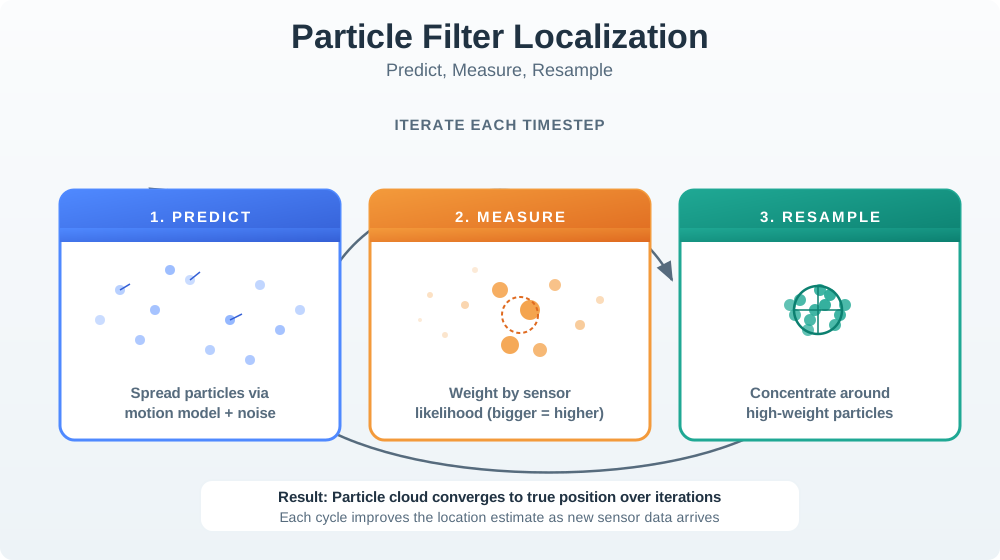
The common bootstrap particle filter has four operating steps.
- Resample when the particle set has collapsed too far onto a few hypotheses.
- The likelihood model is the engineering contract.
- For a range sensor it may be a Gaussian error model around distance.
- For BLE localization it may compare observed RSSI against a fingerprint map.
Major section
Predict, Weight, Resample (continued)
For a map-aware robot it may assign near-zero likelihood to poses that imply the robot crossed a wall.
- A shoe-mounted pedestrian dead-reckoning system shows why that map-aware weighting matters in practice.
- The 12.0 m particle is not impossible, but it contributes little evidence.
- Particle impoverishment removes diversity and hides alternate modes.
Major section
Degeneracy and Compute Limits
A particle filter usually fails in one of two ways.
- Degeneracy happens when nearly all probability mass sits on a few particles, so most compute is wasted.
- Particle impoverishment happens after repeated resampling when the surviving particles become too similar, so the filter stops representing uncertainty.
- Both problems are operational, not just mathematical.

Major section
Degeneracy and Compute Limits (continued)
If all particles have equal weight, ESS is close to the particle count.
- Many systems resample only when ESS falls below a threshold, then inject process noise so the population can keep exploring plausible states.
- example threshold: 0.5 * N = 2.5 decision: ESS is below threshold, so resample.
- Without noise, the copied particles can become identical and the filter may not recover when the next measurement contradicts them.
Major section
Degeneracy and Compute Limits (continued)
Continuing the resampling-trigger example above, the cumulative weights are 0.62, 0.80, 0.90, 0.96, and 1.00 for particles P0 through P4.
- A bootstrap filter uses the motion model; stronger proposals can use the latest measurement too.
- Latency BudgetParticle count, likelihood cost, and update rate must fit the edge gateway, robot, or phone that runs the filter.
- Many particles become copies and the filter cannot recover after a turn or missed beacon.
Major section
Degeneracy and Compute Limits (continued)
Particle count or likelihood calculation is too expensive for the device.
- The UI shows one precise location while logs still support several modes.
- The P2 = 0.42 label is a changed probability, not a teleported pose, so proposal coverage still bounds what the filter can recover.
- Random u maps three example draws to particles, and Copy and re-noise explains why high-weight hypotheses multiply without becoming identical forever.
Deck summary
Key takeaways
One dot on a map may jump through a wall, while two possible paths still fit the evidence.
- A particle filter is a sequential Monte Carlo estimator.
- A robot cannot pass through a wall even if the motion model says the straight-line path is short.
- Wi-Fi, BLE, UWB, and floor-plan constraints can create several possible positions.
- That progression advances the chapter's narrative: particle filters earn their cost when ambiguity or non-linearity matters, and their claim remains reviewable only with model, likelihood, particle-count, and degeneracy evidence.
Retrieval practice
Recall check 1 of 3

Data Dora says: answer from memory, then check your reasoning.
Q1Why might an indoor localization system use a particle filter instead of publishing only a Kalman-filter mean?
Show answer
Answer: B Particle filters are useful when the state belief may be multimodal, constrained, or nonlinear.
Retrieval practice
Recall check 2 of 3
Data Dora says: answer from memory, then check your reasoning.
Q2In the worked example, why does the 10.2 m particle receive the largest normalized weight?
Show answer
Answer: C Particle weights come from the likelihood of the measurement under each particle hypothesis.
Retrieval practice
Recall check 3 of 3
Data Dora says: answer from memory, then check your reasoning.
Q3What does a low effective sample size indicate in a particle filter?
Show answer
Answer: A ESS estimates how many particles are meaningfully contributing to the weighted belief.
Print reference
Answers
Answer key.
- B · Particle filters are useful when the state belief may be multimodal, constrained, or nonlinear.
- C · Particle weights come from the likelihood of the measurement under each particle hypothesis.
- A · ESS estimates how many particles are meaningfully contributing to the weighted belief.